Update: Mekong Pirates Sentenced to Death

Further to his earlier conviction for the murder of 13 chinese sailors on the Mekong River last year, notorious former druglord Naw Kham has been sentenced to death today by the Intermediate People’s Court of Kunming, in China’s Yunnan province. We blogged on the Mekong River murders here. The incident was one of the deadliest assaults on Chinese nationals overseas and prompted unprecedented joint boat patrols along the river.

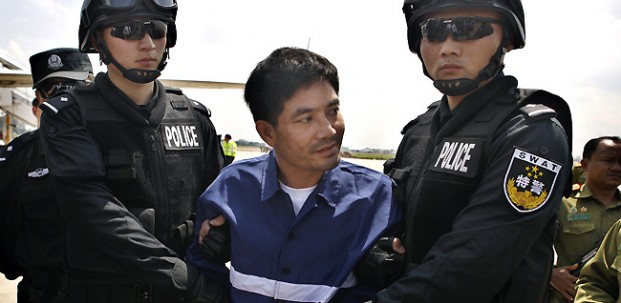
Naw Kham Upon His Transfer from Laos to China for Trial in May this Year – Asian Correspondent

Three of Naw Kham’s gang members were also sentenced to death, another received a  suspended death sentence while one was sentenced to eight years in prison, respectively. They had all pleaded guilty on a 3-day long trial in September this year. We previously blogged about the Mekong Trial here. The defendants were also ordered  to pay compensations to the victims families. They all said they will appeal the verdict.


Child pirates: A key issue for respecting child’s rights and halting piracy

This guest post is by Sonia Messaoudi who is a trainee-lawyer at Paris Bar School with an LLM in international law and human rights. She has interned at Amnesty International and the United Nations Assistance to the Khmer Rouge Trials

Two Somali youth accused of piracy returned home to their parents on 13 August 2012 after a Seychelles court determined they were too young to sentence after an eight-month detention. [Hassan Muse Hussein/Sabahi]

In August 2012, two Somali youth who had been accused of piracy returned home after a Seychelles court determined that they were too young to be sentenced. The children were brought to Garowe on a private plane paid for by the United Nations Office on Drugs and Crime. This is the modern and dark version of piracy books for children. Indeed, this is not an isolated case off the Horn of Africa as about one-third of Somali pirates are children. While eliminating piracy became a worldwide issue, it has to be approached without forgetting the protection of children who are involved in such criminal activities. As noted on the 23 November 2010 for the first time in a piracy resolution, the Security Councilexpressed concern about the involvement of children off the coast of Somalia.

According to international law, children should not be prosecuted by the same means as adults. The United Nations Convention on the Rights of Child states a child (i.e. anyone under 18 years old) should be handled differently than adults when charged with serious crimes, and “be treated in a manner consistent with the promotion of the child’s sense of dignity and worth.”  However, many Somali youth linked to piracy are held in foreign jails, causing great worry for their parents.

As the use of child soldiers is denounced, there is an increasing international mobilization against the use of children for criminal purposes. When dealing with child pirates, there are two possibilities: arrest them in accordance with a juvenile crime, or release them which means they must be put back into one of the worst forms of child labour.

In some countries, children are prosecuted, while in others children are protected. In the countries where children are prosecuted, the State must ensure it does so in accordance with international juvenile justice standards. Over the last twenty-five years, child-specific instruments, such as the UNCRC and general human rights treaties, have played a crucial role in setting out states’ obligations towards young offenders. The UNCRC has four general principles – (i) the right to life, survival and development, (ii) the right not to be discriminated against, (iii) the requirement that the best interests of the child be a primary consideration in all actions concerning children and finally (iv) the right of the child to be heard in all decisions that affect him/her. It requires a dedicated juvenile justice system, a minimum age of criminal responsibility and the adoption of measures to deal with children without resorting to judicial proceedings, provided that human rights and legal safeguards are fully respected. The UNCRC prohibits the imposition of the death penalty and life imprisonment on children, and requires that imprisonment be imposed only as a last resort and for the shortest appropriate period of time. It also prohibits arbitrary deprivation of liberty and provides for the right to prompt legal assistance and the right to challenge the legality of the detention.

As Radhika Coomaraswamy, the Special Representative of the Secretary-General for Children and Armed Conflict stated, if an international criminal tribunal is convened to deal with the perpetrators of acts of piracy, no child should be tried in the same court as adults but rehabilitated and integrated back into their communities. However, if a prosecuting state decides not to prosecute them, the concrete consequence is to put children back into a situation where they may be forced to perpetrate further acts of piracy. Therefore, solutions should be found in order to reintegrate them into the society as required by Article 7 of The 1999 ILO Convention on the Elimination of the Worst Forms of Child Labour, and article 40 the Convention of the Rights of the Child.

Potential solutions may be drawn from the situation of child soldiers. Roméo Dallaire has noted there is no major difference between a child soldier and a child pirate: “they are children being used by adults for criminal or political purposes, and they are extremely vulnerable, and there are a lot of them.” As for child soldiers, a program called “Prevention, Demobilization and Reintegration” created in 1990’s for helping child soldiers helped more than 100 000 since 1998. Prevention consists essentially in advocacy and supporting civil society by raising awareness of child rights through a variety of media, and using local and international human rights reporting mechanisms. Centers have been created in this purpose, assisted by local or international non-governmental organizations, UNICEF, and UN. Furthermore since piracy business is currently costing and estimated $12 billion to the world economy, prevention seems to be a good investment while finding a solution for child pirates and in order to prevent them from engaging in such criminal activities.

However, prevention and reintegration of children is not enough to eradicate piracy. We must attack the roots. Indeed, the employment of children in criminal activities such as piracy is forbidden by the Labour Organization Convention. The UNCRC states the State parties recognizing the right to child to be protected from exploitation shall provide for appropriate penalties or other sanctions to ensure an effective enforcement. In countries where  pirates originate, such as Somalia, governments often do not respect international standards of human rights. However in order to prosecute pirates who are using or recruiting children, some recommendations were made. Indeed, encouraging government to enforce national legislation to ensure there is no impunity against those accused of perpetrating these violations against children, and increasing pressure on persistent perpetrators through greater interaction between the Council and the Secretariat of UN, national courts and the ICC are one of them, as Resolution 1918 requested it off the coast of Somalia. In case of armed conflicts, some resolutions recommend sanctions, such as arms embargos. We could think about these kinds of solutions for piracy too.

However, the issue is now to know whether or not the use or recruitment of children for criminal activities such as piracy can be prosecuted. In some domestic law, as France and in some states in United States of America for instance, there are specific statutes criminalizing encouraging, using or recruiting children for criminal activities. However, where such is not criminalized especially for recruiting children, it may be possible to prosecute for causing, encouraging, soliciting, or recruiting criminal gang members. Furthermore, Article 101(c) on UNCLOS provides another way to prosecute them stating the recruitment can be as an act of incitement.

At the international level, convictions by International Courts of Thomas Lubanga Dyilo and Charles Taylor have helped raised awareness of the criminal nature of the recruitment and use of children in armed conflict. Furthermore, the International Criminal Court disallows the recruitment or conscription of child soldier (under the age of 15 years) into military which is defined as war crimes.

In order to draw a parallel between child soldiers and child pirates, the question is whether child pirates may be considered to be child soldiers. According to the international definition, a child soldier is any child under 18 years of age, who is part of any kind of regular or irregular armed force or armed group in any capacity including but not limited to: cooks, porters, messengers, and anyone accompanying such a group other than family members. Therefore, the question is whether or not pirates who are using or recruiting children are regular or irregular armed force or armed group. An International armed conflict exist whenever there is resort to armed force between two or more States, while Non-international armed conflicts are protracted armed confrontations occurring between governmental armed forces and the forces of one or more armed groups, or between such groups arising on the territory of a State [party to the Geneva Conventions]. The armed confrontation must reach a minimum level of intensity and the parties involved in the conflict must show a minimum of organization. There are two options then. First, it is an non-international armed conflict and we have to determine if the pirates groups can be seen as armed group or irregular armed force, and secondly, it is an international armed conflict and the question is whether or not piracy as international conflict. But pirates group are not well identified.  Both of the two options are not legally convincing. So it seems in most of the case, international humanitarian law cannot apply to child pirates in Somalia, as it applies for child soldiers.

Therefore, in order to impede children piracy and respecting children’s human rights, we should deal with child pirates but also with persons using or recruiting children for such a criminal activities. Where the first ones should not be prosecuted but reintegrated into the civil society, the second ones should be.

What is sure is that we have all, from the local communities to the States and international institutions, the responsibility to make sure the only pirate children should know is Captain HooK.

The Mekong Pirates on Trial

For 3 days at the end of last week, the Intermediate People’s Court in Kunming, the capital of the Yunnan Province in southwest China, was the stage for yet another high profile, yet swift, criminal trial. The case involved the mysterious murder of 13 Chinese sailors on the Golden Triangle’s area of the Mekong River in October last year. We have blogged about the incident here, focusing in particular on China’s unprecedented role in strengthening law enforcement in the strategic Mekong River basin. Since the murders, Laos, Vietnam, Myanmar and even Thailand joined China in holding several military patrols across the lawless boundary waters.

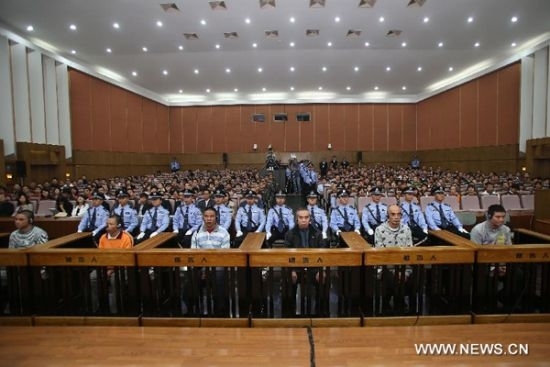
The Mekong River Trial in Session at the Intermediary People’s Court in Kunming

The murders, one the deadliest assault on Chinese nationals oversea, sparked a large public outcry in China. It therefore comes as little surprise that the trial attracted much attention from the Chinese press. Among the 6 defendants was Naw Kham (aka Nor Kham aka Jai Norkham),a member of Myanmar’s Shan ethnic minority and a notorious once-untouchable drug lord and gang leader who for years is thought to have ruthlessly run the drug and other illicit trade in the Golden Triangle area. Naw Kham was arrested in April in Laos in another joint military sting operation and traded over to China shortly thereafter. Prior to his arrest, only two blurred pictures of Naw Kham were said to exist.

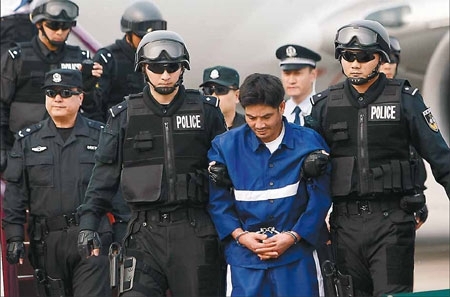
Naw Kham is Extradited to Beijing amid Tight Security – Xinhua

Much of the news regarding the investigation and trial is limited to Chinese media, with only a few outlets providing reporting in the English language. The holding of the trial has been hailed as another example, further to the joint river patrols, of China’s growing concern over cross-border security issues and its novel policy of regional cooperation in combating international crimes. Indeed, it is unlikely that the arrest and trial of the alleged perpetrators could have taken place in such a swift manner without China’s involvement. As discussed in another previous post, most notably this policy included China’s unprecedented participation in the international anti-piracy patrols off the coast of Somalia and in the larger Gulf of Aden area. Chinese media praised the trial as a model of judicial cooperation, coupling armed drug trafficking gangs on the Mekong and Somali pirates as “common enemies of mankind” and calling for their prosecution as a duty of all States. This is a remarkable development in the debate over the universal nature of piracy prosecution but also, leaving piracy aside, in the more controversial debate over modern China’s sovereignty and its role in large-scale international cooperation. However, China’s sudden primary stance in the Mekong murders also seems to be a show of strength in view of other disputes concerning the economic development in the Mekong River basin as well as in other areas of economic interest in Asia.

After allegedly confessing his role in the Mekong River murders upon his arrest and recanting it in a recent interview, the media reports that Naw Kham partially admitted knowledge of the murders at the beginning of the short trial, which then concluded with his full admission of guilt and plea for leniency. All other defendants, members of Naw Kham’s gang, promptly confessed their responsibility upon the opening of the trial. They were all accused of murder, drug trafficking, kidnapping and hijacking and now face the possibility of the death penalty. During the trial, simultaneous interpretation was provided in Laotian and Thai to accommodate the testimony of foreign policemen and witnesses from Laos and Thailand. Such testimonies are apparently unprecedented in Chinese judicial proceedings. China asserted jurisdiction over the case upon its direct links with the crimes and the victims as well as within the general framework of regional cooperation within the Mekong River. Chinese media also praised the trial as a demonstration of the efficiency of Chinese judiciary to the rest of the world. From an international justice perspective, however, doubts still remain as to the procedural fairness and completeness of such fast-paced trials whose outcome increasingly relies on the defendant confession. Interestingly, the arrest and trial of Naw Kham seems to have fallen under Interpol’s radar, as at the time of writing Naw Kham still remains on its Most Wanted Fugitive List.

Naw Kham Arrives in Court Blindfolded – Not a Common Procedure Everywhere – Xinhua

According to the prosecution, the Chinese boat refused to pay protection money for safe-passage in Naw Kham controlled areas and the murders were framed as a drug related incident to set an example. Several aspects of the murders, however, remain unclear. In particular, one possibly relevant factual element of the case appears to have been given limited consideration, namely the alleged participation in the murders of 9 members of the Thai military, part of an army unit responsible for security along the Mekong. Initial investigations by Chinese authorities already revealed a role played by a group of Thai military. It is still unclear whether they acted in collusion with Naw Kham’s gang. Investigation by Thai authorities, who are currently holding the soldiers as suspects, appear to show conclusive and corroborative evidence of the Thai soldiers shooting at the Chinese boats once they crossed over into Thailand.

The Mistreatment of Somalis Accused of Piracy

This guest commentary, cross-posted at ilawyerblog, is by Rachel Lindon, who has represented Somalis charged with piracy in legal proceedings in France. An English version is available here. We have previously discussed piracy trials in France, here and here.

Three of the six Somalis charged with taking the crew of Le Ponant hostage walk along a wall of La Sante jailhouse in Paris on 15 June 2012, a day after being released from prison (Photo: THOMAS COEX/AFP/GettyImages)

Deux procès se sont tenus à ce jour en France, à l’encontre de somaliens accusés d’actes de piraterie au large des côtes somaliennes. Lors du premier procès, qui s’est tenu en novembre 2011, dans l’affaire dite du Carré d’As, sur les six personnes accusées, une a été acquittée, et les cinq autres ont été condamnées à des peines de 4 à 8 années d’emprisonnement. Le Parquet ayant interjeté appel, cette décision n’est pas définitive. Lors du deuxième procès, qui s’est tenu en juin 2012, dans l’affaire dite du Ponant, sur les six personnes accusées, deux ont été acquittées, et les quatre autres ont été condamnées à des peines de 4 à 10 années d’emprisonnement. Cette décision est devenue définitive, en l’absence d’appel des parties. Ainsi, à ce jour, quatre somaliens se retrouvent libres en France : trois qui ont été acquittés et souffert pendant plusieurs années de détention provisoire indue et arbitraire, et un dont  la détention provisoire abusivement longue de quatre années a couvert sa peine (la France, régulièrement condamnée par la Cour Européenne des Droits de l’Homme pour des durées de détention trop longues, a établi un funeste record mondial en matière de détention provisoire de supposés pirates somaliens…). Après avoir été interpellés en territoire somalien (territoire maritime ou terrestre selon les cas), transférés en France, quelles ont été les conditions des détentions provisoires des somaliens pendant les longs mois d’enquêtes, et qu’a-t-il été prévu à leur sortie ?

 LE TRAITEMENT PAR LA FRANCE DES SOMALIENS EN DETENTION

 Ces douze somaliens, coupables ou non, ont été arrachés de leurs terres pour être transférés dans des geôles d’un pays qui leur était inconnu. Déracinés brutalement, ils ont été incarcérés dans des conditions devenues presqu’inhumaines: ne parlant que le somalien, et devant être séparés les uns des autres pendant l’enquête, ils n’ont pu communiquer avec personne pendant des années, sauf pendant les interrogatoires chez le juge d’instruction. Les avocats ont systématiquement sollicité les services d’un interprète, pour les parloirs. Les magistrats ont également sollicité les interprètes pour tous les actes d’instruction. Pourtant, ces douze somaliens n’ont jamais bénéficié du truchement d’un interprète, en détention, tant pour les actes médicaux, parfois lourds, que pour les commissions disciplinaires, en violation du principe du respect de la dignité humaine du prisonnier, reconnu par la Cour européenne des Droits de l’Homme (RAFFRAY TADDEI C. France, 21 décembre 2010, §50) et les règles minima pour le traitement des détenus, telles que définies par le Haut Commissariat des Nations Unies aux droits de l’homme (article 36§2). Nombre d’entre eux ont été victimes de violences de la part de codétenus, d’autant plus qu’ils étaient particulièrement isolés, et l’Administration Pénitentiaire française semble avoir trop souvent manqué à son devoir d’enquête, en violation de la jurisprudence de la CEDH (PREMININY C. RUSSIE, 10 février 2011).

 A ces violations s’ajoutaient les difficultés et l’isolement propres à leur situation de ressortissants somaliens : ils ne recevaient pas de deniers de l’extérieur (alors qu’il est connu dans les prisons françaises qu’il faut un pécule minimal pour survivre, louer un téléviseur, et s’acheter de la nourriture), ils ne recevaient aucune visite et que très rarement des nouvelles de leurs familles, un courrier annuellement tout au plus, alors que la plupart étaient mariés et pères de familles. Ces détentions provisoires furent d’une telle violence que nombre d’entre eux ont souffert de problèmes psychologiques graves, ont été internés dans les hôpitaux psychiatriques de l’Administration Pénitentiaire, au point qu’aujourd’hui, certains, même libres, doivent encore faire l’objet d’un suivi psychiatrique.

 LE TRAITEMENT PAR LA FRANCE DES SOMALIENS HORS DE DETENTION

 L’espoir du procès et de la fin de la dureté de la détention n’a été que de courte durée pour ceux qui ont été libérés : relâchés quelques heures après les délibérés, en pleine nuit, dans Paris, l’Administration pénitentiaire française leur a remis, outre leurs ballots de vêtements accumulés pendant la détention grâce au secours populaire, un kit indigent comprenant un ticket de métro, cinq tickets restaurant et une carte de téléphone… La France n’a pas estimé utile de prévoir ce qu’il adviendrait de ces hommes, appréhendés à plus de 6.000 km, reconnus innocents pour trois d’entre eux, après la détention. Ils ne peuvent, qu’ils soient innocents ou coupables, retourner dans leur pays, du fait des  mesures de rétorsion encourues. En effet, la justice  a exigé une coopération complète, en les sommant d’indiquer les noms des puissants chefs pirates qui agissent en Somalie.

 Ces véritables coupables, ces chefs de guerre exploitant la misère des somaliens, et possédant eux mêmes des biens immobiliers issus de la piraterie, aussi bien à Nairobi qu’à Londres, sont toujours actifs sur place, sans jamais avoir été inquiétés, la France se contentant de lampistes ou d’innocents, qui aujourd’hui risquent la peine de mort en cas de retour. Les somaliens acquittés, et ceux coupables mais ayant coopéré, libres ou encore détenus, sont par conséquent contraints de demander l’asile en France, puisqu’ils craignent d’être persécutés dans leur pays et de ne peuvent se réclamer de sa protection. puisque « craignant avec raison d’être persécutés du fait de (…) (leur) appartenance à un certain groupe social ou de (leurs) opinions politiques, se trouvent hors du pays dont (ils ont) la nationalité et qui ne (peuvent) ou, du fait de cette crainte, ne (veulent) se réclamer de la protection de ce pays ».

 Mais pas plus qu’un retour dans leur pays n’est possible, une vie en France ne l’est. Lâchés dans les rues de Paris aussi brutalement qu’ils avaient été appréhendés en Somalie, ils n’ont eu de toits pour dormir et se nourrir que grâce à la solidarité de la société civile, compatriotes, conseils et interprète, puis d’associations pour le logement… Pêcheurs somaliens, parlant peu ou pas le français, ils se retrouvent à nouveau dans un dénuement extrême, mais dans un environnement inconnu, et définitivement séparés des leurs.

 Leur situation ubuesque ayant interpellé certaines personnes, les trois somaliens du dossier du Ponant, sortis de détention le 15 juin 2012, à 3 heures du matin, ont finalement trouvé une association pour les héberger temporairement, dans l’attente prochaine de places en Centre d’Accueil pour Demandeurs d’Asile (leur situation particulière a permis que leur demande de logement soit considérée comme prioritaire). Ils recevront également l’aide financière conférée par l’Etat français pour tout demandeur d’asile, quel qu’il soit, de l’ordre de 400 euros mensuellement. Enfin, pour ceux définitivement acquittés, une requête en référé d’indemnisation de détention arbitraire est en cours. La justice aura à quantifier 50 mois de détention arbitraire et des vies définitivement brisées…

 Pendant ce temps, le sort de ceux encore détenus est loin d’être résolu, car condamnés à des peines de 4 à 10 années d’emprisonnement (peines qui pourraient paraître légères, mais le peuple français, au travers de ses jurés, a pris en compte la particularité des crimes et de la situation sur place), ils sortiront bientôt de détention.

 Dans un mois, le mineur du dossier du Carré d’As, âgé de 17 ans au moment des faits et donc de son incarcération, condamné à 4 années d’emprisonnement, aura accompli l’intégralité de sa peine. Il devra par conséquent être libéré. Encore une fois, rien n’est prévu pour sa sortie : il ne pourra quitter le territoire français, car il se doit d’attendre l’appel de son affaire (qui se déroulera probablement au printemps 2013). Mais pour autant, il ne sera pas régulier sur le territoire, et ne pourra espérer aucune aide au logement… Il sera hors des murs de FLEURY MEROGIS, sans  argent, sans famille et sans papiers, mais non expulsable et contraint de rester. L’Etat français, qui a tant voulu protéger ses ressortissants navigant dans le Golf d’Aden, va ainsi laisser un jeune mineur, totalement isolé, ne parlant que quelques mots de français appris au contact des autres détenus  et ne connaissant de notre territoire que nos maisons d’arrêt, errer dans nos rues, le temps de l’audiencement de l’appel interjeté par le Parquet… La France ne lui aura appris ni sa langue ni un métier, seulement à survivre dans une maison d’arrêt, puis survivre dans une ville si éloignée de sa vie passée…

 Les somaliens libérés se heurteront ensuite à la rigueur administrative française : Les services d’insertion et de probation des maisons d’arrêts appliquent leur règles : sans papiers, pas d’aide à la sortie. Les services des demandeurs d’asiles les leurs : à la suite d’une demande d’asile (à effectuer dans les limites des règles très strictes), et sans s’attarder sur leur situation pénale, le logement n’est conféré qu’à certaines conditions. Les services du Ministère de la Justice demandent que l’on applique les leurs : il ne reste qu’à demander une indemnisation pour ceux innocentés, et sinon, cela ne les regarde plus… La France se comporte comme la communauté internationale : appliquons des règles abstraites, à la Somalie, ou à ses ressortissants transférés en France, sans qu’il soit évoqué le particularisme de leurs situations…

 Le combat contre la piraterie et les déclarations d’intention aux visées électoralistes autorisent-ils la « patrie des droits de l’homme » à bafouer ces droits et à jeter dans nos geôles puis dans nos rues des hommes ? Le traitement que ces hommes, accusés de piraterie, innocents ou coupables, ont subi en France leur en fait regretter la Somalie, pays  sans Etat, en situation de guerre civile depuis 20 ans, mais qu’ils ne pourront, tout comme leur famille, plus jamais retrouver.