Mauritius Strengthens Its Anti-Piracy Capacity

Last month, Mauritius became the latest country in the Indian Ocean area to enter into an agreement with the United Kingdom for the transfer of suspected pirates before its courts for prosecution. The agreement was announced earlier this year during the London Conference on Somalia, which highligthed the UK driving role in Somalia’s recovery, including the fight against piracy. Mauritius thus follows in the footsteps of Tanzania and the Seychelles who have recently penned similar agreements with the UK, in 2012 and 2010, respectively, aiming to break the pirates business circle by providing a jurisdictional basis for their prosecution after apprehension at sea.
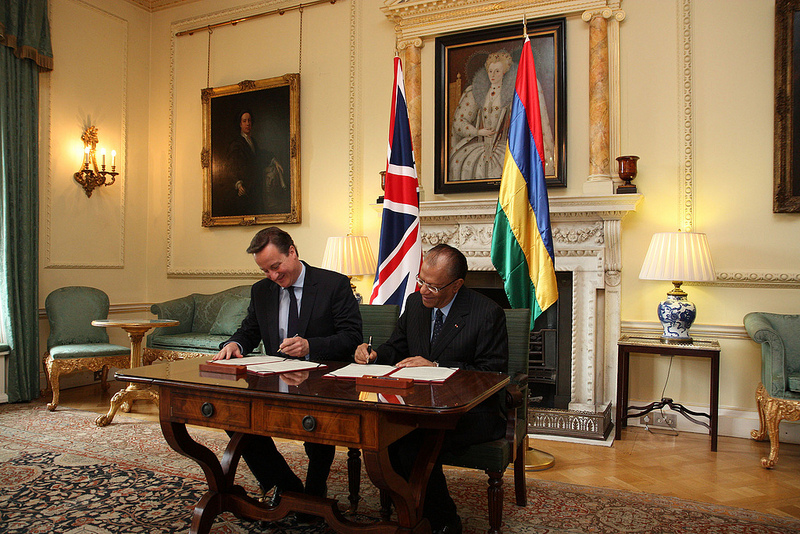
Prime Minister David Cameron and his Mauritius counterpart Navinchandra Ramgoolam sign the prisoners transfer agreement – FCO

Notoriously, foreign navies deployed off the Somali coast to counter piracy are reluctant to take pirate suspects to their own countries because they either lack the jurisdiction to put them on trial, or fear that the pirates may seek asylum. Evidentiary hurdles are also seen as an increasing impediment to effective prosecutions. Suspected pirates detained on the high seas are therefore often released after a brief detention due to the governments’ reluctance to bring them to trial.

Under the terms of the new international agreement, Mauritius will receive and try suspected pirates captured by British Forces patrolling the Indian Ocean. Last year, Mauritius entered into another agreement with the European Union for the transfer, trial and detention of suspected pirates captured by the EUNAVFOR naval mission. As reported on this blog, Mauritius has also inked a deal with the TFG, Somaliland and Puntland to start to transfer convicted pirates to Somali prisons, paving the way for the commencement of prosecutions in Mauritius.

The first trial of a suspected Somali pirates is due to commence in September 2012. In the meantime, Mauritius, already a signatory of UNCLOS, further strengthened its anti-piracy capabilities by adopting various relevant legislative instruments. First and foremost, a new anti piracy law was adopted at the end of 2011. The new Piracy and Maritime Violence Act 2011, premised on the transnational dimension of modern day piracy and the principle of universal jurisdiction to counter it, incorporates nearly verbatim in the national judicial system the definition of piracy as contained in Article 101 of UNCLOS. Acts of violence within Mauritius internal waters are defined as “Maritime Attack”. The novel term adds a degree of fragmentation in the definition of this offence, which is otherwise commonly referred to internationally as “armed robbery at sea”. In an attempt to cater for a wider range of piracy related criminal activities, the Piracy Act also criminalizes the offences of hijacking and destroying ships as well as endangering the safety of navigation. For each of these offences, the Piracy Act provides for a maximum term of imprisonment of 60 years.

More interestingly, the Piracy Act introduces the possibility for the holding of video-link testimonies and/or the admission of evidence in written form where the presence of a witness, for instance a seafearer, cannot be secured. While not uncommon in certain national criminal jurisdictions, as well as those of international criminal courts, the introduction of out of court statements, particularly when relevant to the acts and conducts of an accused, could trigger fair trial rights issues. These issues are principally due to the limited ability of the defence to test such evidence when relied upon at trial in the absence of the witness. In light of these concerns, the Piracy Act provides for the admissibility of evidence in rebuttal as well as for the court’s discretionary power in assessing the weight to be given to written statements.

In addition to the Piracy Act, which entered into force on 1 June 2012, Mauritius also adopted and/or amended its laws concerning assets recovery and mutual assistance in criminal matters in order to foster cooperation with foreign governments to tackle pirates and criminal cartels. The implementation of the agreement with the UK, however, is still to be fully tested. In May 2012, the UK announced that defence budget cuts required it to scale back its naval commitments in the region, withdrawning its ships from full-time counter-piracy operations.

 

The HMS Ocean Arrives in London Ahead of the London 2012 Olympic Games – Courtesy AP

These difficulties have been compounded by the need to commit ships and personnel to the security efforts for the London 2012 Olympic Games. The UK long-term commitment to combat piracy in Somalia extends beyond its current patrolling and disruption efforts in the Indian Ocean. To remain within the Olympic spirit, French Baron Pierre de Coubertin, considered the founder of the modern Olympics Games, famously noted how “The important thing in life is not the triumph but the struggle, the essential thing is not to have conquered but to have fought well.”  With piracy attacks in the region at their lowest level, during monsoon season, however, it is worth considering whether we should be content with the current efforts to combat piracy, or whether we should be aiming for more.

Somalis Pirates on Trial in France: 4 year long pre-trial detention creates evidentiary hurdles

Following her earlier post on French legislation on PCASP, below is another guest post by Valerie Gabard:

After four years of provisional detention, six Somalis faced a jury trial in Paris this month for the hijacking of the French luxury yacht Le Ponant in the Gulf of Aden, in 2008. They were tried for holding the 30 crew members as hostages in exchange for a 2.15 million euros ransom. The six men were arrested a week after the hijacking while driving in Somalia territory. When arrested by the French Military, they were carrying $200,000 believed to be part of the ransom. The convictions and sentences were delivered on Thursday last week. Two of the accused were acquitted by the Court, while the four others were convicted and sentenced to four to ten years of imprisonment.

The six men were charged with kidnapping, illegal confinement and organized gang theft but not with a specific offence of piracy. The legal qualification chosen by the Prosecution and the Investigating Judge in this case is due to the absence, in 2008, of a specific definition of piracy in the French Penal Code. Since 1825, France had a law criminalizing piracy but it was obsolete and did not reflect the definition adopted by the Montego Bay Convention. This Law was thus abolished in 2007 and only replaced by new Piracy legislation on 7 January 2011. Despite the legal lacunae from 2008 until 2011, the existing offences of kidnapping, illegal confinement or the offence of seizing or taking control of a ship by force or threat of violence (see article 224-6 of the Criminal Code) largely covered the legislative gap. The new legislation does not substantially change this approach as it does not create an independent offence of Piracy but merely refers to existing crimes in the Criminal Code that could qualify as Piracy as defined by the Montego Bay Convention (See Report from the French Senate – in French).

Le Ponant

During the trial, five of the six accused claimed their innocence. Only one admitted his participation in the operation and his presence on the yacht. Two accused admitted being on Le Ponant but only as sellers and three claimed that they were never pirates or having ever boarded the yacht. Although the accused were identified by the crew four years ago, with time passing doubts arose concerning identification and some of the crew members changed their initial statements. The captain of the yacht confirmed at Trial his initial statement but recognized that the identification of the pirates after four years is today impossible. The weakness of the eyewitness identification and the absence of forensic evidence linking the accused to the yacht, lead the Prosecution to rely almost exclusively on circumstantial evidence. The six men were not arrested on board of the yacht but a week later, during an armed operation conducted by French forces, while traveling by car on Somali territory. They were arrested carrying $200,000 believed to be part of the ransom. Establishing whether or not the accused were ever on the yacht, appeared to be the real evidentiary challenge in the case. The Accused benefited from these doubts and, while the motivations of the verdict are not immediately available, this almost certainly explains the acquittals with respect to the two accused that firmly denied their participation in the crimes. The convictions and sentences imposed by the Court also appear to mirror the accused admissions as their role in the operation during the investigation and at Trial. This shows that it is probably their own admissions that lead the jury to believe that they were guilty rather than the evidence presented by the Prosecution.

The Prosecution requested sentences ranging from 10 to 15 years imprisonment but the Court did not follow this approach acquitting two accused, convicting one to ten years, two to seven years and the last one to four years of imprisonment for complicity. This latter only acknowledged driving the car and, presumably should be released with the two acquitted persons as he has already spent four years on provisional detention. Parties have ten days to appeal the judgement but the six Somalis seem generally satisfied with the outcome and only the Prosecution might file an appeal. It is highly possible as the Prosecution wants this case to be an example and a warning for the Somalis still actively implicated in piracy in the Gulf of Aden. Indeed, because it considered the sentences to be too lenient, the Prosecution already appealed last year the Judgement that jailed five Somalis pirates between four and eight years for hijacking the yacht Carréd’As in the Gulf of Aden in September 2008. The appeal trial is still pending.

Four years of provisional detention prior to trial is significant, in particular when a trial concludes with two acquittals. The acquitted men are Somalis being transferred to France for the purpose of the Trial, thus placing them in an isolated and fragile situation. They are now recognized as not guilty and are set free but in an unfamiliar country with no money, no papers and their lawyers as only assistance (See “Abdulkader, «pirate» somalien naufragé dans les rues de Paris”). French authorities appear to repeat the tragic story of the only man acquitted at the first piracy trial (See previous CHO Blog post “Acquitted of Piracy, lost in Paris”).  This emphasized one of the down sides of extraterritorial trials.

Finally it should be noted that there are two more piracy trials coming up in France where the accused are already provisionally detained in France. The first one involves three Somalis arrested while hijacking another French yacht, the Tanit in 2009 and the second one involves the trial of seven men accused of the attack in September 2011 of a catamaran where a French citizen was killed. The latter should be tried based on the new piracy law that appears to be passed to address the unforeseen burgeoning of Somali piracy in the Gulf of Aden.

Somaliland’s New Anti-Piracy Law

The semi-autonomous region of Somaliland has become an increasingly important ally to shipping states in resolving the present quagmire in piracy prosecutions in the Gulf of Aden. In the buildup to t­­­he recent London Conference on Somalia, Somaliland passed legislation criminalizing piracy within its judicial system. It is based to a large degree on the UN Convention on the Law of the Sea definition of piracy with some important differences. The Anti-Piracy Law, together with legislation contemplating the transfer to Somaliland from other States of convicted offenders, were signed into law by Somaliland’s President last month. While not directly referring to piracy repression measures, the Prisoners Transfer Law already facilitated the transfer of several convicted Somali pirates from other countries in the Gulf of Aden region currently carrying out piracy prosecutions, particularly the Seychelles. The passing of both Laws signals Somaliland’s commitment to combat maritime piracy off its coast and elsewhere in the region in its growing engagement with the international community in a quest for international recognition. More importantly, the Laws fill a lacuna in Somalia’s out-of-date and politically-motivated legal framework, as applicable to Somaliland pursuant to Article 130(5) of its 2001 Constitution. The new Law is a case study in the potential hazards in partial implementation of UNCLOS terms.

Under the previous applicable legislation, particularly Somalia’s 1962 Penal Code, acts of piracy and armed robbery at sea where arguably punishable as armed robbery (Article 484), extortion (Article 485) and kidnapping (Article 486). Additional issues arose in connection with the applicable forms of participation to these crimes as well as the punishment of inchoate crimes. Recourse to the 1975 Kidnapping Law, adopted during the military dictatorship, was particularly problematic due to the possible unconstitutional breach of fundamental human rights by its provisions, which also included the jurisdiction over this crime by a special national security court. Finally, Articles 205-206 of the 1959 Somalia Maritime Code criminalize piracy and mutiny carried out by ship masters and crews. However, these articles do not provide sufficient legal basis to contrast the current pirates modus operandi in the Gulf of Aden, where pirates often operate off small and unregistered skiffs and without a formalized chain of command. An excellent analysis of the inadequacy of both Somalia and Somaliland previous anti-piracy legal framework can be found at Somaliland Law.com.

First and foremost, it has to be noted how the Anti-Piracy Law eliminates within its judicial system the customary law distinction between piracy and armed robbery at sea, defining any attack within Somaliland territorial waters as “piracy” (Article 2(1)(c)). The new Law also repels Articles 205-206 of the 1959 Maritime Code (Article 13, see also Article 9) and affirms the applicability of the 1962 Penal Code for matters not specifically dealt with within the Law (Article 14), for instance with regard to forms of participation in the commission of the crime. More importantly, the Law introduces a term of imprisonment of 5 to 20 years (Article 4) without the possibility of conversion of a sentence into a fine (Article 10). In the case of murder, the provisions of Article 434 of the Penal Code, which provides for the death penalty, will apply. In addition, the Law has expanded the definition of piracy set forth in UNCLOS by adding two forms of participation: ‘willful participation’ and ‘aiding’ piracy.

Article 2: Definitions

A. An act of Piracy means:

1. Any illegal act of violence or detention or depredation committed by the crew or the passengers of a private ship or a private aircraft or by armed pirates for the purposes of illegal financial gain and directed:

a) on the high seas, against a ship or aircraft, or against persons or property on board such a ship or aircraft;

b) against a ship, an aircraft, a person or property on board a ship or an aircraft in a place outside the jurisdiction of any state;

c) against a ship, an aircraft, a person or property on board a ship or an aircraft within the territorial waters of the Republic of Somaliland.

2. Any act of willful participation in an act directed knowingly as a pirate’s attack against a private ship or private aircraft.

3. Any act which incites or facilitates or aids piracy as defined in Clauses 1 and 2 of this Article.

4. Similarly, any act of piracy directed at or by a warship or military aircraft or a government ship or aircraft whose crew takes over its control by means of a mutiny and commits acts of piracy as defined in (this) Article 2 of this Law.

B. Ship means any sea vessel including ship, boat, speed boat, launch, canoe or any other sea vessels which are used for acts of piracy.

Law on Combating Piracy – LAW NO. 52/2012

(Unofficial Translation – Courtesy http://www.somalilandlaw.com)

Definitions of Piracy

Article 2 of the Anti-Piracy Law reproduced in extenso above mirrors the provisions of Article 101 of UNCLOS, with the exception of some small but notable differences. Article 2(1) expressly refers to actions of “armed pirates”. Article 6(1) only briefly expands on this notion, identifying pirates as “persons who intend to commit the acts of piracy referred to in Article 2”. Article 2(1) also identifies “illegal financial gains” as the purpose of the acts of piracy thus providing a narrower, though more precise, definition than the customary “private ends” requirement contained in UNCLOS.

Article 2(2) is particularly interesting in that it removes the traditional direct link between acts of piracy and the use of a ship. Because of its wording and its location within the Law, Article 2(2) appears to replace Article 101(b) of UNCLOS which refers to “any act of voluntary participation in the operation of a ship”. Some authors have noted a possible lacuna in the punishment of direct perpetrators of acts of piracy created by the departure from Article 101(b) UNCLOS, which is also referred to as punishing “cruising with pirate intent”. This has prompted a call for an amendment to the Anti-Piracy Law to include this latter provision. However, it is also arguable that Article 2(2) is an entirely novel provision expanding the criminalization of piracy to encompass the responsibility of pirate kingpins and middle-men operating from dry land. Indeed, these types of  criminal conduct might not always fall under the provisions of Article 2(3) of the Law, as well as Article 101(c) UNCLOS, which criminalize inciting as well as internationally facilitating piracy.

Somaliland Territorial jurisdiction

Further to the comment above concerning the abandonment of the customary term of “armed robbery at sea”, pursuant to Article 5 of the Law, Somaliland Courts will have jurisdiction over any offence of piracy committed within Somaliland sea or in an area outside the territorial waters of any other country. In this regard, pursuant to Article 8, the Somaliland Coast Guard have the power to seize ships and to arrest and investigate suspected pirates.

Confiscation of Pirate Property

Article 11 of the Law provides for the confiscation of property seized from pirates. The main goal of this provision, also contemplated by the UNCLOS, is to drain off the resources of pirates’ cartels by removing their main revenues, including equipment and paid ransoms. However, further consideration has to be given to the  full extent of application of this rule, particularly with regard to ships seized by pirates and subsequently used in connection with pirate attacks, for instance as mother ships. The strict application of this norm risks further depriving, even if just temporarily, the legitimate ship owners of costly assets, as well as of their cargo, upon it and its crew being freed from captivity. Crucial in this regard will be the interpretation of Articles 6(2) and 7 of the Law which, respectively refers to the status and the ownership of a pirated ship.

Conclusions

The general thrust of the new Anti-Piracy Law is to adapt Somaliland’s legislation not only to the established international norms, particularly the relevant UNCLOS provisions, but also to provide an effective tool to respond to the modern features of pirates attacks, as well as armed robbery within Somaliland’s coastal waters. The Law identifies relevant criminal conduct and provides a clearer definition of pirate ships. However, an opportunity has been missed for the provision of a more direct definition of pirates. The Law also clearly targets the financing and other actions in support of piracy (see also Article 3(4)). Yet, the Law risks paying too much tribute to the current factual circumstances of the pirates attacks taking place in the Gulf of Aden, departing from a more abstract legislative framework. In several instances, Somali-based pirates have already shown a peculiar capacity to adapt their modus operandi, as well as their targets, as the international community struggles to devise efficient deterrent measures, whether involving increased naval presence in the Gulf of Aden or the harmonization of national anti-piracy laws. With the implementation of the Somaliland Anti-Piracy Law we will soon have a chance to assess whether this criminal trend will continue evolving or whether the legislation managed to fill a long overdue legal gap. It also remains to be seen whether there will be continued political will in Somaliland, and support from the international community, to put this Law into action. Of particular interest will be whether Somaliland will take the responsibility to prosecute suspected pirates even if they are native to other regions within Somalia, particularly from Puntland.

Historic Piracy Trial Opens in Italy

Another landmark piracy trial involving alleged Somali pirates opened on 23 March 2012 in Rome. The trial is the first international piracy trial taking place in Italy, mirroring similar trials already held in France, Germany, the Netherlands, Spain and the US, among others, in addition to “regional prosecutions” in the Seychelles and neighboring States in the Gulf of Aden. This trial provides a perfect opportunity to examine the interplay of international and municipal law as Italy has incorporated in its own fashion the relevant provisions of UNCLOS and the SUA Convention.

Factual Background – Citadel Saves Seafarers

Before reaching these legal provisions, it is important to have an understanding of the rich factual tapestry underlying this case. Nine suspected Somali pirates have appeared before the Court d’Assise of Rome in connection with the 10 October 2011 attack and highjack of the Montecristo, an Italian-owned cargo vessel, some 600 miles off the Somali Coast. At the time of the attack, the Montecristo was en route to Yemen transporting scrap iron from Liverpool, UK to Vietnam, The vessel’s twenty-three men crew was composed of Italians, Indians and Ukrainians. Among the seven Italians on board were four civilians with security tasks, although unarmed.

According to media reports on the incident, the pirates approached the Montecristo from two skiffs and a mothership, firing at the vessel before successfully boarding it. The vessel’s crew immediately sought refuge in a fortified citadel, from which it could control the engine and continue steering. Some 24 hours after the attack, the Montecristo and its crew were rescued by UK and US troops in a NATO Ocean Shield operation. The then Italian Minister of Defence has since indicated that, prior to the security blitz, Italy agreed with UK authorities to detain and try the perpetrators before its national courts. Despite the pirates managing to cut off the vessel’s means of communication, the crew was able to communicate with the naval authorities, apparently tossing a message in a bottle attached to a flashing beacon. With the crew out of harms’ way, the RFA auxiliary ship Fort Victoria and USS frigate De Wert headed to the rescue, launching a helicopter raid from the former. Eleven suspected pirates were found on board and surrendered without opposing any resistance. Four other suspects were later intercepted 200 miles off the Somali coast on an Iranian dhow deemed to be the pirate mothership from which the attack on the Montecristo was launched. Twenty Pakistani members of the hostage crew manning the hijacked dhow for the pirates were freed. Ladders and weapons were also found on board,  including a rocket-propelled grenade as well as life jackets from the Asphalt Venture, a Panama-flagged ship previously hijacked in 2010 and released after payment of a ransom. All fifteen suspected pirates were handed over to Italian authorities and their arrest confirmed. During the judicial investigation into the incident, two suspects from Pakistan were found to have been also previously kidnapped by pirates. They were therefore released by the Italian authorities.

Prosecutors have charged the alleged pirates with depredation and damage to a foreign vessel, kidnapping and illegal possession of weapons. According to the prosecutors, the pirates have connections with Al-Shabaab and the attack on the Montecristo was aimed at financing its terrorist activities and foster a campaign of obstruction of the free maritime transit in the Indian Ocean. The Italian government is participating in the trial as a civil party not only to emphasize the gravity of modern day piracy as communis hostis omnium but also to highlight its relevant social and economic costs vis a vis security and other prevention and deterrence measures. The trial will continue on 15 May 2012 with the testimony of the Montecristo’s captain as well as the captain of the Iranian dhow. The remaining four alleged pirates were previously found to be below 18 years of age and their case was therefore transferred to the juvenile courts. Their trial will commence on 2 April 2012, also in Rome, and will hopefully shed light on the phenomenon of the involvement and use of juveniles as pirates.

Notably, the highjack of the Montecristo triggered the deployment of military forces onboard Italian merchant ships as Vessel Protection Detachment to protect these against pirate attacks. Law N. 130 of 2 August 2001 allows for the deployment of both army personnel as well as contractors onboard commercial ships. As widely reported, two Italian marines on duty aboard the container ship Enrica Lexie are currently detained in Kerala, India in connection with the murder of two Indian fishermen during the shooting of a suspected pirate boat in the Indian Ocean. In 2005, Italy was the first nation to deploy one of its military ships off the Somali coasts, the frigate Granatiere, with anti-piracy tasks. Contrary to an increasing number of other States, Italy did not fully implement the provisions of L. 130/11 allowing privately contracted armed security guards on board of merchant ships operating under its flag. Previously, 2 Italian-flagged ships, the oil tanker Savina Caylyn and the cargo ship Rosalia D’Amato were captured by Somali pirates and released only after the payment of ransoms.

Italian Anti-Piracy Legislation

In connection with the holding of these trials, it is worth highlighting the main anti-piracy norms currently in force in Italy with regard to piracy and armed robbery at sea. Italy ratified the 1982 UNCLOS by means of Law N. 689 of 2 December 1994 which also gives full execution to the Convention on Italian soil. Italy also ratified and gave full execution to the SUA Convention, adopted in Rome on 10 March 1988, with Law N. 422 of 28 December 1989. Article 3 of L. 422/89 introduced various terms of imprisonment for the crimes contained in the Convention. Italy first criminalized piracy by adopting its Navigation Code back in 1942. Articles 1135-39 of the Italian Navigation Code contain the relevant regime for the criminalization of piracy within the Italian judicial system. Notably, Articles 1135 provides as follows (unofficial translation):

Art. 1135 – Piracy

1.   The Master or Officer of a national or foreign ship, who commits acts of depredation against a national or foreign ship or its load, or for the purpose of depredation commits violence against any person on board, shall be punished with a term of imprisonment from ten to twenty years.

2.   For all the others members of the crew, punishment is reduced by a maximum not exceeding one third; for those individuals extraneous to the crew, the punishment is reduced to the maximum of a half.

Article 1136 is particularly interesting, criminalizing the suspicion of piracy where a ship is illegally equipped with weapons while lacking proper navigation papers:

Art. 1136 – Ship on Suspicion of Piracy

1.   The Master or Officer of a national or foreign ship, illegally equipped with weapons, who sails without proper certification, shall be punished with imprisonment from five to ten years.

2.   Para. 2 from art. n. 1135 applies.

This Article, although rarely utilized, does not find immediate comparison within the UNCLOS provisions relevant to the repression of piracy. As elucidated below, its applicability is relevant as a matter of municipal legislation pursuant to the norms enshrined in Article 7 of the Italian Penal Code. Question arises, yet, on the basis of which national legislation, particularly when concerning Somali pirates, the illegality of weapon possession shall be assessed. Article 1137 instead refers to crimes committed within the Italian territorial seas and is relevant for the punishment of armed robbery at sea. Articles 1138-39 are also worth mentioning, criminalizing not only the seizure of a ship or an agreement to this end, respectively, but also providing for a harsher punishment regime for those who promote these acts.

Considering the charges against the suspected pirates, the oldest of which is of twenty four years of age, it has also to be noted that under Article 289bis of the Italian Penal Code, the crime of kidnapping in connection with terrorism carries a possible sentence of twenty-five to thirty years of imprisonment.

In addition, Article 5 of Law Decree No. 209 of 30 December 2008, relevant to Italy’s participation to several humanitarian and peace enforcement missions, originally established a series of criminal sanctions with specific reference to international maritime piracy. In particular, it states that crimes referred to in Articles 1135-36 of the Italian Navigation Code, committed either on the High Seas or territorial waters and covered by the EU NAVFOR ATLANTA mission, are punished in accordance with Article 7 of the Italian Penal Code, which allows the punishment of certain crimes committed outside the Italian territory by foreigners or national citizens. Pursuant to L. 422/89, Article 7 also applies for crimes contemplated in the SUA Convention. In accordance with Law Decree N. 61 of 15 June 2009, to be punished under this Article, the crimes committed off the coast of Somalia need to retain a link with national interests, for instance damage to Italian citizens or property. Furthermore, territorial jurisdiction for these crimes resides in the Ordinary Tribunal based in Rome.

Finally, in case of arrest for these crimes, Article 5, L. 209/08 extends the provisions of Article 9, para. 5, of the Law Decree N. 421 of 1 December 2001, relevant to Italy’s participation in the chapter of the Enduring Freedom mission in the Horn of Africa. Article 9 provides for the applicability of stricter procedures in cases where it is not immediately possible to bring the arrested individuals before the competent judicial authorities for the confirmation of their arrest. These provisions include the possible extension of further 48 hours after formal notification of the arrest and the use of audio-video conference means for interrogation, confirmation of the arrest and access to a defence lawyer in the place of temporary detention.

How will the prosecution charges play out in the Montecristo trial? Particularly relevant appears the piracy-terrorism link, specifically in relation with the funding of Al Shabaab. In this regard, the trial might become the first major trial discussing the link between the activities of the pirates and those of the militias which has been since long theorized but never so far clearly established.