November 8, 2011
by Roger L. Phillips
The vulnerability of commercial ships to piracy and armed robbery at sea is caused in part by the weak capacity of East African navies and coast guards. The inability of the Kenyan police and the Kenyan Navy to prevent the kidnapping of a UK national off the island of Lamu brings this issue into relief. In that incident, “The police sent a boat to Manda [near Lamu] to investigate, but soon returned to Lamu to gather reinforcements — which was not a simple task. Although Lamu’s police have three boats, each equipped with twin 115-horsepower outboard engines, two of the boats were out of commission that morning. Instead officers had to hire one 140-horsepower craft from a local captain and requisition another from the Kenya Wildlife Service.“ The Kenyan Navy also had trouble responding: “The Kenyan Navy had sent out a small boat to intercept the kidnappers, but it struck a coral reef and capsized.”
Failures such as these have resulted in two related developments. One, a call to build up naval and coast guard capabilities of states in regions affected by piracy and two, an increasing acceptance of armed guards on board commercial ships to fill the void of naval capacity.
First, there has been a call to build up naval capacity of littoral states. In his July 2011 report concerning the modalities for establishing courts to prosecute pirates, the UN Secretary General discussed the possibility of an extraterritorial Somali court based in Tanzania. He noted, “Tanzania wished to communicate to the international community its willingness to assist under the right conditions. Tanzania’s primary concerns were security and the need to reach international standards. He indicated that his Government had collected views from the judiciary, prisons authority and navy on what would be needed to achieve these elements. The prisons needed sufficient facilities and the navy needed a ship to defend the coast.”
Similarly, Tayé-Brook Zerihoun, Assistant Secretary-General for Political Affairs said the international community should consider ways of developing Somali capacity to deal with piracy on land and waters close to shore through the establishment of a coast guard.
The phenomenon is not limited to East Africa. Both Ghana and Benin are in the process of acquiring naval boats to patrol their waters. Ghana has ordered two 46 metre patrol vessels from China’s Poly Technologies Incorporated as part of a larger drive to modernise its navy. The vessels will be used to combat piracy and increase maritime security off Ghana’s coast once they are delivered before year-end. Likewise, China provided a grant of four million euros in September to Benin for the purchase of a patrol boat.
Without question, littoral states have the right pursuant to international law to protect their territorial waters. These states may also have rights to patrol in the exclusive economic zone (extending beyond territorial waters) if established pursuant to the UN Convention on the Law of the Sea. But the effects of building up navies and coast guards will be felt long after maritime piracy and armed robbery at sea have been neutralized. The common enemy of piracy has brought together strange bedfellows (for example, the joint naval operations in the Indian Ocean including China, the United States, and India). However, once the common enemy is vanquished old rifts will likely reappear. In the case of the Gulf of Guinea in particular, where the coastal and territorial waters are resource rich, the build up of navies may create post-piracy tension.
The second obvious trend, is the build up of small arms on ships. The October 2011 Secretary General Report to the UN notes that a combination of new tactics have reduced the success rate of pirate attacks in the Gulf of Aden and Indian Ocean. He notes, ”As of early October 2011, 316 people and 15 vessels were being held hostage. This compares with 389 people and 18 vessels held in October 2010. The reduction was achieved through a combination of actions by naval forces and the improved implementation of the IMO guidance and industry-developed Best Management Practices for Protection against Somalia-Based Piracy. That included better application of self-protection measures and situational awareness by merchant ships. Naval forces reported that in the last year, 75 per cent of attacks were warded off by military intervention, while this year, merchant ships achieved the same success rate by taking robust action, including through the use of fortified safe rooms.”
While the Secretary General downplays the effect of private security contractors, PMSCs have obviously had an impact on reducing the success rate of pirate attacks. As a result, the International Maritime Organization, and several states, including the UK, India and the US have become increasingly tolerant of private military contractors being hired to protect commercial ships transiting through high risk areas.
“The [IMO] guidance includes sections on risk assessment, selection criteria, insurance cover, command and control, management and use of weapons and ammunition at all times when on board and rules for the use of force as agreed between the shipowner, the private maritime security company and the Master. The interim recommendations for flag States recommend that flag States should have in place a policy on whether or not the use of [PMSC] will be authorized and, if so, under which conditions. A Flag State should take into account the possible escalation of violence which could result from the use of firearms and carriage of armed personnel on board ships when deciding on its policy. The recommendations are not intended to endorse or institutionalize the use of [PMSCs] and do not address all the legal issues that might be associated with their use onboard ships.”
Likewise, following on India’s issuing of guidance to permit PMSCs on-board commercial ships, Prime Minister Cameron has said he wishes to legalise armed guards on ships passing through dangerous waters, such as the Red Sea and the Gulf of Aden. Although the United States has not gone so far as to create new laws in this area, it has started to privately encourage the use of PMSC’s for ships transiting the high-risk corridor.
The increased use of PMSCs was perhaps unavoidable in this area. But, as pirates become increasingly desperate to find available targets, and commercial shippers resort to armed escorts, an escalation in violence will ensue. This will lead to increased risk to the lives of hostages and seafarers as well as the valuable cargo transiting these waters.
 During 2011, the IMO engaged at various levels to bring about a solution to piracy and related crimes, particularly concerning the protection of both ships and seafarers as well as the enhancement and enforcement of maritime law. Most notably, the IMO dedicated this year world maritime day to the theme of “Piracy: Orchestrating the Response” and launched a campaign directed at improving coordination among States, the private sector, international and non-governmental organizations to tackle piracy.
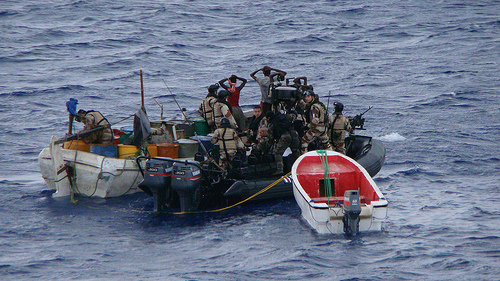 While the falling of piracy related numbers in the Somalian hotspot is certainly a welcome news, the IMO understandably warned of the risk of becoming complacent with these positive results. Success in combating piracy remains contingent on the local situation on the ground which, in the case of Somalia, remains unstable. Current signs of criminal activities, particularly the risk of these spreading into West Africa, call for a continuing engagement with the process stakeholders. This should also be aimed at developing a comprehensive and holistic approach towards all facets and root-causes of transmaritime criminality.

 Roger L. Phillips
 Hilarie Henry
 Jon Bellish
 Matteo Crippa
 Milena Sterio
 Shannon Maree Torrens
 sonia messaoudi
 Michael Y. Liu
 Communis Hostis Omnium