Piracy in Somalia is Decreasing, says IMO

At the end of a year focused on a wide-ranging anti-piracy campaign, the International Maritime Organization (IMO) cautiously announced a decrease in piracy and other related attacks in Somalia:

“Recently compiled statistics show that the number of ships and seafarers held captive by Somali pirates have reduced from a peak of 33 and 733 in February to 13 and 265 respectively, at the beginning of December. The number of reported attacks has also declined from a high of 45 per month in January 2011 to 14 for the month of November 2011; and the proportion of successful attacks has been cut from 20 per cent in January 2011 to just 7 per cent in November 2011.”

Further up to date figures are also available from the International Maritime Bureau piracy reporting centre.

During 2011, the IMO engaged at various levels to bring about a solution to piracy and related crimes, particularly concerning the protection of both ships and seafarers as well as the enhancement and enforcement of maritime law. Most notably, the IMO dedicated this year world maritime day to the theme of “Piracy: Orchestrating the Response” and launched a campaign directed at improving coordination among States, the private sector, international and non-governmental organizations to tackle piracy.

 The changing nature of modern day piracy and other forms of armed robbery at sea, its increasing links with other forms of organized crimes, the deeply rooted social causes at their basis as well as their impressive economic impact have given a new dimension to the phenomenon. We have referred to this as transmaritime criminality.
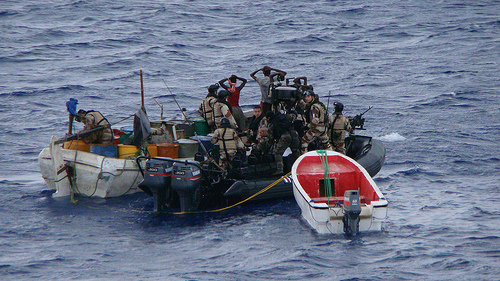
While the falling of piracy related numbers in the Somalian hotspot is certainly a welcome news, the IMO understandably warned of the risk of becoming complacent with these positive results. Success in combating piracy remains contingent on the local situation on the ground which, in the case of Somalia, remains unstable. Current signs of criminal activities, particularly the risk of these spreading into West Africa, call for a continuing engagement with the process stakeholders. This should also be aimed at developing a comprehensive and holistic approach towards all facets and root-causes of transmaritime criminality.

Acquitted of Piracy, Lost in Paris

Great article in lemonde today (in French):

The [Somali] man, aged 36, almost missed Sante prison, where he was ten days ago. At least life there offered something reassuring for this man uprooted, torn from his country by a group of French soldiers in 2008, moved to Paris a hood over his face, imprisoned for over three years as a suspected pirate, acquitted by a criminal court, Wednesday, November 30th , then thrown the same night into the streets of Paris, free but without papers, without any money and almost completely unable to speak the language. [rough translation]

Perhaps an overlooked consequence of extraterritorial prosecutions.

Creating Rule of Law in Somalia By Empowering Civil Society

We spend a lot of time on this blog talking about prosecution, but most would agree that the only sustainable solution to piracy requires competent governance in Somalia. It is almost a cliche, acknowledged but with no real understanding as to what it takes to create rule of law in Somalia. With this in mind, the recent trip to Somali of our friends at Haki Legal Empowerment is informative. Haki first lays forth the background:

In Somalia, customary justice systems predominate and are an essential starting point. Three parallel legal systems – xeer (customary), sharia, and statutory – operate across the country often in conflict on important issues such as gender-based violence. Traditional leaders – sheiks and clan elders – resolve over 80% of all disputes, including negotiating between fighting clans on complicated arrangements for access to scarce natural resources. However, countless abuses and human rights violations are either condoned or directly perpetrated by the elders, particularly against women.

It further observes:

Formal institutions such as the judiciary and prosecutors provide little oversight, monitoring or review and in most cases only serve to strengthen the status quo. In many parts of Somalia they have been entirely co-opted by militias and powerful interests. The President of Puntland recently sacked 28 judges – perhaps a necessary move to counter corruption, but one that does not instill faith in the independence of the judiciary and the separation of powers.

Nonetheless, Haki suggests that assistance to certain civil society institutions can lay the groundwork for rule of law in Somalia. Haki concludes:

The international community needs to support a long-term vision to securing and rebuilding Somalia that empowers Somalis to use and improve their indigenous dispute resolution systems and fledgling institutions as a means to strengthen local security and combat piracy, increase rights protection for the vulnerable, and address the root causes of famine and poverty.

Military and prosecutorial efforts outside of Somalia do not provide a long-term solution to piracy. As the international community looks to create a comprehensive strategy, it must consider what can be done in Somalia to address this problem at its source.

Pirate Victim Turned Pirate


The M/V Quest

Of the fourteen pirates indicted for the hijacking of the M/V Quest, a 58 foot yacht, and killing its occupants, four Americans on an around the world adventure, one of the pirates was not of Somali origin. Mounir Ali, 23, is a Yemeni national who was a fisherman who was himself captured by pirates.  According to a press statement from US Attorney responsible for his prosecution:

This defendant, the sole Yemeni, was part of the crew of another boat that was hijacked by a separate group of pirates some months earlier. The defendant had been taken on at least two piracy outings in his captured ship. On the second outing, the defendant was with other pirates when the Yemeni fishing boat, used as a mothership for the Quest hijacking, was captured.  The defendant transferred to the Yemeni fishing boat and then chose to go with the pirates when they located the Quest in exchange for a share of the ransom.

Mr. Ali argued that he only joined the pirates because he had no other choice. His boat was hijacked and he was promised that it would be returned if he joined in this raid. As I have previously remarked, this type of defence was common during another era of piracy. As noted here, during the 18th century, Caribbean pirates cleverly avoided conviction in British prosecutions based on a defence of impressment or duress:

Voluntary complicity with a pirate crew was important to establishing guilt. Pirates exploited this loophole by pretending to conscript seamen who joined their ranks voluntarily. Since pirates did genuinely compel some seamen to join their companies, court officials considered the impressment defense plausible.

In Mr. Ali’s case, he pleaded guilty in order to avoid the death penalty. The Judge, apparently unmoved by Mr. Ali’s claims of duress, sentenced him to life in prison.

But the defence can be successful in the right circumstances. Larger fishing vessels are regularly hi-jacked and the occupants conscripted to support piracy operations. In a recent example, the UK Navy considered the seafarers of a fishing vessel to be unworthy of prosecution even though the vessel had been used in several recent pirate attacks. They let 20 Pakistani crew go, while turning over four Somalis  to Italian authorities on suspicion of involvement in the recent attack on the Italian vessel MV Montecristo. Duress is also recognized by Article 31 of the Rome Statute which excludes criminal responsibility if:

The conduct which is alleged to constitute a crime within the jurisdiction of the Court has been caused by duress resulting from a threat of imminent death or of continuing or imminent serious bodily harm against that person or another person, and the person acts necessarily and reasonably to avoid this threat, provided that the person does not intend to cause a greater harm than the one sought to be avoided.

Duress will continue to be a common defence in future piracy trials and determining its applicability will pose a challenge to any court addressing the issue.

Kenyan Intervention in Somalia Will Have Minimal Effect on Piracy

Kenya has entered into Somali-territory and is making slow progress northward. As yet, it is not entirely clear what military objective Kenya seeks to obtain. At its outset, the Kenyan government justified the incursion based upon recent kidnappings of foreign tourists and aid-workers, asserting that they were all the work of al-Shabaab. However, It appears that only the latter attack on Spanish aid workers for the charity MSF can be attributed to al-Shabaab. While the other two attacks on tourists near Lamu were likely the work of pirates/armed bandits. More recently, sources in the Kenyan military have asserted:

Kenya’s military says it plans to remain in Somalia until the Shabab’s capacity is “reduced” and Somalia’s weak, American-backed transitional government is able to function.

The more immediate goal appears to be to take the port town of Kismayu, one of Somalia’s biggest towns and a major money-earner for the Shabab. The United States and France have joined in this fight, emboldened by the success of using air power to assist foreign ground troops in Libya. The Kenyan incursion into Somalia falls within the U.S.’s fight against the Shabaab which until now was limited to targeted drone strikes in the Shabaab controlled areas.

Although principally a military intervention against the Shabaab, this is also an opportunity for Kenya to root-out pirates based in the south of Somalia and to discourage any further attacks on tourist-areas on its coast. While the Shabaab was initially hostile to pirates, asserting piracy was contrary to Islam, it appears Shabaab has become more tolerant of pirate gangs in view of the revenue they can produce. They are not working together, but appear to have reached a détente.

It is possible that Kenya’s intervention will prevent further pirate attacks in its coastal tourist areas. However, the vast majority of pirate attacks at sea originate in the breakaway region of Puntland, far to the north of the Shabaab controlled areas. Therefore, Kenya’s incursion into Somalia, while perhaps limiting attacks on tourists in Lamu, will not have any meaningful impact on attacks in international waters which have so affected commercial shipping.