Somalis Pirates on Trial in France: 4 year long pre-trial detention creates evidentiary hurdles

Following her earlier post on French legislation on PCASP, below is another guest post by Valerie Gabard:

After four years of provisional detention, six Somalis faced a jury trial in Paris this month for the hijacking of the French luxury yacht Le Ponant in the Gulf of Aden, in 2008. They were tried for holding the 30 crew members as hostages in exchange for a 2.15 million euros ransom. The six men were arrested a week after the hijacking while driving in Somalia territory. When arrested by the French Military, they were carrying $200,000 believed to be part of the ransom. The convictions and sentences were delivered on Thursday last week. Two of the accused were acquitted by the Court, while the four others were convicted and sentenced to four to ten years of imprisonment.

The six men were charged with kidnapping, illegal confinement and organized gang theft but not with a specific offence of piracy. The legal qualification chosen by the Prosecution and the Investigating Judge in this case is due to the absence, in 2008, of a specific definition of piracy in the French Penal Code. Since 1825, France had a law criminalizing piracy but it was obsolete and did not reflect the definition adopted by the Montego Bay Convention. This Law was thus abolished in 2007 and only replaced by new Piracy legislation on 7 January 2011. Despite the legal lacunae from 2008 until 2011, the existing offences of kidnapping, illegal confinement or the offence of seizing or taking control of a ship by force or threat of violence (see article 224-6 of the Criminal Code) largely covered the legislative gap. The new legislation does not substantially change this approach as it does not create an independent offence of Piracy but merely refers to existing crimes in the Criminal Code that could qualify as Piracy as defined by the Montego Bay Convention (See Report from the French Senate – in French).

Le Ponant

During the trial, five of the six accused claimed their innocence. Only one admitted his participation in the operation and his presence on the yacht. Two accused admitted being on Le Ponant but only as sellers and three claimed that they were never pirates or having ever boarded the yacht. Although the accused were identified by the crew four years ago, with time passing doubts arose concerning identification and some of the crew members changed their initial statements. The captain of the yacht confirmed at Trial his initial statement but recognized that the identification of the pirates after four years is today impossible. The weakness of the eyewitness identification and the absence of forensic evidence linking the accused to the yacht, lead the Prosecution to rely almost exclusively on circumstantial evidence. The six men were not arrested on board of the yacht but a week later, during an armed operation conducted by French forces, while traveling by car on Somali territory. They were arrested carrying $200,000 believed to be part of the ransom. Establishing whether or not the accused were ever on the yacht, appeared to be the real evidentiary challenge in the case. The Accused benefited from these doubts and, while the motivations of the verdict are not immediately available, this almost certainly explains the acquittals with respect to the two accused that firmly denied their participation in the crimes. The convictions and sentences imposed by the Court also appear to mirror the accused admissions as their role in the operation during the investigation and at Trial. This shows that it is probably their own admissions that lead the jury to believe that they were guilty rather than the evidence presented by the Prosecution.

The Prosecution requested sentences ranging from 10 to 15 years imprisonment but the Court did not follow this approach acquitting two accused, convicting one to ten years, two to seven years and the last one to four years of imprisonment for complicity. This latter only acknowledged driving the car and, presumably should be released with the two acquitted persons as he has already spent four years on provisional detention. Parties have ten days to appeal the judgement but the six Somalis seem generally satisfied with the outcome and only the Prosecution might file an appeal. It is highly possible as the Prosecution wants this case to be an example and a warning for the Somalis still actively implicated in piracy in the Gulf of Aden. Indeed, because it considered the sentences to be too lenient, the Prosecution already appealed last year the Judgement that jailed five Somalis pirates between four and eight years for hijacking the yacht Carréd’As in the Gulf of Aden in September 2008. The appeal trial is still pending.

Four years of provisional detention prior to trial is significant, in particular when a trial concludes with two acquittals. The acquitted men are Somalis being transferred to France for the purpose of the Trial, thus placing them in an isolated and fragile situation. They are now recognized as not guilty and are set free but in an unfamiliar country with no money, no papers and their lawyers as only assistance (See “Abdulkader, «pirate» somalien naufragé dans les rues de Paris”). French authorities appear to repeat the tragic story of the only man acquitted at the first piracy trial (See previous CHO Blog post “Acquitted of Piracy, lost in Paris”).  This emphasized one of the down sides of extraterritorial trials.

Finally it should be noted that there are two more piracy trials coming up in France where the accused are already provisionally detained in France. The first one involves three Somalis arrested while hijacking another French yacht, the Tanit in 2009 and the second one involves the trial of seven men accused of the attack in September 2011 of a catamaran where a French citizen was killed. The latter should be tried based on the new piracy law that appears to be passed to address the unforeseen burgeoning of Somali piracy in the Gulf of Aden.
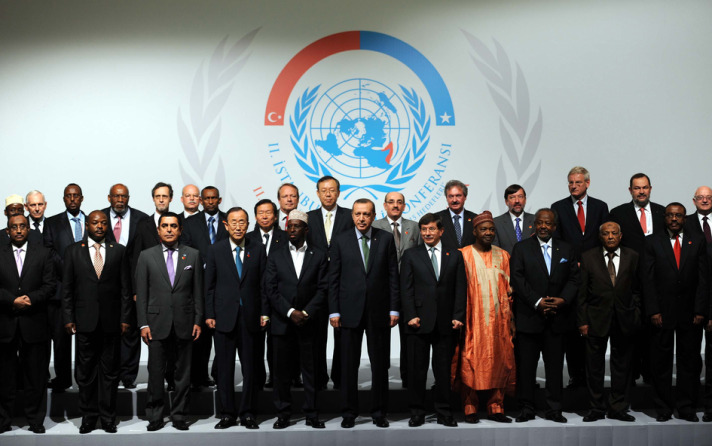
In Brief: the Second Istanbul Conference on Somalia

(Participants to the Second Istanbul Conference on Somalia)

The Second Istanbul Conference on Somalia took place in Istanbul, Turkey from 31 May to 1 June 2012. The Conference, which followed an initial event held in 2010, was attended by several representatives of Somalia’s government, autonomous regions, tribal elders and diaspora, as well as of the international community. Under the theme “Preparing Somalia’s Future: Goals for 2015”, the Conference focused on long-term and multi-dimensional solutions to the country democratization process, including recovery, social and economic development and peace consolidation.

Organized in partnership with the United Nations, the Conference is the lastest effort in Turkey’s growing engagement in Somalia. In recent years, Turkey launched a major diplomatic, economic and humanitarian campaign culminating with the visit of its Prime Minister to Mogadishu and the opening of an Embassy in 2011. Turkey’s “ soft power” efforts have drawn praises as well as some concerns, particularly by the US and Ethiopia.

“[P]rimary responsibility for establishing a political solution in the country lies with Somalis. The role of the international community is to support Somalis to provide leadership and ownership in rebuilding a functioning state and local governments that can provide security, ensure the rule of law and respect for human rights, provide basic social services and create an enabling environment that allows for economic opportunity for all its citizens.”

(Istanbul II Declaration)

Obviously, piracy featured in the Conference Agenda. However, also in light of the upcoming specialized Second International Counter-Piracy Conference in Dubai, UAE on 27-28 June 2012, the International Piracy Conference in Perth, Australia on 15-17 July 2012 as well as the Plenary Meeting of the Contact Group on Piracy off the Coast of Somalia, in New York, USA on 25 July 2012,  the discussion focused on broader issues affecting the country’s justice and security sectors, such as  inter-clan conflict, violence, corruption and misappropriation of funds, kidnapping, terrorism and human rights abuses.

The Conference Final Declaration can be found here.

USAID may increase development assistance to Somalia

Senator Kirk at the Shimo la Tewa Prison in Mombasa, Kenya
where five dozen Somali pirates are held, including Ahmed
Abdulkadir Hersi.

From 2008 to 2011 the development assistance provided by USAID to Somalia decreased from $260 to $80 million. Language has been inserted into the foreign appropriations bill that could indicate a change in this trend in order to address the root-causes of piracy.  Last week, the Senate Appropriations Committee approved S.3241, including the following provision:

(g) PIRACY.—Not later than 180 days after enactment of this Act, and following consultation with other relevant Federal agencies, the Secretary of State shall submit to the Committees on Appropriations a diplomacy and development counter-piracy strategy for the Horn of Africa region, including an assessment of the potential effectiveness of economic and security assistance for vulnerable Somali and Kenyan communities in providing gainful alternatives to piracy and encouraging collective action within such communities against groups and individuals involved in piracy. (emphasis added).

The language was inserted by Mark Kirk who has taken on maritime piracy as one of his policy initiatives. In April 2011, he compiled a report including recommendations to stem the rise of piracy:

  1. A US/UN ban on ransom payments that support the expansion of pirate operations
    and support for East African Al Qaeda/Al Shabaab terror;
  2. Aggressive Rules of Engagement giving authority for local naval commanders to
    attack and disable pirate “motherships,” leaving them adrift to empower on-scene
    commanders with the tactical authority to arrest pirates and rescue crews;
  3. Economic Assistance to reward Transitional Federal Government (TFG),
    Somaliland, Puntland, Ahlusunna Wal-jamea (ASWJ) and Jubaland frontline
    communities who confront or convert Al Shabaab or pirate-controlled areas;
  4. Judicial Assistance to Puntland and Kenya to expand their courts and prisons to
    readily accept pirates captured by international or Somali allied military/law
    enforcement forces;
  5. Military Assistance to TFG, Puntland, Somaliland, ASWJ or Jubaland forces who
    gain control of Al Shabaab or pirate-controlled areas; and,
  6. A Blockade of the three primary pirate ports and shorelines, including the El Danaan
    Anchorage, where 12 western tankers/merchant ships with 290 hostages are held.

The language inserted into the bill would ostensibly support point 3 on the list of proposals.  Development assistance has been encouraged as a way to dis-incentivize piracy as the lack of any other sources of income has made piracy an attractive option for young Somalis. However, any increase in assistance would have to contend with the danger of graft in the TFG and other institutions. As USAID puts it, “The situation in Somalia is highly fluid, and Somalia’s social, economic, and political development faces formidable challenges.”

U.S., Iran and China target pirate financiers and Kingpins

Rescued Chinese crew aboard cargo ship Xianghuamen wave to a welcoming Chinese delegation near Bandar Abbas, Iran, April 7, 2012. One of Somalia’s most wanted pirates was captured after Iranian commandos rescued the hijacked ship. PHOTO | XINHUA |

In May, Thomas P. Kelly, Principal Deputy Assistant Secretary of State gave a lengthy speech to the American Petroleum Institute outlining the U.S. strategy to address piracy. The approach includes the following:

  • diplomatic engagement to spur collective international action;
  • expanding security at sea through the use of naval assets to defend private vessels and to disrupt pirate attacks;
  • preventing attacks by encouraging industry to take steps to protect itself;
  • deterring piracy through effective legal prosecution and incarceration; and
  • disrupting the piracy enterprise ashore, including the financial flows that make it possible.

Of particular interest to the prosecution of pirate leaders and organizers was the following:

After an intensive review of our strategy last year, Secretary Clinton approved a series of recommendations which constitute a new strategic approach. A focus on pirate networks is now at the heart of our strategy. We are using all of the tools at our disposal in order to disrupt pirate networks and their financial flows. We are focused on identifying and apprehending the criminal conspirators who lead, manage, and finance the pirate enterprise, with the objective of bringing them to trial and disrupting pirate business processes. Often, the best way to attack organized crime is to follow the money. That’s how the U.S. put some nefarious criminals behind bars. Pirate organizers receive income both from investors and ransom payments, and disburse a portion of the proceeds of ransoms back to these investors. Already, the United States has convicted one Somali pirate negotiator.

This highlights the focus on high-value kingpins as opposed to just the foot soldiers executing attacks. In 2010, President Obama signed Executive Order 13536 concerning Somalia which identified 11 individuals who were suspected of financing piracy. The Executive Order imposed economic sanctions on individuals who “have engaged in acts that directly or indirectly threaten the peace, security, or stability of Somalia” and indicated that “among other threats to the peace, security, or stability of Somalia, acts of piracy or armed robbery at sea off the coast of Somalia threaten the peace, security, or stability of Somalia.” Some of these same individuals were named in a list created by the UN Security Council in February 2012 indicating they are “individuals and entities subject to the travel ban, assets freeze and targeted arms embargo imposed by paragraphs 1, 3 and 7 of Security Council resolution 1844 (2008).”

The list of individuals annexed to the Executive Order includes, Mohamed Abdi Garaad, who was recently arrested together with 12 other suspected pirates on 4 April by Iranian commandos after the pirates had hijacked a Chinese cargo ship. It is reported that Garaad was:

In command of one of the largest pirate militias, Garaad is outspoken and well known to the international media.  He is reported to command 13 separate militia groups, totaling over 800 pirates.  In a 2009 interview, he proclaimed, “The navies, they can’t stop us … we have more than 200 crews and we are increasing all the time.”  Garaad is responsible for the attack on M/V Maersk Alabama, which ended with the successful operation by US Navy SEALs.  After this operation, Garaad publicly threatened to retaliate against US ships and crews.  Garaad is also responsible for the 2009 attack on the M/V Sea Horse, a ship delivering World Food Program aid to Somalia.

See also here and here. It is unclear whether he is in the custody of Iranian or Chinese authorities, whether he will be brought to trial and if so where and under what legal regime.

Upcoming Event: Second International Counter-Piracy Conference – Dubai, 27-28 June 2012

As announced during the anti-piracy chapter of the recent London Conference on Somalia, the United Arab Emirates will host its second International Counter-Piracy Conference next month. The event, which follows a similar initiative convened in April 2011, will be held in Dubai, UAE on 27-28 June 2012. The Conference aims to further advance public-private coordination and partnership to combat maritime piracy, bringing together high-level government officials from more than 50 countries, senior representatives of international organizations and CEOs from leading global companies from maritime-related businesses. The UAE, the current chairman of the Contact Group on Piracy Off the Coast of Somalia, has since long engaged in counter-piracy initiatives in the Gulf of Aden and the larger area of the Indian Ocean.

The official website of the Conference can be found here. Notably, some of the main presentations and position papers are already available, giving a sneak preview of the upcoming debate.