Changing Landscape of Gulf of Guinea Piracy as UN Takes a Secondary Role

Despite recent efforts to increase naval patrols, pirate attacks and incidents of armed robbery at sea have continued throughout the Gulf of Guinea and in particular in the Niger Delta region of Nigeria and off the coast of Benin. The region is extremely resource-rich, with oil, cocoa, and various minerals filling tankers and bulk carriers. Since the beginning of 2012, there have been numerous attacks on such vessels in the Gulf of Guinea.  Such attacks tend to be more violent than those in the Indian Ocean. For example, in one recent attack, pirates killed the captain and chief engineer of a cargo ship off the coast of Lagos, Nigeria. A number of recent developments in the dynamics of this criminality and the international community’s efforts at addressing it are worth surveying here.

Piracy and Terrorism in the Gulf of Guinea

It has been suggested that increased militancy in the Niger Delta region is the root cause of the rise of piracy in the Gulf of Guinea. For example, in another recent attack, the captain and chief engineer of a Dutch ship were kidnapped and a crew-member injured.  MEND, the Movement for the Emancipation of the Niger Delta, whose mission is to fight for a fairer distribution of Nigerian oil revenue, has been accused of involvement in the recent pirate attack. But MEND has specifically disclaimed responsibility and refused to mediate between the pirates and hostage negotiators. Nonetheless, MEND continues to operate in the Niger Delta despite a widespread amnesty last year aimed at disarming the movement and claims to be responsible for the recent killing of Nigerian police at a marine checkpoint. Nigerian security forces deny this claim. What can be said is that just as with Somali piracy, there has been a tendency to conflate terrorism and piracy in the Gulf of Guinea without a thorough factual analysis. That said, other types of transmaritime criminality clearly interact with and will have an effect upon piracy in the Gulf of Guinea.

Fuel Subsidies and Smuggling

Nigeria President Goodluck Jonathan’s recent move to decrease the fuel-subsidy in his country, hugely unpopular at home, may have an impact on pirate operations. It has been reported that land-based smugglers of cheap Nigerian-subsidized fuel to neighbouring countries are having trouble turning a profit. One smuggler explained:

The removal of subsidy has choked our business. It is no longer lucrative as the price of fuel in Cameroon is between N160 and N180 per litre; by the time you bribe some officials of the two countries at the border, what you get after selling the fuel is not encouraging at all.

Although the reduced fuel subsidies will have the effect of reducing cross-border fuel smuggling, these criminals will be looking for other sources of revenue and could look to piracy as a new source of income. The situation is further complicated by the presence of a more expansive variety of transmaritime criminality in the region, including drug trafficking, illicit fishing, illicit dumping of toxic waste, and illegal or clandestine immigration or migration. For example, The United Nations estimates that $1 billion worth of cocaine, destined for Europe from Latin America, passed through West Africa in 2008. Much of this criminality is perpetrated in and through maritime jurisdictions and will often be associated with pirates. A comprehensive solution must take all transmaritime criminality into account.

General Features of Piracy off the Gulf Guinea

In the face of this volatile situation, the UN undertook an assessment mission and issued two important documents regarding the Gulf of Guinea situation. A recent report of the Secretary General sheds some light of the general features of West African piracy and how the international community plans to address it.

The UN Secretary General reported on 19 January 2012 (only recently released) that piracy in the Gulf of Guinea since the late 1990s has focused on high-value assets, particularly oil shipments.  Shell executive vice president Ian Craig has noted that as much as 150,000 barrels of crude a day is being stolen by oil thieves in the Niger Delta. But since Nigeria has responded robustly to the growth of piracy, attacks have migrated to the Benin port of Cotounou (19 nautical miles to the west). Recent attacks are generally targeted at oil and chemical ships at a distance of over 40 nautical miles from shore (i.e. on the high seas). Pirates generally steal cargo and sell it on the black market – as opposed to holding the goods or crewmen for ransom (as in Somalia).

These attacks have had a significant impact on the economies of West Africa. There are 70 percent fewer ships entering the Cotounou port. This port is the entry point for goods to in-land countries such as Niger, Mali, and Burkina Faso who will also suffer from increased costs due to scarcity of goods and increased insurance rates on all maritime shipments. In contrast, attacks off the Central African coast mainly target oil drilling platforms and ships in order to steal money and goods from crew. The combined effect of these types of piracy is an estimated annual loss of $2 billion to the West African subregional economy.

However, West African countries have had somewhat more success than their East African counterparts in mobilizing regional resources and coordinating efforts to prevent and punish pirates. Of particular note is the cooperation between Nigeria and Benin in conducting joint patrols (albeit with some international contributions). Their relative success may be partly attributable to a more limited geographic area of recent attacks (as compared with Somali pirates who have perpetrated attacks over 1000 nautical miles from the coast of Somalia). More importantly this is attributable to the fact that there are robust state institutions in the areas targeted by pirates. That said, more must be done to increase state capacity, and, in particular naval capacity. Furthermore, pirates are bound to find where governance structures are the weakest and to take advantage of those failures (e.g. by launching attacks from states lacking effective naval or coast guard patrols).

The UN’s Secondary Role and Upcoming Regional Conference

As a result of this organic cooperation, the UN and the international community have taken a secondary role in the fight against piracy in the Gulf of Guinea. The UN, both in the UNSG’s report and in its Security Council Resolution, lauds the current littoral state cooperation and encourages the Gulf of Guinea states to strengthen this cooperation, while promising to provide international financial assistance where required. It is clear from the statements of a number of representatives after the 27 February 2012 briefing on the UNSG report that a number of states would prefer to leave West and Central African states to take the lead in enhancing regional security against piracy and armed robbery in the Gulf of Guinea. The U.S., for one, has responded to this call by committing about $35 million for the training of naval personnel in Nigeria and other countries within the Gulf of Guinea on how to combat piracy and other maritime crimes. It is not suggested that the international community should create a joint naval force, such as EUNAVFOR, to combat pirates. This may encourage a reliance on PMSCs in the Gulf of Guinea where shippers lack confidence in littoral state navies.

Following on the recent report, the UNSC adopted a resolution 2039 on 29 February 2012 encouraging littoral states of the Gulf of Guinea to adopt the recommendations in the report. In particular, it encourages Benin and Nigeria to continue joint naval patrols and to work independently to secure their territorial waters. In addition, it suggests that the international community provide all possible assistance. Finally, it advocates a regional conference including Gulf of Guinea states, in collaboration with the African Union, in order to elaborate a regional strategy to fight piracy. As stated in UNSC 2018, the purpose of the conference would be the following:

to consider a comprehensive response in the region and [for] the States of the Economic Community of West African States (ECOWAS), the Economic Community of Central African States (ECCAS) and the Gulf of Guinea Commission (GGC) to develop a comprehensive strategy, including through: (a) the development of domestic laws and regulations, where these are not in place, criminalizing piracy and armed robbery at sea; (b) the development of a regional framework to counter piracy and armed robbery at sea, including information-sharing and operational coordination mechanisms in the region; and (c) the development and strengthening of domestic laws and regulations, as appropriate, to implement relevant international agreements addressing the safety and security of navigation, in accordance with international law.

The planned conference (a “joint regional summit of Heads of State of the three regional organizations”) is to take place as soon as possible in 2012, but has not yet been assigned a specific date or location. As this conference approaches, regional organisations would do well to consider that further developing regional coordination will be key to formulating a comprehensive counter-piracy strategy in face of the resource fragmentation that currently exists in this sector.

The Enrica Lexie Incident – Private Security Counterpoint

Italian Marines on Trial in India

There has been considerable public interest in a recent incident off the coast of India where an Italian Vessel Protection Detachment (VPD) of Italian marines shot and killed two Indians aboard a fishing vessel whom they apparently mistook for pirates. Jurisdiction over the incident has been contested by the two nations and the facts are very much in dispute.  It is now reported that an Indian court has ordered the Italians be held in jail while they await trial. The report notes:

Italy’s Foreign Minister Guilio Terzi traveled to New Delhi last week to press his country’s position that the men should be tried in an Italian court, but India refused to cede jurisdiction.

New Delhi says the case should be tried in India because the killings happened on an Indian boat. Rome says the shooting took place in international waters and the case should be handled in Italy.

There are several interesting analyses about the jurisdictional arguments in this case. Douglas Guilfoyle states that UNCLOS provides for concurrent jurisdiction to India (as the flag ship of the victims) and Italy (as the flag ship of the defendants). He notes, however,

As Indian courts have jurisdiction, the next question is immunity. The easy thing to assume about VPDs is that they will enjoy State immunity for their official actions. While this is true, it falls for other States’ courts to respect it in practice – and there will always be pressure to look for exceptions where the death of a national is involved.

Jon Bellish also notes that the Convention for the Suppression of Unlawful Acts of Violence Against the Safety of Maritime Navigation supports the finding of concurrent jurisdiction in these circumstances as it more explicitly provides for jurisdiction based on  territorial, nationality, passive personality, and protective principles.

Apart from the diplomatic drama, what makes this incident extremely important is the repercussions it may have on Private Military and Security Companies (PMSCs). If these two marines are granted State immunity and let go, it could be an encouraging sign to other seagoing nations to support VPDs on their own flagged vessels. If State immunity is denied, and VPDs risk the same liabilities that exist with PMSCs, it could discourage states from continuing to provide VPDs. In the latter case, shipping companies would be left to decide whether to hire PMSCs and take on the liabilities that come with hiring companies in a loosely regulated industry. The stakes are very high as one report valued the PMSC industry for piracy alone at around $1 billion in 2011.

Adrift for two months, Somalis to stand trial in Seychelles

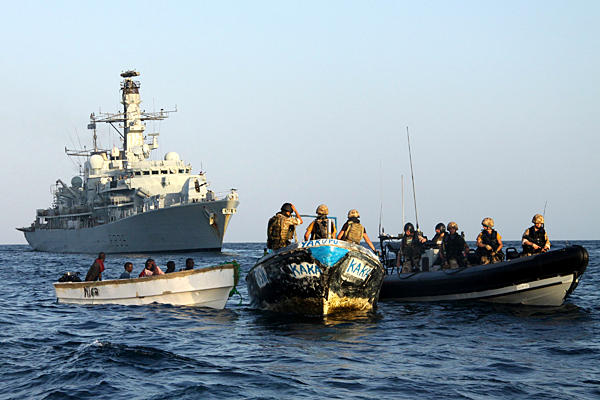
The U.S. has finally found a state willing to prosecute 15 pirates captured aboard an Iranian mothership in January 2012. As we noted at the time, there was no convenient location for prosecution. The U.S. had a legal basis to prosecute, but the cost of transferring the Somalis to the U.S. coupled with the risk that some would claim asylum was a deterrent. Iran was not likely to be the prosecuting nation. Although it may have a legal basis in its own domestic legislation to prosecute the pirates, the U.S. might have doubts that the pirates would receive a fair trial there. Further, it would be a public relations coup for Iran if it took possession and prosecuted the pirates. Finally, Somalia still has significant hurdles to overcome before it will be ready to administer fair piracy trials, be it in Somaliland, Puntland, or elsewhere.

Today the nytimes notes:

Fifteen Somali men accused of being pirates, who were captured aboard a hijacked Iranian fishing vessel by the United States Navy in January, were transferred on Tuesday to the Seychelles for trial.

The move from Djibouti to the Seychelles, an island nation in the Indian Ocean, was a welcome development for the United States in a high-profile case that had no clear legal resolution.

It also signaled the end of an intensive interagency effort to find a jurisdiction willing to receive the suspects, who had been held aboard a series of American warships for almost two months.

From its outset, the case, for all its high-seas drama, underscored the difficulties in developing effective and comprehensive programs to fight piracy. Capturing pirates, once international navies applied themselves to the task, has proved easier than bringing them to justice.

None of the nations most directly involved in the case — Somalia, home of the suspects; Iran, home of 13 hostages seized in the case; or the United States, which detained the Somalis — had either the capacity or desire to take on the costs and difficulties of prosecuting the suspects.

And the Seychelles, which in recent years has been a regional hub for hearing piracy cases, had no space in its tiny prison system for more convicts, American officials said.

Nonetheless, the recent transfer of several convicted pirates from Seychelles to Somaliland based upon a bilateral transfer agreement, freed up space in Seychelles to hold these defendants in jail and prosecute them. The U.S. Navy must be breathing a sigh of relief as considerable resources were occupied with maintaining the pirates on board:

A senior Navy officer expressed satisfaction at the Seychelles’ decision, which ended weeks of transferring the suspects among vessels at sea. The pirates, he said, first captured by the Kidd, a destroyer, had been held aboard three nuclear aircraft carriers, another destroyer and an amphibious warship before being brought ashore in Djibouti on Tuesday for a flight aboard an American military C-130 transport plane to the Seychelles.

Following on the London conference, a number of prisoner-transfer agreements were signed by East African states where prosecutions will most often occur and either Somaliland or Puntland, where UNODC is supporting the construction of new prisons. Until these new prisons are built, there will continue to be a bottleneck and could lead to a repeat of this incident where Somalis remain in military custody. This also raises some fair trial concerns. Insofar as it was not clear where they would be prosecuted, the Somalis could not very well have been charged with any offence during their two months in captivity. Piracy would have been the charge, but under which state’s legal system? Moreover, there remain questions as to how the prosecution will obtain eyewitness testimony. As we mentioned before, the Iranian hostages may not be at liberty to provide such testimony in order to support piracy charges for the hijacking of their fishing dhow. In addition, the nytimes notes that two of the pirates claim to be minors. All of that said, a solution has been found to the most pressing issue: where to prosecute. Other issues will remain for another day.

The OTHER Anti-Piracy Legislation

There is a continuing debate over whether flag states should sanction the hiring of armed guards aboard commercial ships. There are significant financial risks associated with hiring Private Military and Security Companies (PMSCs), including liability for damages to cargo and crew. As a Congressional Research Office report concluded in April 2011, “Some industry experts suggest that hiring armed security teams may be more expensive than taking the risk and paying the occasional ransom.” Nonetheless, there is a growing trend among flag states to permit the use of PMSCs on-board commercial ships. India and the UK paved the way, and a number of other states have indicated a willingness to accept such practices. Just today it was announced that the Philippines issued guidelines to permit armed security details.

Likely because of prior controversies in Iraq and Afghanistan, the United States has been reluctant to embrace the use of PMSCs aboard marine vessels. Thus far, the U.S. has not publicly sanctioned the use of PMSCs, although some reports indicate that the U.S. State Department has privately encouraged the use of PMSCs in pirate hot spots. It is in this context that in November 2011, the U.S. House of Representatives passed the Piracy Suppression Act of 2011 (within H.R. 2838) which would require the Department of Transportation to train U.S. mariners in “standard rules for the use of force for self defense […] including instruction on firearm safety for crewmembers of vessels.” This suggests that mariners would be permitted to carry and use firearms in certain situations. The Bill would also require all U.S. flagged ships carrying goods belonging to the United States to be provided with armed personnel to be paid for by the U.S. government. The initial house bill was even more ambitious and would have permit the U.S. to seek reimbursement for U.S. military assistance to pirate victims from other states, as well as criminalize attempts to commit piracy. Interestingly, the Senate version of the Bill (S. 1665) omits all of these provisions. Therefore, if the Senate Bill passes, the Piracy Suppression Act is unlikely to become law. (The House tried to pass a similar bill in 2010 (H.R. 2647), but the Senate version did not include the armed security provisions and they failed.) It remains an open question whether the U.S. Congress will keep the Piracy Suppression Act within the bill. But the conditions may be different this time around as Congress considers the successful rescue of two aid workers in Somalia and the maritime world starts to coalesce around the view that sanctioning PMSCs is the most practical, immediate solution to counter piracy.

UK House of Commons Issues Piracy Report, Eyes Private Security Guards on Board, Local Prosecutions in East Africa (Part I)

The Foreign Affairs Committee of the UK House of Commons recently released an interesting report on piracy off the coast of Somalia.  For those who are not conversant with its work, here is some background.

The Report was originally commissioned in June 2011 in response to the growing concerns from piracy and armed robberies activities in recent years, particularly off the coast of Somalia, and on their effect on the UK’s economy and security:

“Piracy off the coast of Somalia has escalated over the last four years and is a major concern for the UK. The threat is not primarily to UK ships as very few have been captured. Rather, the threat is to the UK’s economy and security. Piracy affects the UK’s banking, insurance and shipping industries, and threatens the large volume of goods which are transported to the UK by sea.” (para. 20)

More particularly, the Committee examined the role of the Foreign Commonwealth Office (FCO) in support of UK and international efforts to combat piracy, including the adequacy of international and domestic anti-piracy legislation, the support for anti-piracy projects on the ground in Somalia (including coordination at the international level, particularly with the United Nations), as well as UK naval involvement with NATO and EU anti-piracy operations. As part of this inquiry, the Committee received evidence from shipping and insurance industries, EUNAVFOR and the Ministry of Defence, in addition to experts on piracy and Somalia. Paul and Rachel Chandler, whose yacht was hijacked by Somali pirates in October 2009 and who were held captive for over a year also provided testimony.

The Report contains a set of wide ranging conclusions, the most important of which is a call for the UK, as a state “whose strengths and vulnerabilities are distinctly maritime”, to “play a leading role in the international response to piracy.” However, while its publication has been promptly noted by an authoritative legal source and welcomed by experts in the shipping, naval and security fields, the Report is yet to receive an in-depth legal analysis, at least with regard to some of its main recommendations. It is hoped that the UK Government response to the Report will help generate more discussion on the UK policies (as well as those of the international community) towards piracy in Somalia. As noted in the Report, the UK is also soon to host an high-profile international conference on piracy, to be held in February 2012.

The Committee’s final recommendations touch upon several relevant issues. These include the UK’s overall response to piracy and the need for the FCO to increase its support to victims and families as well as the continuation of the UK contribution to the naval task forces patrolling the Gulf of Aden. The Report also commended the positive efforts made by the shipping industry to ensure safety and exercise self-defence and discussed the appropriateness of the payment of ransoms to pirates to rescue hijacked boats and kidnapped seafarers as well as the need to improve the financial tracking of the monetary flows connected with piracy. In addition, the Report called for  more coordination in the international response and local solutions on the ground to tackle the social and economic root causes of piracy in Somalia. Finally, the Report addressed the deployment of armed security guards on board of vessels and local efforts to prosecute and enforce penalties against pirates. These two last points appear of particular momentum and interest, thus warranting a more focused comment.

Private Armed Security Guards (paras 26-43)

The use of private armed security guards (PASG) in post-war settings is not a novelty. Most recently, governments have increasingly resorted to outsource their security functions while private security companies have notoriously rushed to provide relief to military intervention forces in places such as Iraq and Afghanistan. It is therefore not surprising that, also considering the high costs associated with episodes of piracy and armed robberies off the Somali coast, the sector of private armed security on board of shipping and cruise vessels is booming. A simple internet search reveals a plethora of security companies offering services to the maritime industry. One cannot but agree with the Report when it cautions a “‘gold rush’ of new private maritime security firms.” As discussed in a recent post, the unprecedented launch of a fleet of fully fledged private armed ships appears imminent. As suprising as this might sound, worthy of note is that private security contractor Blackwater Worldwide appears to have previously attempted to provide similar security services. See also a comprehensive jurisdictional analysis on the use of PASG here, particularly noting how the underlying legal issue is mainly one of the exercise, and limits, of self-defence.

The Report notes and supports the recent UK Government about-face by now permitting the deployment of PASG on board of UK-flagged vessels:

“the evidence in support of using private armed security guards is compelling and, within legal limits and according to guidance, shipowners should be allowed to protect their ships and crew by employing private armed security guards if they wish to do so.”

This recommendation certainly marks a shift in favor of the deterrent effect and towards empowering and calling for shipowners, as well as insurers, to bear some of the responsibilities and costs associated with providing security along the main shipping routes. However, regulation and accountability mechanisms have not kept pace with the surging growth of the private security sector. The Report addresses the various risks of using PASG on board (particularly using lethal force), and calls for further formal and practical guidelines to better regulate their operation. However, it falls short of emphasising any concrete direction on what force can be used and when. The International Maritime Organization (IMO) has also issued interim guidelines on the use of private security guards as well as several aspects of their activities. The IMO previously clarified that these guidelines are not intended to institutionalise the use of armed and privately contracted security guards on ships and that they do not address all the legal issues that could be linked to their use. India and the U.S. have also issued guidances.

Calls for further and uniform clarifications have already been raised and, together with an assessment of the need for a permanent legislative framework that substitutes the current interim guidelines, should be on top of the agenda for the Government response to the report. In addition, with other States having opposed the use of such armed guards, the risk of fragmentation between flag, port and coastal states is of particular concern.  This leaves PASGs in the awkward position of being permitted by a flag-state to bear weapons on board and ship and tossing those weapons overboard before calling to port in a jurisdiction that may not permit armed personnel aboard commercial ships

In addition to the security of commercial ships, any holistic solution will encompass mechanisms for the prosecution, transfer and imprisonment of pirates. The solutions suggested by the Report in this regard will be discussed in a forthcoming separate posting.