Somaliland’s New Anti-Piracy Law

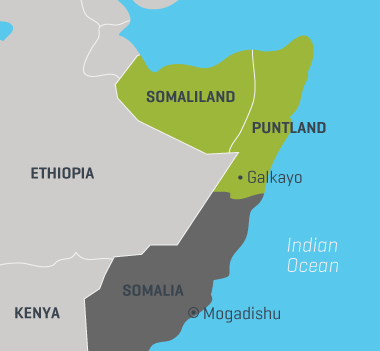
The semi-autonomous region of Somaliland has become an increasingly important ally to shipping states in resolving the present quagmire in piracy prosecutions in the Gulf of Aden. In the buildup to t­­­he recent London Conference on Somalia, Somaliland passed legislation criminalizing piracy within its judicial system. It is based to a large degree on the UN Convention on the Law of the Sea definition of piracy with some important differences. The Anti-Piracy Law, together with legislation contemplating the transfer to Somaliland from other States of convicted offenders, were signed into law by Somaliland’s President last month. While not directly referring to piracy repression measures, the Prisoners Transfer Law already facilitated the transfer of several convicted Somali pirates from other countries in the Gulf of Aden region currently carrying out piracy prosecutions, particularly the Seychelles. The passing of both Laws signals Somaliland’s commitment to combat maritime piracy off its coast and elsewhere in the region in its growing engagement with the international community in a quest for international recognition. More importantly, the Laws fill a lacuna in Somalia’s out-of-date and politically-motivated legal framework, as applicable to Somaliland pursuant to Article 130(5) of its 2001 Constitution. The new Law is a case study in the potential hazards in partial implementation of UNCLOS terms.

Under the previous applicable legislation, particularly Somalia’s 1962 Penal Code, acts of piracy and armed robbery at sea where arguably punishable as armed robbery (Article 484), extortion (Article 485) and kidnapping (Article 486). Additional issues arose in connection with the applicable forms of participation to these crimes as well as the punishment of inchoate crimes. Recourse to the 1975 Kidnapping Law, adopted during the military dictatorship, was particularly problematic due to the possible unconstitutional breach of fundamental human rights by its provisions, which also included the jurisdiction over this crime by a special national security court. Finally, Articles 205-206 of the 1959 Somalia Maritime Code criminalize piracy and mutiny carried out by ship masters and crews. However, these articles do not provide sufficient legal basis to contrast the current pirates modus operandi in the Gulf of Aden, where pirates often operate off small and unregistered skiffs and without a formalized chain of command. An excellent analysis of the inadequacy of both Somalia and Somaliland previous anti-piracy legal framework can be found at Somaliland Law.com.

First and foremost, it has to be noted how the Anti-Piracy Law eliminates within its judicial system the customary law distinction between piracy and armed robbery at sea, defining any attack within Somaliland territorial waters as “piracy” (Article 2(1)(c)). The new Law also repels Articles 205-206 of the 1959 Maritime Code (Article 13, see also Article 9) and affirms the applicability of the 1962 Penal Code for matters not specifically dealt with within the Law (Article 14), for instance with regard to forms of participation in the commission of the crime. More importantly, the Law introduces a term of imprisonment of 5 to 20 years (Article 4) without the possibility of conversion of a sentence into a fine (Article 10). In the case of murder, the provisions of Article 434 of the Penal Code, which provides for the death penalty, will apply. In addition, the Law has expanded the definition of piracy set forth in UNCLOS by adding two forms of participation: ‘willful participation’ and ‘aiding’ piracy.

Article 2: Definitions

A. An act of Piracy means:

1. Any illegal act of violence or detention or depredation committed by the crew or the passengers of a private ship or a private aircraft or by armed pirates for the purposes of illegal financial gain and directed:

a) on the high seas, against a ship or aircraft, or against persons or property on board such a ship or aircraft;

b) against a ship, an aircraft, a person or property on board a ship or an aircraft in a place outside the jurisdiction of any state;

c) against a ship, an aircraft, a person or property on board a ship or an aircraft within the territorial waters of the Republic of Somaliland.

2. Any act of willful participation in an act directed knowingly as a pirate’s attack against a private ship or private aircraft.

3. Any act which incites or facilitates or aids piracy as defined in Clauses 1 and 2 of this Article.

4. Similarly, any act of piracy directed at or by a warship or military aircraft or a government ship or aircraft whose crew takes over its control by means of a mutiny and commits acts of piracy as defined in (this) Article 2 of this Law.

B. Ship means any sea vessel including ship, boat, speed boat, launch, canoe or any other sea vessels which are used for acts of piracy.

Law on Combating Piracy – LAW NO. 52/2012

(Unofficial Translation – Courtesy http://www.somalilandlaw.com)

Definitions of Piracy

Article 2 of the Anti-Piracy Law reproduced in extenso above mirrors the provisions of Article 101 of UNCLOS, with the exception of some small but notable differences. Article 2(1) expressly refers to actions of “armed pirates”. Article 6(1) only briefly expands on this notion, identifying pirates as “persons who intend to commit the acts of piracy referred to in Article 2”. Article 2(1) also identifies “illegal financial gains” as the purpose of the acts of piracy thus providing a narrower, though more precise, definition than the customary “private ends” requirement contained in UNCLOS.

Article 2(2) is particularly interesting in that it removes the traditional direct link between acts of piracy and the use of a ship. Because of its wording and its location within the Law, Article 2(2) appears to replace Article 101(b) of UNCLOS which refers to “any act of voluntary participation in the operation of a ship”. Some authors have noted a possible lacuna in the punishment of direct perpetrators of acts of piracy created by the departure from Article 101(b) UNCLOS, which is also referred to as punishing “cruising with pirate intent”. This has prompted a call for an amendment to the Anti-Piracy Law to include this latter provision. However, it is also arguable that Article 2(2) is an entirely novel provision expanding the criminalization of piracy to encompass the responsibility of pirate kingpins and middle-men operating from dry land. Indeed, these types of  criminal conduct might not always fall under the provisions of Article 2(3) of the Law, as well as Article 101(c) UNCLOS, which criminalize inciting as well as internationally facilitating piracy.

Somaliland Territorial jurisdiction

Further to the comment above concerning the abandonment of the customary term of “armed robbery at sea”, pursuant to Article 5 of the Law, Somaliland Courts will have jurisdiction over any offence of piracy committed within Somaliland sea or in an area outside the territorial waters of any other country. In this regard, pursuant to Article 8, the Somaliland Coast Guard have the power to seize ships and to arrest and investigate suspected pirates.

Confiscation of Pirate Property

Article 11 of the Law provides for the confiscation of property seized from pirates. The main goal of this provision, also contemplated by the UNCLOS, is to drain off the resources of pirates’ cartels by removing their main revenues, including equipment and paid ransoms. However, further consideration has to be given to the  full extent of application of this rule, particularly with regard to ships seized by pirates and subsequently used in connection with pirate attacks, for instance as mother ships. The strict application of this norm risks further depriving, even if just temporarily, the legitimate ship owners of costly assets, as well as of their cargo, upon it and its crew being freed from captivity. Crucial in this regard will be the interpretation of Articles 6(2) and 7 of the Law which, respectively refers to the status and the ownership of a pirated ship.

Conclusions

The general thrust of the new Anti-Piracy Law is to adapt Somaliland’s legislation not only to the established international norms, particularly the relevant UNCLOS provisions, but also to provide an effective tool to respond to the modern features of pirates attacks, as well as armed robbery within Somaliland’s coastal waters. The Law identifies relevant criminal conduct and provides a clearer definition of pirate ships. However, an opportunity has been missed for the provision of a more direct definition of pirates. The Law also clearly targets the financing and other actions in support of piracy (see also Article 3(4)). Yet, the Law risks paying too much tribute to the current factual circumstances of the pirates attacks taking place in the Gulf of Aden, departing from a more abstract legislative framework. In several instances, Somali-based pirates have already shown a peculiar capacity to adapt their modus operandi, as well as their targets, as the international community struggles to devise efficient deterrent measures, whether involving increased naval presence in the Gulf of Aden or the harmonization of national anti-piracy laws. With the implementation of the Somaliland Anti-Piracy Law we will soon have a chance to assess whether this criminal trend will continue evolving or whether the legislation managed to fill a long overdue legal gap. It also remains to be seen whether there will be continued political will in Somaliland, and support from the international community, to put this Law into action. Of particular interest will be whether Somaliland will take the responsibility to prosecute suspected pirates even if they are native to other regions within Somalia, particularly from Puntland.

Will the United States Play a Role in Prosecuting Pirate “Kingpins”?

Somalia has no trouble producing pirates. Between a central government that controls little beyond the capitol city of Mogadishu, an utter lack of economic opportunity for young men, and a 3,025 mile long coastline with access to the world’s busiest shipping corridors, for every Somali pirate captured at sea, there are many more waiting to take his place. Accordingly, one of the most promising means to put an end to this global menace is the prosecution and detention of the financiers of pirate action groups – those benefitting most from lawlessness in the Indian Ocean but never actually setting foot on a boat.

The Eastern District of Virginia and the Fourth Circuit Court of Appeals are in the process of hearing two separate cases that, taken together, could decide whether or not the United States of America will have any role in the prosecution of these so-called “kingpins” of piracy.

One case, United States v. Shibin, is just beginning the trial phase and is the United States first attempt to prosecute a high level facilitator of piracy. The case concerns Mohammad Saaili Shibin’s role in the hijackings of the M/V Marida Marguerite and the S/V Quest. In both attacks, Shibin’s role was that of translator and hostage negotiator. Shibin was paid between $30,000 and $50,000 for his role in the M/V Marida Marguerite attack but was paid nothing in for his role in the S/V Quest, as all hostages were killed before a ransom could be negotiated. Shibin confessed to his role in both hijackings to American authorities.

Mohammad Saaili Shibin – AP Photo

At issue is, inter alia, whether Shibin can be charged with Piracy under 18 U.S.C. § 1651, which outlaws “piracy as defined by the law of nations” and carries with it a mandatory life sentence.

Because Judge Robert G. Doumar denied the defendant’s motion to suppress his confessions, it will be difficult for Mr. Shibin to argue that he did not participate in the hijackings in the manner alleged. Instead, his case will rise and fall on the way the Fourth Circuit settles a split on the legal question of whether “piracy as defined by the law of nations” is an evolving or a static concept.

This legal question comes to the Fourth Circuit in the context of a split within the Eastern District of Virginia on two cases with essentially the same set of facts. In both United States v. Said and United States v. Hasan, the defendants set out to plunder a merchant vessel and fired upon what they believed to be such a vessel. In both cases, the would-be pirates were actually firing upon a United States Naval vessel.

In Said, the trial court held that § 1651 should be interpreted in light of the nineteenth century definition of piracy, which included only “robbery at sea.” Because the defendants in Said only fired upon a ship and never actually stole anything, their acts did not rise to the level of piracy.

The Hasan trial court, on the other hand, found that “the ‘law of nations’ connotes a changing body of law,” and that Congress meant to keep pace with those changes as they relate to maritime piracy when they drafted § 1651. The court went on to find that the contemporary definition of general piracy under customary international law is embodied in the High Seas Convention and UNCLOS,[1] both of which define piracy as:

(A) (1) any illegal act of violence or detention, or any act of depredation; (2) committed for private ends; (3) on the high seas or a place outside the jurisdiction of any state; (4) by the crew or the passengers of a private ship or a private aircraft; (5) and directed against another ship or aircraft, or against persons or property on board such ship or aircraft; or

(B) (1) any act of voluntary participation in the operation of a ship or an aircraft; (2) with knowledge of the facts making it a pirate ship; or

(C) (1) any act of inciting or of intentionally facilitating (2) an act described in subparagraph (A) or (B).

The cases of United States v. Shibin and United States v. Hasan are therefore inexorably tied to one another. If the Fourth Circuit overrules the Hasan trial court and holds that, for the purposes of § 1651, piracy only includes armed robbery at sea, none of the defendants in Hasan, Said, and Shibin are guilty of a crime under that statute. If it affirms the Hasan trial court’s holding that that the definition of piracy under the law of nations has expanded to include the definition embodied in UNCLOS and the High Seas Convention the result will almost certainly be the opposite. The defendants in Hasan and Said would be guilty of piracy resulting from acts of violence on the high seas, and Mohammad Saaili Shibin would be guilty of intentionally facilitating piracy. Though Shibin, as a translator and hostage negotiator, would be considered a mid-level pirate at best, the same legal reasoning that applies to him will apply to higher level facilitators who “incit[e] or . . . intentionally facilitat[e]” piracy but do not themselves commit robbery at sea.

An interpretation of § 1651 as embodying an evolving definition of piracy would make the United States an excellent venue to prosecute the financiers and facilitators of piracy, as the level of due process afforded to the defendants would be unassailable and the mandatory life sentence imposed by § 1651 would be a strong deterrent. Prosecuting these “kingpins” is, apart from solving Somalia’s broader governance problems, the surest way to put an end to maritime piracy in the Indian Ocean and Arabian Seas. Hopefully the American judicial system can adapt to this modern realities of maritime piracy.


[1] Actually, this conceptualization of piracy was first announced in a 1932 study on the international law of piracy conducted by Harvard University and later incorporated into the Law of the Sea Treaty in 1958 and reproduced in UNCLOS in 1982.

Direct application of the international law of piracy in municipal systems

Cross-posted at The View From Above.

Most legal authorities assume that signing and ratifying the UN Convention on the Law of the Sea is insufficient, in and of itself, to provide a state a jurisdictional basis to prosecute acts of piracy on the high seas.  For example, Jose Luis Jesus, the former President of the International Tribunal for the Law of the Sea has explained:

The international legal regime on piracy, as codified in articles 100 to 107 of UNCLOS, is, as already mentioned, a jurisdictional regime and, as such, only allows States to arrest pirates, seize their ships and cargo, and bring them to trial in the State’s domestic judicial system. This legal regime is not predicated on the existence of an international criminal substantive law, nor does it contemplate any international judicial means or structure to try pirates.

As it stands now, there is no international court or tribunal that includes in its jurisdiction a mandate to try pirates. Once a State asserts its jurisdiction over pirates and their ship by arresting them, under the international piracy regime, that State is encouraged to try the pirates and dispose of the pirate ship and its cargo in accordance with its own national legislation and judicial system. This means that if the arresting State does not have penal legislation allowing for the punishment of pirates, or if the arresting State does not want to try them in its own territory for political or other convenience, then the legal regime as codified in UNCLOS is of little use.

Similarly, the most recent UNSG report of 19 January 2012 on the problem of piracy in the Gulf of Guinea states that UNCLOS provides for universal jurisdiction to prosecute pirates, but since Benin’s Maritime Code does not incorporate these provisions, Benin’s jurisdiction on piracy acts committed on the high seas is limited to acts committed by its citizens or on board of Benin’s ships.  The same concern has been expressed regarding the failure of the Transitional Federal Government to pass legislation criminalizing piracy in Somalia. Finally, based on UNCLOS Article 100 which requires that states must “cooperate to the fullest possible extent in the repression of piracy”, Douglas Guilfoyle has stated that “the inference is that States have no duty to enact relevant national offences [for piracy] and have ‘a certain latitude’ to cooperate in suppressing piracy by means other than prosecution.”

This view is understandable when observed through the lens of treaty law whereby implementing legislation is a necessary prerequisite to application within a municipal system. But the international law of piracy has also been accepted as customary law. For example, the 2010 Digest of US Practice in International Law, though noting the U.S. has not signed or ratified UNCLOS, states, “the actions and statements of the Executive Branch over more than six decades reflect the consistent U.S. view that this definition [of piracy in Article 101 of UNCLOS] is both reflective of customary international law and universally accepted by states.” Furthermore, each of the UN Security Council resolutions on piracy in Somalia and the Gulf of Guinea have emphasized that the only definition for the crime of piracy in international law is the one set forth in UNCLOS to which 162 states are states parties. UNCLOS has codified the customary international law of piracy.

Considering the law of piracy is settled both in treaty as well as customary law, is it possible that it is directly applicable in municipal systems without the need for implementing legislation? Some states accept that international law, especially with regard to jus cogens or very serious crimes (such as crimes against humanity and war crimes), applies directly within that state without the need to pass such legislation. With regard to piracy, whether or not it may apply directly would appear to hinge on a number of factors, including the gravity of the offence, whether there is a duty to prosecute in international law, whether the applicable treaties are self-executing, and the nature of a municipal system as monist or dualist. (Ward N. Ferdinandusse’s study is particularly helpful on this point.) Direct application of international law is not without precedent in African states, but will obviously need to be addressed on a case by case basis. To cite but one intriguing example, the 2010 Kenyan Constitution provides in Article 2 that the general rules of international law shall form part of the law of Kenya and that any treaty or convention ratified by Kenya shall form part of the law of Kenya under the Constitution.

The somewhat academic question of the indirect or direct application of international legal norms may not have been addressed by many African states confronted with piracy. Therefore, in the absence of clarity on this issue, the least risky practice would be to assume there is no direct application and insist on the codification of the legal definition of piracy in municipal law prior to instituting any prosecution. Indeed this seems to be the strategy adopted by the UN Security Council Resolutions on the issue. Is it, nonetheless, possible that the international law of piracy is directly applicable in certain African states, thereby rendering criminalization in positive law superfluous? The answer could have important ramifications for prosecutions in states without anti-piracy legislation or in those with incomplete legislative frameworks.

Adrift for two months, Somalis to stand trial in Seychelles

The U.S. has finally found a state willing to prosecute 15 pirates captured aboard an Iranian mothership in January 2012. As we noted at the time, there was no convenient location for prosecution. The U.S. had a legal basis to prosecute, but the cost of transferring the Somalis to the U.S. coupled with the risk that some would claim asylum was a deterrent. Iran was not likely to be the prosecuting nation. Although it may have a legal basis in its own domestic legislation to prosecute the pirates, the U.S. might have doubts that the pirates would receive a fair trial there. Further, it would be a public relations coup for Iran if it took possession and prosecuted the pirates. Finally, Somalia still has significant hurdles to overcome before it will be ready to administer fair piracy trials, be it in Somaliland, Puntland, or elsewhere.

Today the nytimes notes:

Fifteen Somali men accused of being pirates, who were captured aboard a hijacked Iranian fishing vessel by the United States Navy in January, were transferred on Tuesday to the Seychelles for trial.

The move from Djibouti to the Seychelles, an island nation in the Indian Ocean, was a welcome development for the United States in a high-profile case that had no clear legal resolution.

It also signaled the end of an intensive interagency effort to find a jurisdiction willing to receive the suspects, who had been held aboard a series of American warships for almost two months.

From its outset, the case, for all its high-seas drama, underscored the difficulties in developing effective and comprehensive programs to fight piracy. Capturing pirates, once international navies applied themselves to the task, has proved easier than bringing them to justice.

None of the nations most directly involved in the case — Somalia, home of the suspects; Iran, home of 13 hostages seized in the case; or the United States, which detained the Somalis — had either the capacity or desire to take on the costs and difficulties of prosecuting the suspects.

And the Seychelles, which in recent years has been a regional hub for hearing piracy cases, had no space in its tiny prison system for more convicts, American officials said.

Nonetheless, the recent transfer of several convicted pirates from Seychelles to Somaliland based upon a bilateral transfer agreement, freed up space in Seychelles to hold these defendants in jail and prosecute them. The U.S. Navy must be breathing a sigh of relief as considerable resources were occupied with maintaining the pirates on board:

A senior Navy officer expressed satisfaction at the Seychelles’ decision, which ended weeks of transferring the suspects among vessels at sea. The pirates, he said, first captured by the Kidd, a destroyer, had been held aboard three nuclear aircraft carriers, another destroyer and an amphibious warship before being brought ashore in Djibouti on Tuesday for a flight aboard an American military C-130 transport plane to the Seychelles.

Following on the London conference, a number of prisoner-transfer agreements were signed by East African states where prosecutions will most often occur and either Somaliland or Puntland, where UNODC is supporting the construction of new prisons. Until these new prisons are built, there will continue to be a bottleneck and could lead to a repeat of this incident where Somalis remain in military custody. This also raises some fair trial concerns. Insofar as it was not clear where they would be prosecuted, the Somalis could not very well have been charged with any offence during their two months in captivity. Piracy would have been the charge, but under which state’s legal system? Moreover, there remain questions as to how the prosecution will obtain eyewitness testimony. As we mentioned before, the Iranian hostages may not be at liberty to provide such testimony in order to support piracy charges for the hijacking of their fishing dhow. In addition, the nytimes notes that two of the pirates claim to be minors. All of that said, a solution has been found to the most pressing issue: where to prosecute. Other issues will remain for another day.

A Globalized System of Criminal Justice

Piracy and armed robbery incidents reported to the IMB Piracy Reporting Centre during 2011. Map courtesy of International Chamber of Commerce.

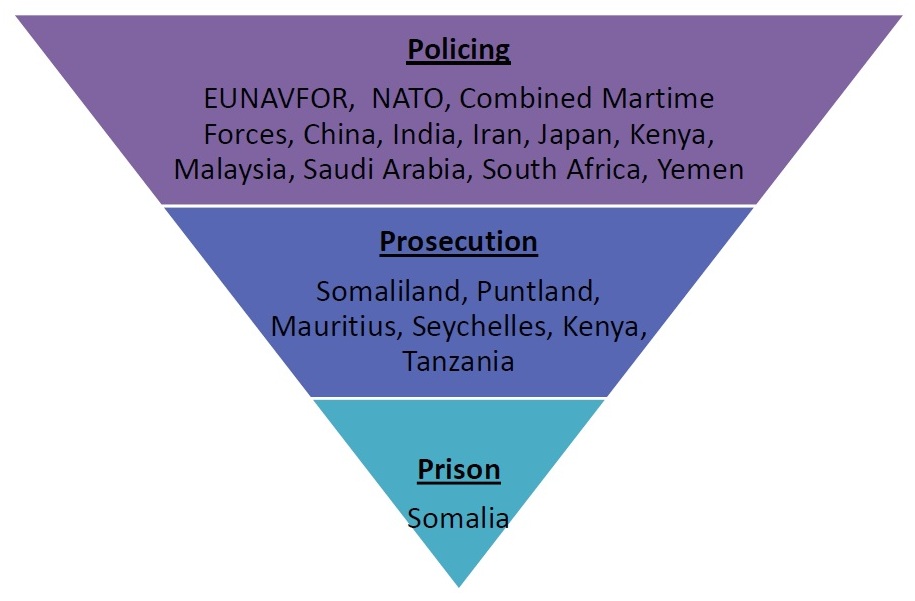
Criminal Justice for pirates has become a truly global affair, utilizing diverse state resources to funnel pirates through a limited number of regional states in East Africa back to their homeland of Somalia. More specifically, the UN’s preferred option for prosecuting Somali pirates will be national prosecutions in several East African states (Seychelles, Mauritius, Kenya, Tanzania) as well as in several semi-autonomous regions of Somalia (Somaliland, Puntland).  Prosecution in European states and the US would remain a backup plan. But this is only one piece of the criminal justice apparatus. Police functions in the Indian Ocean will continue to be performed by a combination of naval coalitions such as NATO and EUNAVFOR and by individual naval states with interests in commercial shipping through the high-risk piracy corridor (including the motley crew of the U.S., India, China, Iran, and others).  At the other end of the criminal justice chain is the prison system where there is currently a bottleneck.  In this regard, the United Nations Office of Drugs and Crime is in the process of refurbishing and building new prisons in Somaliland and Puntland to house convicted pirates.

This solution has several benefits as compared with the other solutions outlined by Jack Lang in January 2011. Prosecuting pirates in multiple regional states creates redundancies, so that if one or more courts prove incapable of continuing prosecutions, other options remain available. For example, Kenya recently stopped all of its piracy prosecutions due to a High Court decision ruling Kenyan courts did not have jurisdiction over piracy offences. Likewise, the Seychelles recently refused to accept pirates from a Danish ship because there was no guarantee that the pirates, if convicted, could be sent back to Somalia (for lack of prison space) and because the Seychelles’ limited judicial capacity. In situations such as these, other states might serve as back-up solutions so that prosecutions could be directed elsewhere.

Funneling Pirates Back to Somalia

Another advantage of this proposed solution is that it has the benefit of building local capacity. Instead of directing resources into a foreign institution, providing support to local courts and local prosecutors promises to increase the capacity of regional state institutions to address criminal justice issues beyond piracy.

The report also raises hopes that the financiers and organizers of piracy can be adequately addressed by East African states. In relation to Mauritius and Seychelles in particular, the report highlights the capacity of these states to prosecute inchoate crimes such as conspiracy, incitement and attempts to commit piracy. The UK and the Netherlands are funding a Regional Anti-Piracy Prosecutions Intelligence Co-ordination Centre (RAPPICC) in Seychelles, in part, for this purpose. This capability will be crucial in order to bring to justice those individuals who organize pirate enterprises, but never step foot on board a pirate vessel.

There will be heavy reliance on prisons in Puntland and Somaliland

However, the report and the plan are lacking in several respects.  First, the cost savings of this plan have likely been exaggerated. There is no final accounting provided in the UNSG report. But a cursory survey of the various costs associated with refurbishing courtrooms, providing expert assistance, hiring additional judges and prosecutors, conducting trainings and, especially building prisons, shows a quickly rising price tag. Combine this with additional unspecified costs that would likely accompany this proposal such as rule of law, general training, and governance projects and the costs may actually be about the same as a hybrid tribunal such as the Special Court for Sierra Leone or the Extraordinary Chambers in the Courts of Cambodia (about $40 million each annually). In any event, the proposed solution’s budget is modest compared with the sums that are currently being dumped into unsustainable solutions that fail to address the root of the problem.

In addition, the UNSG report apparently hazards some guesses as to the potential of its proposed course of action. Despite the different conditions in each country or region, the report indicates that Somaliland, Puntland, Kenya, and Mauritius will be capable of performing piracy investigations in 20 months and within two years would be able to prosecute 24 cases of 10 defendants each. These are good benchmarks to evaluate the success of these projects.  But it is hard to believe that they are realistic assessments of local conditions. The report evaluates the local capacities of each state/region indicating the number of prosecutors and judges in each. But it fails to compare these numbers of professionals to the actual populations that they must serve. Three hundred and five (305) Prosecutors in Tanzania seems to be a significant number compared to the 36 prosecutors for the whole of Somaliland. However, Tanzania’s population is 43.5 million and the population in Somaliland appears to be around 3.5 million. Therefore, the number of prosecutors per capita in Somaliland (1/10,000) is higher than in Tanzania (1/140,000). In addition, only 10 Tanzanian prosecutors would be in charge of piracy prosecutions. Likewise, the report fails to take into consideration the caseload of the respective prosecutorial groups that would be responsible for piracy prosecutions (i.e. the number of cases each attorney is responsible for, thereby dictating how much time they would have to devote to piracy cases). This suggests the projected capacities are not based upon a realistic assessment of current capacity.

More importantly, the report acknowledges that it was unable to predict with any accuracy the number of piracy cases that would likely proceed to trial. That is, how much prosecutorial and penal resources will likely be required in the next few years.  Due to the volatility of Somalia, the changing tactics of pirates and of commercial vessels responding with various self-defence measures, an accurate assessment in this regard is quite difficult. However, the report suggests that anticipating the numbers of piracy suspects likely to be apprehended at sea and transferred to regional states for prosecution was not possible because no information was available as to the reasons for the release of piracy suspects from the numerous states conducting naval anti-piracy missions in the Indian Ocean.  It is unclear why the UNSG was unable to obtain this information from various member states of the United Nations. But it has certainly left a conspicuous gap in the report’s findings.

Finally, the report ends without any recommendations as to how to prevent recidivism, including programs to retrain Somali prisoners and integrate them back into the community. In this regard, the proposed solution is short-sighted, enabling the relocation of pirates back to Somalia, but providing no real long-term preventative measures. The only permanent solution to piracy is a stable and economically prosperous Somalia. Hopefully, the London Conference can initiate positive reforms in this regard as it is widely accepted that the solution or piracy resides on land, and not at sea.