Prosecution seeks death penalty for Felony Murder

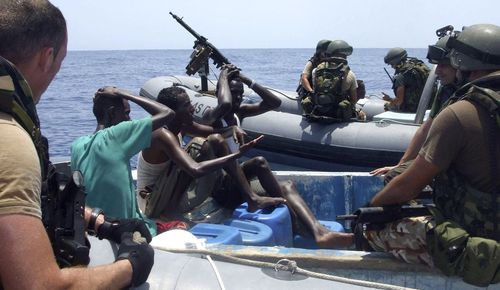
Ahmed Muse Salad, Abukar Osman Beyle and Shani Nurani Shiekh Abrar entered their pleas to murder and other charges in U.S. District Court in Norfolk, July 20, 2011. (Credit: AP)

It was recently announced that federal prosecutors in the U.S. intend to seek the death penalty against three Somalis if they are convicted of murder in the fatal shooting of four Americans which occurred aboard a hijacked yacht during a failed rescue attempt last year. Of the other Somalis implicated in the incident: one was released by authorities because he is a juvenile; eleven have pleaded guilty to piracy and been sentenced to life in prison; and the ransom negotiator’s piracy conviction is on appeal.  Furthermore, the AP reports that four of the hijackers died on board, including two who have been identified in court records as those who shot at the Americans. This last assertion is based on the charging documents before a judge or jury has established the actual facts of the case. But, if these facts are borne out at trial, the three Somalis who remain to be prosecuted, and for whom the Federal prosecutors are seeking the death penalty did not commit premeditated murder.

Somali pirates do not take hostages with the intent of killing them; that is bad for business. They intend to hold the hostages for ransom. Of course, the pirates who pointed guns at the American hostages and killed them evidently changed their plans upon the imminent boarding of the yacht by U.S. Navy SEALS (and were killed themselves). But it is not clear that that those charged in this last case intended to kill the hostages. Some of them claim to have attempted to stop the killings. This is supported in part by the Prosecutor’s charging documents which indicate the deaths occurred in the commission or immediate flight from the offenses of kidnapping, hostage taking and violence against maritime navigation. Therefore, the basis for seeking the death penalty on the murder charges in this case appears to be the felony murder rule, whereby a killing that occurs in the course of a dangerous felony, even an accidental death, can be charged as first-degree murder. If the three pirates at issue here were fleeing the scene when two other pirates killed the hostages, is the death penalty a just sentence?

This issue is further highlighted by a discrepancy in the way the US Attorney is charging the eleven pirates who pleaded guilty and the three for whom the death penalty is sought.  By accepting pleas for life imprisonment for the former, the US Attorney has indicated that the death penalty is not forcibly necessary to serve the interests of justice in this case. It may be that there are facts that support a harsher sentence for the latter three. It may also be that the three refused to enter a plea agreement, so the US Attorney is wielding a stiffer penalty as leverage. But the question remains, is the death penalty an appropriate penalty for felony murder?

One final incongruity is the fact that the Prosecutor is not seeking the death penalty on the charge of piracy. From 1790, the crime of piracy pursuant to U.S. statutory law imposed a mandatory death penalty. The death penalty was replaced by “imprisonment at hard labor for life” in 1897, and then “imprisonment for life” in 1909. Therefore, the death penalty is no longer available for the crime of piracy under 18 U.S.C. 1651. The fact that Congress amended the statute to eliminate the death penalty indicates Congress’ view that the death penalty is not an appropriate punishment for piracy. If the principle crime at issue here is piracy, and Congress intended that no person be put to death for the crime of piracy, should that penalty still be available if the crime is charged as hostage taking or violence against maritime navigation resulting in death? Of course, a jury will have to decide whether the aggravating factors have been proven to justify a sentence of death.  But I really am curious as to what you all think on these issues.

Adrift for two months, Somalis to stand trial in Seychelles

The U.S. has finally found a state willing to prosecute 15 pirates captured aboard an Iranian mothership in January 2012. As we noted at the time, there was no convenient location for prosecution. The U.S. had a legal basis to prosecute, but the cost of transferring the Somalis to the U.S. coupled with the risk that some would claim asylum was a deterrent. Iran was not likely to be the prosecuting nation. Although it may have a legal basis in its own domestic legislation to prosecute the pirates, the U.S. might have doubts that the pirates would receive a fair trial there. Further, it would be a public relations coup for Iran if it took possession and prosecuted the pirates. Finally, Somalia still has significant hurdles to overcome before it will be ready to administer fair piracy trials, be it in Somaliland, Puntland, or elsewhere.

Today the nytimes notes:

Fifteen Somali men accused of being pirates, who were captured aboard a hijacked Iranian fishing vessel by the United States Navy in January, were transferred on Tuesday to the Seychelles for trial.

The move from Djibouti to the Seychelles, an island nation in the Indian Ocean, was a welcome development for the United States in a high-profile case that had no clear legal resolution.

It also signaled the end of an intensive interagency effort to find a jurisdiction willing to receive the suspects, who had been held aboard a series of American warships for almost two months.

From its outset, the case, for all its high-seas drama, underscored the difficulties in developing effective and comprehensive programs to fight piracy. Capturing pirates, once international navies applied themselves to the task, has proved easier than bringing them to justice.

None of the nations most directly involved in the case — Somalia, home of the suspects; Iran, home of 13 hostages seized in the case; or the United States, which detained the Somalis — had either the capacity or desire to take on the costs and difficulties of prosecuting the suspects.

And the Seychelles, which in recent years has been a regional hub for hearing piracy cases, had no space in its tiny prison system for more convicts, American officials said.

Nonetheless, the recent transfer of several convicted pirates from Seychelles to Somaliland based upon a bilateral transfer agreement, freed up space in Seychelles to hold these defendants in jail and prosecute them. The U.S. Navy must be breathing a sigh of relief as considerable resources were occupied with maintaining the pirates on board:

A senior Navy officer expressed satisfaction at the Seychelles’ decision, which ended weeks of transferring the suspects among vessels at sea. The pirates, he said, first captured by the Kidd, a destroyer, had been held aboard three nuclear aircraft carriers, another destroyer and an amphibious warship before being brought ashore in Djibouti on Tuesday for a flight aboard an American military C-130 transport plane to the Seychelles.

Following on the London conference, a number of prisoner-transfer agreements were signed by East African states where prosecutions will most often occur and either Somaliland or Puntland, where UNODC is supporting the construction of new prisons. Until these new prisons are built, there will continue to be a bottleneck and could lead to a repeat of this incident where Somalis remain in military custody. This also raises some fair trial concerns. Insofar as it was not clear where they would be prosecuted, the Somalis could not very well have been charged with any offence during their two months in captivity. Piracy would have been the charge, but under which state’s legal system? Moreover, there remain questions as to how the prosecution will obtain eyewitness testimony. As we mentioned before, the Iranian hostages may not be at liberty to provide such testimony in order to support piracy charges for the hijacking of their fishing dhow. In addition, the nytimes notes that two of the pirates claim to be minors. All of that said, a solution has been found to the most pressing issue: where to prosecute. Other issues will remain for another day.

UK House of Commons Issues Piracy Report, Eyes Private Security Guards on Board, Local Prosecutions in East Africa (Part II)

This is the second part of an earlier post discussing the UK Foreign Affairs Committee Report on piracy off the coast of Somalia.

Regional and Local Prosecutions of Pirates (paras 74-110)

The trial and prosecution of pirates is also an extremely relevant, and pressing, topic. As noted in the Report, the peculiar features of modern day piracy, particularly in the Gulf of Aden and the lack of cohesive governance in Somalia, create several practical difficulties, including the apprehension, detention on board and transfer of suspected pirates. One of the primary purposes of policing activities through naval operations is, indeed, its deterrent effect on pirate attacks rather than the arrest and prosecution of the perpetrators.

The collection of sufficient evidence to secure successful prosecutions is particularly problematic, as we noted in a recent post. It should be remarked how any evidentiary assessment on whether to bring alleged perpetrators to justice should, ordinarily, be best placed in the hands of judicial authorities as neutral fact-finders rather than subject to the prelimary evaluation by the naval authorities upon the capture of suspected pirates. Moreover, the Report correctly points out how such assessment could benefit from modern technological means already available to the naval authorities, namely video, radar and satellite recording. In addition, remote testimony via video or audio link is recommended, particularly when victims are located in third countries or, more likely, have already set sail.

Modern international law asserts the possibility to exercise universal jurisdiction over piracy prosecutions. However, as one expert who gave evidence before the Committee put it, the obstacle to prosecution is not identifying the appropriate jurisdiction, but rather the inability, and unwillingness, to prosecute. In addition, the surge of modern piracy and armed robbery at sea has exposed the current inadequacy of national laws, including in the UK, against piracy. For those operating within the field of international criminal prosecutions, the phenomenon is not new. Several states suddenly found themselves incapable to put Genocide suspects on trial before municipal courts due to the inadequacy of their national laws in enacting the provisions of the Genocide Convention.

We have also discussed whether the response to modern piracy should contemplate a revision of the existing international counter-piracy legislation and mechanisms, in particular because it appears that current treaties have difficulty in addressing the difference between political and purely-financial motivations of pirates attacks, or whether attempted attacks are also punishable. Interestingly, as noted in the Report, the IMO has taken the view that “the development of a new multilateral instrument might be premature, or unnecessary, in light of the existing international legal framework on piracy, which was generally considered to be adequate”. Some concerns remain, however, particularly on the practical implementation and effectiveness of these mechanisms.

The main recommendation contained in the Report with regard to options for the investigation and prosecution of pirates is therefore the rejection of the establishment of a specialized Somali tribunal, initially recommended by the UN Special Adviser to the Secretary General Jack Lang as one possible alternative. This option would have established a court outside of Somalia in a neighboring state (most likely Tanzania) with funding and administration from the international community, but would employ Somali judges applying Somali law. There appear to be a number of compelling legal complications against such court, including its legality vis a vis the Somali Constitution. The UK Report rejected this proposal stating:

 “the Government was right to oppose the establishment of an extra-territorial Somali court as proposed in the Jack Lang report to try Somali pirates in a third country. We recommend that the Government set out in its response to this report its views on the more recent proposals for specialised anti-piracy courts established within regional states under ordinary national law.”(para. 92)

Among the main arguments in support of this conclusion are also the possible high costs of an extra-territorial institution, with a tentative figure of $100 million a year. This is not convincing, particularly considering the lack of clarity at the basis of this figure as well as the present estimates of the global costs of piracy, which already identified high costs from the current prosecutions as well as a cost of ransoms alone capping over $130 million per year. In addition, this figure would remain a fraction of the overall economic costs of piracy. It must be acknowledged, however, that an extra-territorial court, financially supported by international organizations, might not be able to promptly contribute as an anti-piracy deterrent and develop effective outreach capabilities within the turned-pirate population in and around the Gulf of Aden.

The rejection of the UN-funded option reflects a gaining trend to favor specialized piracy prosecutions within the area where the alleged attacks took place, counting on a much stronger deterred effect than trials taking place thousands of miles away. Local prosecution projects have already taken shape in Kenya, Mauritius and Seychelles, among other countries in the region. In addition, a small number of historic trials were also held in the US, Germany and the Netherlands, mainly because the alleged pirates were captured by the naval forces of these countries, or due to a nexus between the piracy acts and these latter.

However, while piracy prosecutions in the UK are still contemplated, albeit in limited circumstances, in the Report, the support expressed therein for local or regional anti-piracy courts also present several difficulties which should be carefully weighed. Requesting the help of regional states to prosecute pirates in their courts does not obviate the need to provide support to the various local authorities in the form of financing, training, monitoring and oversight extending not only to the mere prosecutions and trials of suspected pirates, but also to transfer, investigation, security, procurement and infrastructures as well as pre-trial and post sentence detention. Indeed, the fate of a recently arrested group of alleged Somali pirates by the UK Royal Navy after both Kenya and the Seychelles have refused to detain them because “their court systems are swamped”  is a rather timely reminder of some of these difficulties. As the Kenyan government stated last year when it refused to continue piracy prosecutions, ““We discharged our international obligation. Others shied away from doing so. And we cannot bear the burden of the international responsibility.”

Iran’s Piracy Problem

If you haven’t heard by now, the American Navy has rescued a group of Iranian fishermen whose boat had been hijacked by Somali pirates. The pirates used the fishing dhow al Molai as a mother ship to stage attacks on other higher-value targets. Iran’s Foreign Ministry was initially silent, but has since commended the American rescue as a humanitarian gesture.

U.S. Navy Sailor greets crew member of the Iranian-flagged fishing dhow Al Molai

For the moment, the rescue is a public relations coup for the United States as tensions escalate over strengthened economic sanctions against Iran and competing shows of naval force through the Strait of Hormuz, the only waterway connecting Persian Gulf oil resources with Asia and the West. This incident is an embarrassment to Iran and highlights the indiscriminating nature of Somali piracy.

Just like other sea-faring nations, Iran has struggled to combat piracy off the coast of Somalia. There are currently about 14 ships and 254 hostages in the hands of Somali Pirates. Although EUNAVFOR estimates 7 ships and 194 hostages, not including dhows and smaller vessels. Most non-officer seafarers come from developing countries and particularly, the Philippines, India, and increasingly China.  Therefore, these countries have the highest proportion of hostages being held. However, Iran has also suffered with 10 Iranians taken hostage aboard the Sinan in 2011 and another 45 taken hostage in 2008 and 2009.

Likewise, some of its ships have been targeted, with al Molai the most obvious example, but also including the Delight and the Iran Deyanat, not to mention other vessels with Iran as a destination.

In response to these attacks, Iran has sent naval vessels to the Gulf of Aden to protect Iranian ships from pirates.  It appears to be maintaining two destroyers on mission in the Gulf of Aden, although increasing tensions in the Strait of Hormuz may require Iran’s navy to reallocate resources.  See also here. It is unclear to what extent Iranian war ships have interacted or cooperated with other navies while on mission in the Gulf of Aden and Indian Ocean. However, Iran participates in the 19-member grouping of the Indian Ocean RIM – Association for Regional Cooperation (IOR-ARC) which also includes India, Yemen, Australia, Bangladesh, Indonesia, Kenya, Madagascar, Malaysia, Mauritius, Mozambique, Oman, Singapore, South Africa, Sri Lanka, Tanzania, Thailand, the UAE and Seychelles. The IOR-ARC issued the Bangalore Declaration last November, agreeing to share information, experiences and best practices in the fight against maritime piracy.

Although a momentary boost to the United States, this incident will be quickly overshadowed by the tension in the Strait of Hormuz. As tensions between the United States and other countries (to the extent that they are also imposing economic sanctions on Iran) continue to increase, any naval interaction with Iran will be potentially risky.  Iran’s presence in the Gulf of Aden is no exception. However, with EUNAVFOR, NATO, and the United States-led international naval coalition of 25 nations all operating in the area, Iran is vastly outnumbered in that area and will be reticent to engage offensively there.

It is also worth noting that Iranian’s most valuable asset, its oil tankers, are not seriously at risk to Somali pirates. Transit through the Gulf of Aden, when tankers are most susceptible to attack by Somali pirates, is only necessary to transport oil to Western countries. Although 18 percent of Iran’s crude oil exports went to the EU in the first 6 months of 2011, that percentage will likely drop considerably as a result of new economic sanctions. The remainder of Iran’s exports go to Asia, notably Japan, India, China and South Korea which do not transit the areas most susceptible to pirate attacks. Al Molai fishing dhow was attacked much closer to Iran, but attacks in that region are exceptional.

But what of these particular Somalis?  Will they be prosecuted and where? After the incident, the pirates were in American custody. The New York Times reports that the rescue occurred 210 miles off the coast of Iran, presumably in international waters.  If that is the case, the United States as the seizing nation, has jurisdiction to prosecute, decide on penalties, and determine the action to be taken with regard to ships or property “subject to the rights of third parties acting in good faith.” (Article 105, UNCLOS). Iran, as a third party whose nationals were victims of the attacks, also has an interest in prosecuting the pirates. In this case, it is likely that Iran will defer to the U.S. to prosecute the pirates.

There are also some problems of proof, as the pirates apparently threw their arms overboard and claimed to be joy-riding on the seas. Therefore, prosecution will be based upon video and testimony obtained by the navy helicopters and ships that performed surveillance on the ship and the testimony of the victims.

The problem of prosecuting in United States courts is that testimony must be in person due to the confrontation clause (and the U.S. Supreme Court decision in Crawford). This is where U.S. prosecution presents significant hurdles as U.S. servicemen may not be available to testify in court and it is unclear whether video-link testimony would be constitutionally permissible. In the case of the Iranian victims, there are even more serious practical concerns, as they would have to be given permission by the Iranian government to travel to the US to testify. For these Iranians there may be a temptation to seek asylum while in the U.S. just as witnesses at the ICC have done after reaching the Hague from Africa, notably from the DRC and the CAR.

Hypothetically, the pirates could be prosecuted in Iran. Iran is a signatory to UNCLOS without any reservations as to the definition of piracy contained therein. However, Iran has not ratified the Convention and it is unclear whether Iran has particular legislation that criminalizes piracy directly. Insofar as Islamic law applies in Iran, Islam considers piracy to be forbidden and may be punishable by death.  In a related context, the Iranian Foreign Ministry has called Israel’s attack of an humanitarian aid flotilla to the Gaza strip to recall, “acts of sea piracy in the past centuries, which are clear example of maritime terrorism.”  In 2009, Iran also acceded to the UN Convention for the Suppression of Unlawful Acts Against the Safety of Maritime Navigation (SUA Convention) which defines maritime terrorism (the U.S. is also a state party). If Iran and Somalia were to request extradition of the pirates to Iran, the SUA convention requires the U.S. to pay due regard to Iran’s rights as the flag state of the victim ship(s). (Article 11(5) of SUA). Nonetheless, the U.S. would likely consider it difficult for the pirates to receive a fair trial in Iran and could deny extradition to Iran on that basis. (Article 11(6) of SUA Convention).

A more practical solution would be to identify the home community of the pirates in Somalia, be it Puntland, Galmadug, or Somaliland, etc. for prosecution in their home jurisdiction. The UN Office for Drugs and Crime has established programs to strengthen the prosecutorial capacity of some of these regions. However, there continue to be concerns of corruption and judge-intimidation that undermine confidence of a just outcome in these judicial systems. Likewise, the penalties imposed for piracy may be significantly less than in the U.S. where life-imprisonment has been the norm for recent prosecutions of Somali pirates.

Some difficult decisions will have to be made by the American authorities in this regard. Although policy will likely have been made with regard to which pirates to transfer to other authorities and which to prosecute state-side, the enhanced exposure of this particular case might require a re-examination of this calculus.

At the end of the day, piracy is perhaps the only area where the U.S. and Iran share common interests. For both countries, prosecution of pirates remains a problem without any easy solutions.

UPDATE: I just found a summary Iran submitted to the UN of Iranian law applicable to maritime piracy.  The summary asserts that piracy is punishable by a sentence of 3 to 15 years imprisonment. It also states, “It should be mentioned that “moharebeh” in accordance with “Sharia Law” is resorting to arms in order to frighten people; and “mohareb” [which includes pirates] is a person convicted of “moharebeh”.  The punishmen (sic) of “moharebeh” is “exile” or “death penalty”.” The summary does not state to what extent Shariah law is applied in Iran.

Pirate Victim Turned Pirate


The M/V Quest

Of the fourteen pirates indicted for the hijacking of the M/V Quest, a 58 foot yacht, and killing its occupants, four Americans on an around the world adventure, one of the pirates was not of Somali origin. Mounir Ali, 23, is a Yemeni national who was a fisherman who was himself captured by pirates.  According to a press statement from US Attorney responsible for his prosecution:

This defendant, the sole Yemeni, was part of the crew of another boat that was hijacked by a separate group of pirates some months earlier. The defendant had been taken on at least two piracy outings in his captured ship. On the second outing, the defendant was with other pirates when the Yemeni fishing boat, used as a mothership for the Quest hijacking, was captured.  The defendant transferred to the Yemeni fishing boat and then chose to go with the pirates when they located the Quest in exchange for a share of the ransom.

Mr. Ali argued that he only joined the pirates because he had no other choice. His boat was hijacked and he was promised that it would be returned if he joined in this raid. As I have previously remarked, this type of defence was common during another era of piracy. As noted here, during the 18th century, Caribbean pirates cleverly avoided conviction in British prosecutions based on a defence of impressment or duress:

Voluntary complicity with a pirate crew was important to establishing guilt. Pirates exploited this loophole by pretending to conscript seamen who joined their ranks voluntarily. Since pirates did genuinely compel some seamen to join their companies, court officials considered the impressment defense plausible.

In Mr. Ali’s case, he pleaded guilty in order to avoid the death penalty. The Judge, apparently unmoved by Mr. Ali’s claims of duress, sentenced him to life in prison.

But the defence can be successful in the right circumstances. Larger fishing vessels are regularly hi-jacked and the occupants conscripted to support piracy operations. In a recent example, the UK Navy considered the seafarers of a fishing vessel to be unworthy of prosecution even though the vessel had been used in several recent pirate attacks. They let 20 Pakistani crew go, while turning over four Somalis  to Italian authorities on suspicion of involvement in the recent attack on the Italian vessel MV Montecristo. Duress is also recognized by Article 31 of the Rome Statute which excludes criminal responsibility if:

The conduct which is alleged to constitute a crime within the jurisdiction of the Court has been caused by duress resulting from a threat of imminent death or of continuing or imminent serious bodily harm against that person or another person, and the person acts necessarily and reasonably to avoid this threat, provided that the person does not intend to cause a greater harm than the one sought to be avoided.

Duress will continue to be a common defence in future piracy trials and determining its applicability will pose a challenge to any court addressing the issue.