ReCAAP and the Anti-Piracy Information-Sharing System in Asia

Furthering its current efforts to enhance international cooperation to tackle piracy, the United Kingdom recently became the 18th party to the Regional Cooperation Agreement on Combating Piracy and Armed Robbery against Ships in Asia, commonly referred to as ReCAAP.

Entered into force in September 2006, ReCAAP is the first regional agreement for the promotion and the enforcement of multilateral cooperation against piracy and armed robbery at sea in Asia. Among its original contracting parties are South and East Asian countries. Since its entry into force, ReCAAP is also open for accession by other countries. Like the U.K., other global shipping countries with an interest in Asian maritime economy, such as Norway and the Netherlands, are also parties. Pursuant to its Article 1, ReCAAP adopts the same definition of piracy set forth in UNCLOS as well as the IMO definition of armed robbery at sea. However, ReCAAP does not provide for enforcement powers beyond those already provided in UNCLOS. Many of the lessons learned from the implementation of ReCAAP were incorporated in the Djibouti Code of Conduct, which provides a framework for information sharing, training and capacity building in the Gulf of Aden.

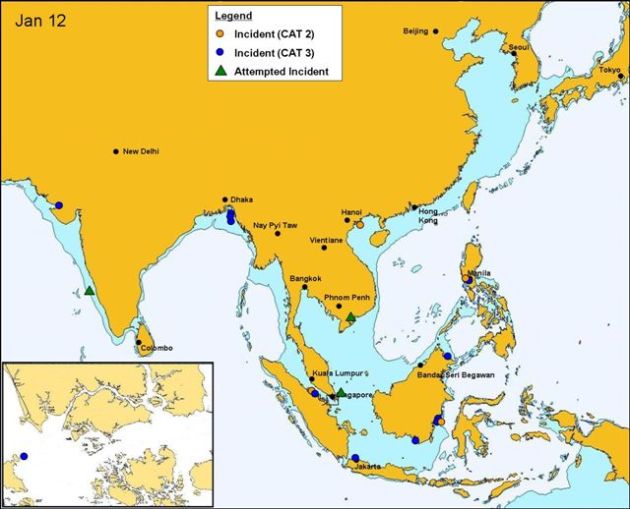
Notably, ReCAAP established an Information Sharing Centre (ReCAAP ISC), which is now a recognized international organization, headquartered in Singapore. ReCAAP ISC’s main functions include facilitating communication and piracy-related information-sharing among the contracting parties as well as furthering capacity building with other organizations and the shipping industry to develop and improve anti-piracy measures. As part of its mandate, ReCAAP ISC produces periodic consolidated incident reports and alerts on piracy and armed robberies at sea in the Asia region. Incidents are classified under 4 different gravity levels, measuring violence and economic impact.

 Map of ReCAAP Consolidated Incident Report for January 2012

Once piracy hot-spots, the straits of Malacca and Singapore as well as the South-China Sea more recently registered a significant drop in piracy related incidents. Due to improved surveillance and security presence, reported incidents now mainly consist of armed robberies or petty thefts at ports and anchorages, particularly in Indonesia.

The Economic Cost of Piracy – Oceans Beyond Piracy Report 2011

The economic cost of piracy has joined the already substantial political and security concerns of such operations, as an issue requiring further research and consideration by the relevant stakeholders. In this vein, the Colorado-based One Earth Future Foundation, which studies the effects of piracy through the Oceans Beyond Piracy project, has released its 2011 working paper on The Economic Cost of Somali Piracy. In order to ensure reliability, the report builds on dialogue and feedback from Oceans Beyond Piracy’s 2010 assessment of the cost of piracy with data obtained through collaboration with maritime stakeholders from industry, government and civil society, in addition to commentators and experts in the field. As the second report of its kind, the paper aspires to flag pertinent concerns for the Oceans Beyond Piracy Working Group, which will release recommendations for a more coordinated, and comprehensive strategy against piracy in July 2012.

In highlighting its concerns about the economic cost of Somali piracy to relevant stakeholders and the wider community, the report estimates the 2011 economic cost of piracy to be $6.6 – $6.9 billion US dollars. The majority of which is spent in mitigation of piracy attacks rather than in ransoms, as is most commonly believed and also portrayed by the media. The report only calculates direct costs, as indirect figures were too difficult for the research to quantify and in doing so assesses nine different cost factors specifically focused on the economic impact of Somali piracy. Namely: increased speeds, military costs, security guards and equipment, re-routing, insurance, labour, ransoms, prosecutions and imprisonment and counter-piracy organisations. The report subsequently found that 80% of all costs relating to countering piracy attacks are covered by the shipping industry, while governments finance the remaining 20% of the expenditures. The approximately $7 billion figure for 2011, is down from the $7 – $12 billion that was estimated in the 2010 report. While the 2010 estimate was higher, the 2011 report is said to be based on more authoritative and exact information according to the author of the report Anna Bowden who explained that in reality the figures of 2010 and 2011 are likely to be similar.

Key piracy developments: overview

The report outlines what it believes to be the key piracy developments affecting the cost of piracy in 2011, where there was an increase in attacks by Somali pirates, particularly in the first quarter. There was a record of 237 piracy attacks, rising from the 212 in 2010. However the proportion of successful attacks fell, with only 28 of the vessels actually captured, in comparison to the 44 in 2010. This is most likely due to the use of private armed guards on vessels and naval operations that have become more familiar dealing with piracy issues. The report recognised that 99% of the $7 billion was spent on yearly recurring costs associated with the protection of vessels including $2.7 billion in fuel costs, $1.3 billion for military operations and $1.1 billion for security equipment and armed guards.

In other observations, shipping behaviour altered whereby shippers increased payments necessary to harden vessels, hire private security and increase speed in high risk areas. Further, the geographic expansion of pirate activities increased eastwards towards India, and northeast towards the Gulf of Oman and Strait of Hormuz. New trends in piracy mitigation included the rerouting of ships so that they transited close to the western Indian coastline rather than the Cape of Good Hope. As will be discussed below, only $16.4 million was spent on prosecutions and $160 million was collected by pirates in the form of ransoms, which is only 2% of the overall economic expenditure. These figures represent a disproportionately small contribution to the economic cost of piracy compared to the $7 billion spent in order to stop the attacks.

Further key developments surrounded ransoms, which increased from $4 – $5 million, as did the duration that ships were held hostage during negotiations. Meanwhile, the human cost in the loss of lives cannot be adequately quantified, but notably increased from eight in 2009 to 24 in 2011, despite the significant economic effort to avoid the attacks. 2011 evidenced an increase in seafarer deaths, in addition to specific incidents highlighted in the media where groups of pirates were accused of kidnapping tourists and humanitarian workers on land in Somalia and Kenya. This resulted in a more aggressive response from military forces conducting counter-piracy missions in the region while pirates changed their primary operations from large vessels to smaller fishing boats.

Piracy and prosecutions

An issue of particular interest is the comparatively low cost of prosecutions, imprisonment and local legal capacity building, which at $16.4 million is a relatively small proportion of the $7 billion overall economic cost of piracy. This figure is an estimate of the cost of trials and imprisonment in the four selected regions of Africa, Europe, North America and Asia. The report highlights that in attempting to find a legal resolution to the issue of piracy, in October 2011, the United Nations Security Council called on UN member states to criminalise piracy, asking member states to report to the Secretary General on the measures they have taken to criminalise piracy.

Certain countries such as the United States and Oman have sentenced pirates to life imprisonment, with South Korea sentencing one pirate to death for murder. In estimating the cost of prosecutions in 2011, the report calculated the average cost of pirate trials that were conducted, in addition to the cost of imprisonment for suspected Somali pirates during the year, accordance with economic development and prosecutorial costs. The cost of trials and imprisonment in Kenya and the Seychelles were not included, due to the fact that the relevant costs for these prosecutions are covered by funding from the UNODC Counter Piracy Programme and other international funding mechanisms.

According to a report released in 2011 by Jack Lang, the United Nations Secretary General’s Special Adviser on Legal Issues Relating to Piracy off the Coast of Somalia, more than 90 per cent of captured pirates will be released without prosecution. The report notes that over the previous few years 1,089 pirate suspects had been arrested for piracy and those individuals have either been tried or are awaiting trial in 20 countries, a figure which has risen from 10 countries in 2010. Lang therefore proposed a specialised extraterritorial Somali court system with its seat in Arusha, Tanzania based on an estimated cost of $2.73 and $2.33 for each following year.

In consideration of this, and as already discussed in this blog, criticisms as to the resources needed for a fully internationalised piracy tribunal, that may cost up to an estimated $100 million, are short sighted against the report’s figure of $7 billion for the overall cost of piracy. In an earlier post by Matteo Crippa, we indicated that the most relevant issue in evaluating the effectiveness of international prosecution was its real deterrent effect. In comparison to an overall figure of $7 billion, $100 million for an international tribunal, however costly in isolation is comparatively low. These disparate figures might also justify a substantial increase in funding for the current localised prosecutorial initiatives, which are similarly capable of meeting effective deterred goals. Whatever solution is chosen, it is clear that prosecutions have not been prioritised as a budgetary matter.

Conclusions

The 2010 Oceans Beyond Piracy report was widely referred to in piracy commentary. The updated and more accurate 2011 version has already been critiqued by various sources. When considering that protecting vessels through high insurance premiums, onboard guards and re-routing costs $7 billion in comparison to the $160 million Somali pirates receive in ransoms or the comparatively small $16.4 million spent on prosecutions and imprisonment, there is an obvious disconnect and disproportionality in dealing with this issue. There is an ever present argument that insurance companies, as well as Private Maritime Security Contractors (PMSCs), earn more from piracy than the pirates themselves, which is well supported by this report, which showed evidence that 99% of piracy costs are recurring. This means that they will be repeated every year and will only fluctuate if piracy itself reduces to the extent that it warrants a change in political and economic approaches to the problem.

The report therefore suggests that stakeholders need to reassess the long-term sustainability of the costs outlined. The fear and preventative economic investment in piracy however looks set to increase with incidents such as Somali pirates launching their first attack in territorial waters when they raised a vessel near the Gulf State of Oman. One particularly disturbing piracy trend is that pirates have begun to focus their attention on people rather than ships. There have been incidents where pirates release the ships, but keep the crew for ransom purposes. This has extended to pirates kidnapping hostages on land such as humanitarian aid workers and tourists in Kenya and Somalia.

While not quantifiable in economic terms, the human cost of piracy is higher than any economic figure given. Twenty four people were killed by pirates in 2011, but hostages were held for longer in order to negotiate higher ransoms, which the report states took an average of 178 days (or six months). Also forgotten are the deaths of the pirates themselves. Due to the economic disconnect between pirate ransoms and the overall economic cost of pirate deterrence, it is clear that a purely mitigating or preventative policy does not offer a solution to control or alleviate piracy. Neither the military nor shipping industry have been successful in stemming the problems and the more money that is invested does not seem to reduce the cost to human life. One option is to stabilise the situation on the ground in Somalia in political and economic terms. As the report notes, very little is spent on the root causes of piracy, suggesting a redirection of investments from short-term symptoms to long-term solutions.

 

The Mekong Pirates

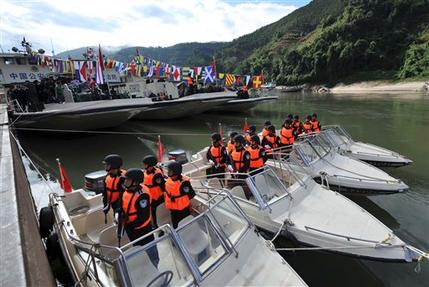
The recent murder of 13 Chinese sailors on South-East Asia’s Mekong river triggered unprecedented joint international naval patrols by China, Laos, Myanmar and Thailand to provide security along parts of the estimated 4900 Km long river.

After crossing the Tibetan plateau and leaving China’s Yunnan Province, the Mekong flows southwest and forms the border between Myanmar and Laos for about 100 kilometers. It then turns southeast to form briefly the border of Laos with Thailand, then flows east and south into Laos for some 400 kilometers and defines the Laos-Thailand border again for some 850 kilometers as it flows east. It then reaches Cambodia, providing significantly for the country’s fishing and rice farming economy. Finally the Mekong empties into the South China Sea and upon entering Vietnam, subdivides into the Mekong Delta. The Mekong flows at the hearth of the so-called “Golden Triangle”, an area overlapping the mountains of Myanmar, Vietnam, Laos, and Thailand which has long since been one of the most extensive opium and heroin-producing areas of Asia and of the world. More recently, the drug production and trade has shifted to methamphetamines.

According to initial reports, the sailors were attacked in October when sailing aboard two ships in the Golden Triangle area. Some of the sailors had been found in the river with their hands tied behind their backs, some were blindfolded and some had been shot. The ships were recovered by Thai river police after a gunfight. Some 900,000 methamphetamine tablets worth more than $3m were found aboard, hence drug smugglers were initially suspected of the attack. In response, China suspended all shipping activities on the Mekong and urged Thai authorities to arrest those responsible. Later reports suggest the involvement of 9 Thai soldiers attached to an anti-drug task force who surrendered shortly after the attack and are now facing prosecution.

While the motives of the attack appear closely linked with drug trafficking, the economic and political interests of the Mekong’s numerous riparian States give an international dimension to the incident. Seasonal variations in water flow and the presence of waterfalls have historically made navigation of the river difficult, thus dividing, rather than uniting, the people of the Mekong. In 1995, following the UN mediation, Laos, Thailand, Cambodia and Vietnam established the Mekong River Commission to assist in the management and coordinated use of the Mekong’s resources. In 1996, China and Myanmar became “dialogue partners” of the Commission and the six countries now work together within a cooperative framework. Recently, each of these countries have been notoriously engaged in lengthy discussions regarding a Chinese-sponsored hydroelectric dam construction project – currently suspended – and its overall impact on the region.

The patrols mark a significant shift in China’s long standing policy of non interference in other States internal affairs. The patrols are said to be the first instance of Chinese police being deployed outside their territory without a UN mandate. It is thus not surprising that China is taking a leading role in the operations. The patrols are headquartered in China with stations in each of the other countries. At a meeting in Beijing, ministers from all four countries agreed on the new measures. China contributed with the deployment of 200 police officers and 11 ships. The plan also involves police departments in the four countries setting up a coordination team to explore further security measures. Finally, China will also help train and equip police in Laos and Myanmar for the patrols.

It is problematic to fully assess the legal framework in which the patrols could be deemed to operate as well as their relation with anti-piracy and armed robbery efforts. Interestingly, a cursory review of the history of piracy reveals limited reported instances of so called “river piracy”, mainly consisting of fluvial criminal activities in the 18th century within the USA. However, lacking its most fundamental element, namely the occurrence of the attack in the high seas, the Mekong incident squarely falls outside the relevant provisions of the Convention on the Law of the Sea (UNCLOS) relevant to piracy. Yet again, there appears to be a situation where the current applicable specialized international legal framework is not directly applicable to contemporary criminal activities or is capable to address their underlying root causes and overall impact, particularly in areas of flourishing economic development. States (including signatories to UNCLOS) are free to adopt broader definitions of piracy applicable to internal waters. However, the current trend is to legislate the definition in Article 101 of UNCLOS. Armed robbery at sea pertains to piratical acts within the territorial sea, but criminal acts within internal waters (even if such waters have an international character) remain unaddressed. The most important upshot to the situation at hand is that the principles which could resolve competing claims of police and judicial jurisdiction over criminal activity along the Mekong are not codified.

Recourse to the current, yet scarce and developing, legal framework attaching to international rivers might therefore provide for more focused analysis. Rivers are ordinarily considered as part of a country’s internal waters. However, rivers are also often used to demarcate borders. More importantly, lengthy rivers could cross several countries, reflecting a wide range of political, geographic, economic and cultural circumstances. The Mekong, the world’s 10th longest, is one such international river. These are also referred to as shared or transboundary rivers, as well as international watercourses.

Riparian states, namely states through which a transboundary river flows or form part of its borders, developed riparian rights and obligations normally confined over the use of the river for livelihood or sustainability purposes. Riparian States traditionally resorted to specific watercourse agreements or treaties to regulate the use of a shared river. Much of these rights and obligations are defined by the UN Convention of Non-Navigational Use of International Watercourses, which has yet to enter into force. Among its key guiding principles, contained in Articles 5 and 7, are the “equitable and reasonable utilization” and the obligation “not to cause significant harm” to other riparian states.

Literature on sharing international rivers define these as both catalyst for cooperation or conflict but also points to several important benefits from a structured cooperation among riparian states, including environmental, direct economic, political, and indirect economic benefits. Instances of state cooperation, however, seldom refer directly to issues relevant to the security of the watercourses, with the exception of risks deriving from pollution or excessive exploitation. Notably, Articles 7 and 8 of the UN Watercourses Convention requires States to “take all appropriate measures” to prevent or mitigate significant harm to other States as well as a general obligation to cooperate among riparian states.

Control of international rivers is inextricably linked with economic opportunity, national security, society and culture. It is within this general framework that the agreed cooperation over patrolling the Mekong and ensuring the safety of its navigation, in essence an international basin or watercourse agreement, should be seen. Such cooperation could cut individual States security costs and further their overall benefits from the use of the river, addressing issues of policing, extradition and prosecution as well as solidifying channels of communication between riparian states to address a potentially volatile situation. In other words, better security over the river will promote unity and integration among the riparian States and more possibility for each of them to manage the development and use of the river.

From the Gulf of Aden Back to the Gulf of Guinea: Piracy Reports in West Africa on the Rise

Dear Readers, Let me introduce you to today’s guest blogger, Matteo Crippa. Mr. Crippa has substantial experience in West Africa and in international criminal law, having served as a legal officer at the Special Court for Sierra Leone from its inception. He brings a fresh perspective and insight to today’s topic. I would like to express my appreciation for his contribution and hope that it is the first of many to come.

The UN Security Council recently expressed concerns over reports of increased piracy, armed robbery and hostage taking in the Gulf of Guinea and their adverse impact on security and economic activities in West Africa. It is calling for the UN Offices for West and Central Africa to work with the UN Office on Drugs and Crime and the International Maritime Organization, all concerned countries and regional organizations. The UN Secretary General further indicated its intention to deploy an assessment mission to explore possible options for UN support.

While today’s counter-piracy attention shifted to the Gulf of Aden, with more than half the global piracy attacks being ascribed to Somali pirates, the Gulf of Guinea has long been a high risk area. With the increase of maritime commercial traffic, discovery of oil off the coasts of countries other than Nigeria, installation of additional offshore extracting infrastructure and on-going instability in various coastal areas, acts of piracy are on the rise. In 2009, the number of attacks fell short of those in the South-East Asia region. But, there are an increasing number of attacks in Togo, Nigeria and Benin.

Albeit sharing similar criminal goals and root causes, the nature of the attacks appears to differ with those off the Somali coast, encompassing an equal amount of armed robberies or hijackings and hostage takings. In addition to the immediate financial effect on oil and natural resource exploration and exploitation, the increased piracy activity appears to have a substantial impact on a set of traditional economic activities, such as commercial trade, regional travel and fishing.

Notwithstanding this difference, one unique feature of West Africa piracy is its limited territorial and regional purview (at least for now). Particularly in the Gulf of Guinea, piracy is mainly a by-product of the Niger Delta crisis. Acts of piracy and related criminal activities are still largely, if not exclusively, confined to territorial waters, and pirates do not yet possess the logistics and organizational capabilities of those operating in Somalia. Piracy per se can only be committed beyond the territorial sea, with all the equivalent acts occurring within territorial and internal waters being a matter for a coastal state’s criminal jurisdiction under the label of armed robbery at sea. All other conditions being met, doubts arise whether the present situation conforms to the customary legal definition of piracy and warrants the import of international-level mechanisms of deterrence and repression.

In the light of these considerations, the UN intervention in the matter at this stage appears to derive principally from the absence of any locally coordinated resources and the need to engage regional cooperation. West African countries, much like East African countries, lack adequate legislative frameworks and enforcement capabilities, as well as logistics and know-how, to address piracy. In addition, they face the increasing threat of becoming a major route for narcotics and drug smuggling. It should be noted that local efforts are underway to counter piracy, including the creation of a piracy task force in Nigeria, coastline patrols in Nigeria and Benin and plans to convene an ad hoc summit to discuss a regional response

The UN counter-piracy strategy in West Africa is thus still at an embryonic stage. An initial point of concern is the immediate risk of resource fragmentation, with already a plethora of UN and regional agencies and organizations involved as possible stakeholders. Building upon the most recent Somali experience and the joint international efforts to tackle piracy, the UN seeks to preemptively mobilize leadership and coordinate resources to avoid the situation in the Gulf of Guinea spiraling further. This perhaps signals a shift from a traditional counter-piracy strategy to a more piracy-prevention oriented approach. Its success will very much depend upon its capacity to include and assess the broader social, political and economic causes feeding piracy.