In Brief: Second International Counter-Piracy Conference Concludes in Dubai

The second International Counter-Piracy Conference concluded yesterday in Dubai, UAE. The Conference, which brought together public and private stakeholders in the fight against piracy, welcomed the significant progress made in combating maritime piracy on land and in the waters off the coast of Somalia and reiterated the need for a comprehensive approach to eradicate piracy and its root causes. The Conference Declaration, adopted by foreign ministers and senior government officials, as well as representatives from UN agencies and top executives from leading maritime companies and organisations, backed the UAE proposal to make the UN Trust Fund to Support Initiatives of States to Counter Piracy off the Coast of Somalia a centralized focal point for funds donated towards the development of Somalia’s maritime security capacity. During the Conference, the UAE pledged US$1million to the Trust Fund. The donation was then matched by a pledge made by Ocean Beyond Piracy.

The Conference also expressed support toward the establishment of a permanent, legitimate, and fully representative government for Somalia and welcomed initiatives to foster long-term economic development in Somalia’s on-shore communities, as well as the increasing financial contributions made by the global maritime industry towards counter piracy initiatives. Industry leaders attending the conference also issued a statement underlining concerns about the impact of hostage taking and violence on seafarers and their families and calling for clear and consistent standards of conduct for privately contracted armed security guards on board of vessels.

Somalia’s Transitional Government President Sheikh Sharif and Somaliland’s President Ahmed Mahamoud Silanyo

One of the most significant development of the Conference, however, has been the holding of unprecendented formal discussions between the leaders of Somalia and the self-proclaimed breakaway region of Somaliland, further to initial talks held last week in London. Somaliland initially agreed to enter into talks with Somalia during the London Conference earlier this year. While the parties are still far apart, particularly with regard to Somaliland’s independence status, they jointly inked the Dubai Declaration, which aims to pave the way for future talks and cooperation between them, including the common fight against piracy and terrorism.
In Brief: the Second Istanbul Conference on Somalia

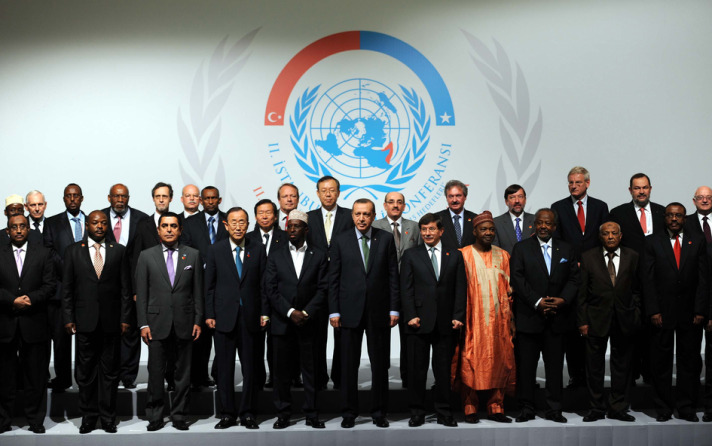
(Participants to the Second Istanbul Conference on Somalia)

The Second Istanbul Conference on Somalia took place in Istanbul, Turkey from 31 May to 1 June 2012. The Conference, which followed an initial event held in 2010, was attended by several representatives of Somalia’s government, autonomous regions, tribal elders and diaspora, as well as of the international community. Under the theme “Preparing Somalia’s Future: Goals for 2015”, the Conference focused on long-term and multi-dimensional solutions to the country democratization process, including recovery, social and economic development and peace consolidation.

Organized in partnership with the United Nations, the Conference is the lastest effort in Turkey’s growing engagement in Somalia. In recent years, Turkey launched a major diplomatic, economic and humanitarian campaign culminating with the visit of its Prime Minister to Mogadishu and the opening of an Embassy in 2011. Turkey’s “ soft power” efforts have drawn praises as well as some concerns, particularly by the US and Ethiopia.

“[P]rimary responsibility for establishing a political solution in the country lies with Somalis. The role of the international community is to support Somalis to provide leadership and ownership in rebuilding a functioning state and local governments that can provide security, ensure the rule of law and respect for human rights, provide basic social services and create an enabling environment that allows for economic opportunity for all its citizens.”

(Istanbul II Declaration)

Obviously, piracy featured in the Conference Agenda. However, also in light of the upcoming specialized Second International Counter-Piracy Conference in Dubai, UAE on 27-28 June 2012, the International Piracy Conference in Perth, Australia on 15-17 July 2012 as well as the Plenary Meeting of the Contact Group on Piracy off the Coast of Somalia, in New York, USA on 25 July 2012,  the discussion focused on broader issues affecting the country’s justice and security sectors, such as  inter-clan conflict, violence, corruption and misappropriation of funds, kidnapping, terrorism and human rights abuses.

The Conference Final Declaration can be found here.

USAID may increase development assistance to Somalia

Senator Kirk at the Shimo la Tewa Prison in Mombasa, Kenya
where five dozen Somali pirates are held, including Ahmed
Abdulkadir Hersi.

From 2008 to 2011 the development assistance provided by USAID to Somalia decreased from $260 to $80 million. Language has been inserted into the foreign appropriations bill that could indicate a change in this trend in order to address the root-causes of piracy.  Last week, the Senate Appropriations Committee approved S.3241, including the following provision:

(g) PIRACY.—Not later than 180 days after enactment of this Act, and following consultation with other relevant Federal agencies, the Secretary of State shall submit to the Committees on Appropriations a diplomacy and development counter-piracy strategy for the Horn of Africa region, including an assessment of the potential effectiveness of economic and security assistance for vulnerable Somali and Kenyan communities in providing gainful alternatives to piracy and encouraging collective action within such communities against groups and individuals involved in piracy. (emphasis added).

The language was inserted by Mark Kirk who has taken on maritime piracy as one of his policy initiatives. In April 2011, he compiled a report including recommendations to stem the rise of piracy:

  1. A US/UN ban on ransom payments that support the expansion of pirate operations
    and support for East African Al Qaeda/Al Shabaab terror;
  2. Aggressive Rules of Engagement giving authority for local naval commanders to
    attack and disable pirate “motherships,” leaving them adrift to empower on-scene
    commanders with the tactical authority to arrest pirates and rescue crews;
  3. Economic Assistance to reward Transitional Federal Government (TFG),
    Somaliland, Puntland, Ahlusunna Wal-jamea (ASWJ) and Jubaland frontline
    communities who confront or convert Al Shabaab or pirate-controlled areas;
  4. Judicial Assistance to Puntland and Kenya to expand their courts and prisons to
    readily accept pirates captured by international or Somali allied military/law
    enforcement forces;
  5. Military Assistance to TFG, Puntland, Somaliland, ASWJ or Jubaland forces who
    gain control of Al Shabaab or pirate-controlled areas; and,
  6. A Blockade of the three primary pirate ports and shorelines, including the El Danaan
    Anchorage, where 12 western tankers/merchant ships with 290 hostages are held.

The language inserted into the bill would ostensibly support point 3 on the list of proposals.  Development assistance has been encouraged as a way to dis-incentivize piracy as the lack of any other sources of income has made piracy an attractive option for young Somalis. However, any increase in assistance would have to contend with the danger of graft in the TFG and other institutions. As USAID puts it, “The situation in Somalia is highly fluid, and Somalia’s social, economic, and political development faces formidable challenges.”

Upcoming Event: Second International Counter-Piracy Conference – Dubai, 27-28 June 2012

As announced during the anti-piracy chapter of the recent London Conference on Somalia, the United Arab Emirates will host its second International Counter-Piracy Conference next month. The event, which follows a similar initiative convened in April 2011, will be held in Dubai, UAE on 27-28 June 2012. The Conference aims to further advance public-private coordination and partnership to combat maritime piracy, bringing together high-level government officials from more than 50 countries, senior representatives of international organizations and CEOs from leading global companies from maritime-related businesses. The UAE, the current chairman of the Contact Group on Piracy Off the Coast of Somalia, has since long engaged in counter-piracy initiatives in the Gulf of Aden and the larger area of the Indian Ocean.

The official website of the Conference can be found here. Notably, some of the main presentations and position papers are already available, giving a sneak preview of the upcoming debate.

ReCAAP and the Anti-Piracy Information-Sharing System in Asia

Furthering its current efforts to enhance international cooperation to tackle piracy, the United Kingdom recently became the 18th party to the Regional Cooperation Agreement on Combating Piracy and Armed Robbery against Ships in Asia, commonly referred to as ReCAAP.

Entered into force in September 2006, ReCAAP is the first regional agreement for the promotion and the enforcement of multilateral cooperation against piracy and armed robbery at sea in Asia. Among its original contracting parties are South and East Asian countries. Since its entry into force, ReCAAP is also open for accession by other countries. Like the U.K., other global shipping countries with an interest in Asian maritime economy, such as Norway and the Netherlands, are also parties. Pursuant to its Article 1, ReCAAP adopts the same definition of piracy set forth in UNCLOS as well as the IMO definition of armed robbery at sea. However, ReCAAP does not provide for enforcement powers beyond those already provided in UNCLOS. Many of the lessons learned from the implementation of ReCAAP were incorporated in the Djibouti Code of Conduct, which provides a framework for information sharing, training and capacity building in the Gulf of Aden.

Notably, ReCAAP established an Information Sharing Centre (ReCAAP ISC), which is now a recognized international organization, headquartered in Singapore. ReCAAP ISC’s main functions include facilitating communication and piracy-related information-sharing among the contracting parties as well as furthering capacity building with other organizations and the shipping industry to develop and improve anti-piracy measures. As part of its mandate, ReCAAP ISC produces periodic consolidated incident reports and alerts on piracy and armed robberies at sea in the Asia region. Incidents are classified under 4 different gravity levels, measuring violence and economic impact.

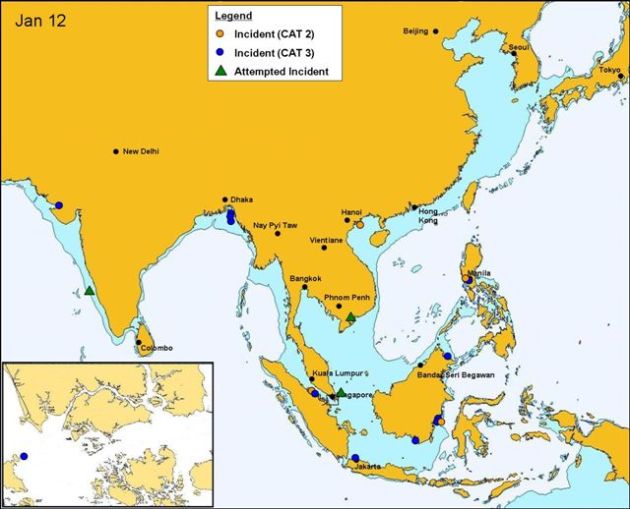
 Map of ReCAAP Consolidated Incident Report for January 2012

Once piracy hot-spots, the straits of Malacca and Singapore as well as the South-China Sea more recently registered a significant drop in piracy related incidents. Due to improved surveillance and security presence, reported incidents now mainly consist of armed robberies or petty thefts at ports and anchorages, particularly in Indonesia.