Private or Pirate Navy?

Puntland Marine Police Forces source:Somaliareport.com

The autonomous region of Puntland in Somalia has gotten a bad rap for being a hotbed for pirates. Though unrecognized as a state, there has been some international expectation that Puntland should take steps to prevent and punish acts of piracy, particularly those originating from within Puntland. In this regard, there have been efforts to create a Puntland coastguard or Navy (the “Puntland Maritime Police Force”), bankrolled by the United Arab Emirates and with training from private security firms. This is where the story of Sterling Corporate Services takes off. The New York Times reports:

Concerned about the impact of piracy on commercial shipping in the Middle East, the United Arab Emirates has sought to take the lead in battling Somali pirates, both overtly and in secret by bankrolling operations like Sterling’s.

[…]

A United Nations investigative group described the effort by a company based in Dubai called Sterling Corporate Services to create the force as a “brazen, large-scale and protracted violation” of the arms embargo in place on Somalia

[…]

Sterling has portrayed its operation as a bold private-sector attempt to battle the scourge of piracy where governments were failing.

Somalia Report notes that the UN effectively shut down the estimated $50 million per year program by threatening sanctions against UAE for violations of the Somalia arms embargo. In addition to the illegal shipments of arms, the program may have been a criminal pirate enterprise.

A Private Navy?

There is an argument that private navies are legally permissible under the law of the sea, particularly the legal regime governing anti-piracy operations on the high seas. Such navies are permissible if the navy is “on government service and authorized to that effect” pursuant to Article 107 of UNCLOS. The idea here is that a government may hire private companies to engage in police functions so long as it is made explicitly clear by markings and identification that the ship is controlled by the government and under a presumably military chain of command. It has been argued that ships on government service could not only provide self-defence to an escorted ship but could also engage in pirate hunting. Alternatively, if a private navy is not on government service but limits its actions to those justified by individual (as opposed to sovereign) self-defence, it may also be legally permissible. Here, aggressive acts would be strictly limited to those necessary to repel an attack, as is consistent with general principles of the law of self-defence. It would not include acts intended to prevent future attacks.

This is where the status of Puntland as an autonomous region becomes important. Though the international community has chosen to engage the Puntland government, it has chosen not to recognize Puntland’s sovereignty instead deferring to the project of solidifying the new Somali Federal Government in Mogadishu. Therefore, naval vessels patrolling the territorial waters of Somalia off of the coast of the autonomous region of Puntland are not “on government service” for purposes of Article 107 of UNCLOS.

Alternatively, there is some evidence that other states may have supported the Puntland Navy:

American officials have said publicly that they never endorsed the creation of the private army, but it is unclear if Sterling had tacit support from parts of the United States government. For instance, the investigative group reported in July that the counterpiracy force shared some of the same facilities as the Puntland Intelligence Service, a spy organization answering to Puntland’s president, Abdirahman Farole, that has been trained by C.I.A. officers and contractors for more than a decade.

Even if this is the case, the Puntland naval vessels are not “clearly marked and identifiable as being on government service” by a recognized sovereign such as the United States or the UAE. Therefore, seizing pirates on the high seas would not be justified pursuant to Article 107 of UNCLOS.

A Pirate Navy?

This raises the question of whether an act of violence by the Puntland Navy against another ship on the high seas constitutes piracy. Although there is some continuing debate as to the “private ends” requirements in Article 101 of UNCLOS, the better view is that it excludes from the definition of piracy, acts of violence by a sovereign. As Puntland is not a sovereign power, this exclusion from the definition of piracy does not apply. Therefore, acts of violence, detention or depredation committed by a Puntland Navy on the high seas (even if purportedly for the purpose of protecting the territory and people of Puntland) would constitute acts of piracy.

As noted above, the other possible justification for the seizure of pirate vessels on the high seas by the Puntland Navy is the doctrine of personal self-defence. This would justify acts strictly necessary to repel an ongoing attack. It would not justify acts of violence against suspected pirate vessels prior to an attack. Nor would it justify acts within the typical mandate of a sovereign navy or coast guard, including patrolling waters and interdicting ships.

The International community was displeased that Sterling was training these individuals because it was an apparent violation of the arms embargo imposed on Somalia. But, technically, Puntland’s Navy may have also been engaged in acts of piracy.

Territorial Waters

The Puntland Navy was also likely conducting operations within Somalia’s territorial waters which are part of the sovereign territory of the Somali Federal Government. The latter has the exclusive right to protect its territorial waters and to restrict traffic through this zone (See e.g. Article 25 UNCLOS “Rights of protection of the coastal State”), although a number of Security Council Resolutions have given foreign sovereigns some powers of interdiction in these waters as an exceptional measure. It is theoretically possible that the Somali Federal Government would attempt to delegate this coast guard function to an autonomous region’s forces such as the Puntland Navy. But it is unclear if this would be permissible pursuant to international law or whether Puntland would be willing to act on behalf of the Somali Federal Government, as opposed to under its own asserted authority as a sovereign.

Free Agents

The more practical question, now that the funding for Puntland’s Navy has disappeared, is what will happen to the individuals who were trained by Sterling. The New York Times reports:

With the South African trainers gone, the African Union has turned to a different security contractor, Bancroft Global Development, based in Washington, to assess whether the pirate hunters in Puntland can be assimilated into the stew of other security forces in Somalia sanctioned both by the United States and the African Union. Among those groups are a 10,000-man Somali national army and troops of Somalia’s National Security Agency, based in Mogadishu, which is closely allied with the C.I.A.

[…]

But with the antipiracy army now abandoned by its sponsors, the hundreds of half-trained and well-armed members of the Puntland Maritime Police Force have been left to fend for themselves at a desert camp carved out of the sand, perhaps to join up with the pirates or Qaeda-linked militants or to sell themselves to the highest bidder in Somalia’s clan wars — yet another dangerous element in the Somali mix.

New Article: Pirate Accessory Liability

In view of the debate concerning the prosecution of pirate leaders and financiers, I have posted a new article on SSRN entitled: Pirate Accessory Liability – Developing a modern legal regime governing incitement and intentional facilitation of maritime piracy. I attach the abstract for your information:

Despite the exponential growth of piracy off the coast of Somalia since 2008, there have been no prosecutions of those who have profited most from ransom proceeds; that is crime bosses and pirate financiers. As U.S. courts begin to charge higher-level pirates, they must ascertain the status of customary international law as reflected in the UN Convention on the Law of the Sea. UNCLOS includes two forms of accessory liability suited to such prosecutions, but a number of ambiguities remain in the interpretation of these forms of liability. These lacunae cannot be explained by reference to the plain terms of the UNCLOS or the travaux préparatoires and leaving domestic jurisdictions to fill these gaps risks creating a fragmented, and potentially contradictory, legal framework. On the contrary, resort to general principles of law ascertained by international criminal tribunals creates a predictable, and consistent, understanding of these modes of responsibility. This article shows how the jurisprudence of the ad hoc criminal tribunals fills the gaps in the law related to incitement and intentional facilitation of piracy. It further shows how these modes of responsibility are particularly suited to charges of financing pirate organizations or inciting children to participate in pirate enterprises.

Kiobel Oral Argument: Piracy May Spell Trouble for Shell

The Supreme Court opened up its October term with a healthy dose of international law in Kiobel v. Royal Dutch Shell. The petitioner, Esther Kiobel, is bringing suit against Royal Dutch Shell (Shell) alleging that the oil company aided and abetted the Nigerian government in committing gross human rights violations in the oil rich Ogoni region of Nigeria.

This is the second time this year that the Court has heard Paul Hoffman’s arguments in favor of the plaintiffs and Kathleen Sullivan’s arguments on behalf of Shell, and maritime piracy played a role in both rounds of arguments.

The first round of Kiobel oral arguments considered whether the Alien Tort Statute (ATS) could be applied to corporations as well as natural persons. There, Justice Breyer evoked the concept of “Pirates, Incorporated” to inquire into whether an in rem action against an 18th century pirate could be foreclosed because “Pirates, Inc.” rather than the individual pirate, owned the property at issue.

The United States Supreme Court

In the second round of oral arguments, held yesterday morning, the issue had changed from whether the ATS can be applied to corporations to whether it can be applied extraterritorially. Despite this change of focus, maritime piracy played an even more important substantive role in the second iteration of the Kiobel arguments than the first.

Piracy first came up when Justice Scalia asked Royal Dutch Shell’s attorney, Kathleen Sullivan, whether she believed – as Scalia thought she “must” – that the ATS applied to high seas conduct. She did not. Ms. Sullivan then quickly tried to turn her argument to the Marbois incident concerning an assault on a French diplomat.

But Chief Justice Roberts immediately raised the question of piracy again, noting that “it was the most clear violation of an international norm” at the time of the ATS’s passage.

Ms. Sullivan again attempted to minimize her high seas argument, noting that even if the justices concluded that the ATS reached high seas conduct, it does not extend into the territory of another state. However, she doubled down when she argued that Sosa v. Alvarez-Machain – the last ATS case heard by the Supreme Court – does not foreclose the possibility that the ATS’s reach stops at the high seas, as that opinion stated that piracy might be an area covered by the statute.

Despite her repeated attempts to stray away the issue of piracy, the oldest international crime came up again and again, including in the context of Filartiga v. Peña-Irala, where the Second Circuit held that, “[f]or the purposes of civil liability, the torturer has become – like the pirate and slave trader before him – an enemy of all mankind.”

As Shell’s attorney, Ms. Sullivan wished to steer clear of the issue of maritime piracy for several reasons. The first is that the Supreme Court explicitly found that the First Congress meant to include piracy as one of three torts available to 18th century ATS plaintiffs. The Supreme Court would likely be reluctant to admit that it was wrong less than a decade after Sosa was handed down.

Second, foreclosing ATS claims that occur on the high seas is the furthest possible extension of the respondents’ argument, one that the majority need not adopt to reach the respondents’ desired verdict.

Finally – and this may have been what Justice Scalia was getting at when he initially posed the question – it is difficult to find an example of an American law that applies on the high seas but not on foreign soil.[1] The presumption against extraterritoriality is purely a creature of Congressional intent, and it seems that Congress rarely distinguishes between the high seas and foreign soil when considering a statute’s extraterritoriality.

If the conservatives on the Supreme Court find the argument that ATS application on the high seas and on another country’s soil rises and falls together persuasive, there is enough historical evidence that the ATS was meant to apply to piracy that more newly-minted universal violations could ride on piracy’s coattails and allow for extraterritorial application of the ATS.

The effect such an opinion would have on pending litigation over a high seas requirement for facilitators of piracy is better saved for another day.


[1] Depending on the ultimate outcome of pending litigation, a notable exception to this general rule could be, however ironically, 18 USC § 1651, the statute criminalizing piracy.

In Brief: the Journal of International Criminal Justice – Symposium on Somali Piracy

The Journal of International Criminal Justice (JICJ) stepped out of its international criminal law-grounded comfort zone dedicating part of its latest issue to a symposium on the rise of piracy off the coast of Somalia from a variety of legal and non-legal perspectives. The symposium includes important contributions, ranging from an overview of counter-piracy initiatives undertaken by the international stakeholders, the local context of the historical and social background to piracy in Somalia, the role of domestic courts worldwide in prosecuting pirates, the key legal issues and challenges to the use of private military companies as well as anti-money laundering practices that could be used to counter Somali piracy. In particular, in his contribution Douglas Guilfoyle describes the international law governing the seizure and prosecution of suspected pirates, critically evaluating past proposals for international or internationalized piracy courts.

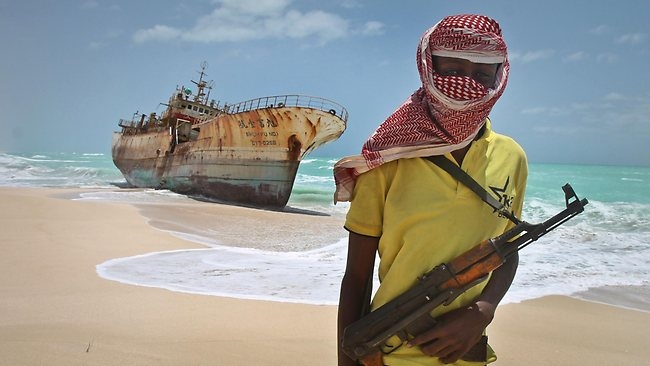
An abandoned hijacked Taiwanese fishing vessel in Hobyo, Somalia – Courtesy AP

The symposium is currently available only upon subscription.  In consideration of its fascinating subject matter, we hope that at least some parts of the symposium will soon be made available free of charge through JICJ’s “Editor’s Choice” section.

Putting political convenience aside, pirates are simply not terrorists

Jon Bellish is a Project Officer at the Oceans Beyond Piracy project in Boulder, Colorado (though all of his views are his own), and he has experience in United States piracy trials. He just got on Twitter. Cross-posted at The View from Above.

Pirates of Terrorists? Either way PCASPs are on board

While running through my piracy news roundup yesterday morning, I came across this piece by Robert Young Pelton of Somalia Report. In it, Pelton criticizes a report by Australia’s Lowy Institute that deals with the use of privately contracted armed security personnel (PCASP).

I took particular interest in a small tangent within Pelton’s piece that reflects an incorrect sentiment that I have seen repeated many times by non-attorneys (and even by some attorneys): that modern pirates should be considered terrorists.

As Pelton’s Somalia Report piece primarily concerns PCASP, the terrorism issue is only mentioned in a passing parenthetical:

“Pirates are criminals, (never terrorists because that would prevent the payment of ransoms) so it makes sense that a direct response by putting armed guards on ships was the most logical and so far, the most effective response to the pirate attacks.”

From this statement, I gather that Mr. Pelton is of the view that a key reason that the global anti-terrorism network has not been brought to bear against Somali pirates is that such an arrangement would force states to “negotiate with terrorists” once the pirates have seized the vessel and taken hostages. He appears to lament this fact. A similar view has been expressed by former U.S. Ambassador to the United Nations John Bolton and others who argue that relaxed rules concerning due process and state sovereignty as they are applied to terrorists would make the piracy fight a much easier one to win.

The oft-expressed desire to equate pirates with terrorists likely stems from several superficial similarities between the two groups. First, as Ambassador Bolton points out, “the same crippling evidentiary and procedural constraints” apply to both terrorists and pirates. Also, both groups consist of non-state actors operating in a truly international fashion to the detriment of the broader international community. Finally, both groups tend to base their operations in the Middle East/North Africa region.

Yet international law is clear as to the respective motives necessary to make one a terrorist or a pirate, and the facts on the ground suggest that, no matter how convenient it may be from a policy standpoint, pirates are not terrorists.

Judge Antonio Cassese, presiding over the Appeals Chamber at Special Tribunal for Lebanon, announced last year that a definition of terrorism has emerged under customary international law. Included in this definition is the requirement that the terrorist has “the intent to spread fear among the population (which would generally entail the creation of public danger) or directly or indirectly coerce a national or international authority to take some action, or to refrain from taking it.”

Conversely, it is well-documented that, although piratical intent is not limited to the desire to rob, for an act to be considered piratical, it must be committed for private ends. This requirement is explicitly laid out in UNCLOS art. 101, as well as its predecessor, 1958 Geneva Convention on the High Seas.

A terrorist’s intent must be to incite mass fear or coerce a government, both purely political motives; a pirate’s motive is strictly limited to making money.

In a smart piece here on piracy-law.com couching this definitional issue in terms of a potential defense available to alleged pirates, Roger Phillips rightly notes that, although in theory it is possible to have both political and pecuniary motives, the political motive appears absent in Somali pirates, who choose not to attack well-protected ships or kill hostages simply because it would be less profitable to do so. It seems like a stretch to argue that the pirates’ modus operandi of attacking a privately-owned ship in the middle of the ocean is somehow carried out in order to coerce a government or frighten the public at large by placing them in danger.

Though Roger covered it thoroughly, this definitional point bears repeating because the terrorist theme has gained so much traction in non-legal commentary on the issue of maritime piracy. As tempting as it is to “talk tough” about pirates and the international community’s response to piracy by evoking the specter of terrorism, there is very little merit to the claim that the two terms can, at least presently, be used interchangeably to describe Somali pirates or their West African counterparts.

Respect for the rule of law – apart from being perennial advice given by developed countries to countries like Somalia – requires taking the law as it is written (or trying to change it through legitimate processes) rather than molding it to fit one’s immediate policy preferences. Unless evidence of pirates taking a less profitable course in favor of a strategy with large political payoff emerges – or the definitions of piracy and/or terrorism change – the “pirates as terrorists” slogan will continue to be just that – a slogan.