Kiobel Postscript

Further to my earlier analysis here, there was one other remarkable detail in the U.S. Supreme Court’s recent decision in Kiobel. Although, the opinion in Kiobel was devoted to the application of the Alien Tort Statute, it injected some confusion into a strictly piracy matter. Citing to Blackstone’s definition of piracy the court majority noted, “the offence of piracy by common law, consists of committing those acts of robbery and depredation upon the high seas, which, if committed upon land, would have amounted to a felony there.” This is an outdated definition of piracy inconsistent with the law of nations. The 4th Circuit Court of Appeals has held in two recent opinions that piracy does not require an intent to rob (animus furandi) because the piracy statute 18 USC 1651 incorporates modern developments in “the law of nations” including the customary definition of piracy in Article 101 on the UN Convention on the Law of the Sea. Only a few months ago, the Supreme Court declined to hear these two cases, thereby taking no view on whether the definition of piracy has been updated by modern developments. By now citing to Blackstone’s definition in the Kiobel opinion, however, the court has muddied the waters.

Calculating the Cost of Piracy

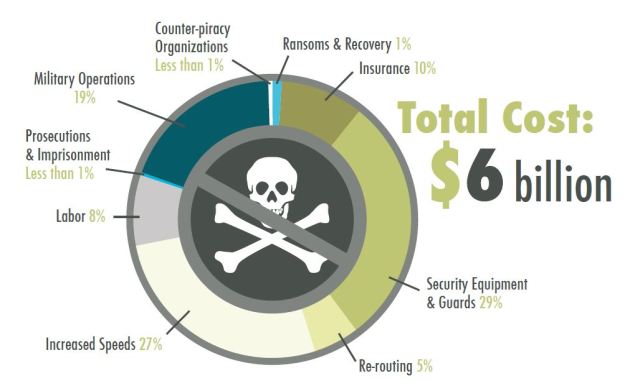
total-pie_graphOn April 9, Oceans Beyond Piracy released its third annual Economic Cost of Somali Piracy (ECoP) Report at the Danish National Museum in Copenhagen. The launch included a panel discussion including representatives from the Danish Shipowners Association, EUNAVFOR, Oceans Beyond Piracy, and BIMCO. Ambassador Thomas Winkler of the Danish Foreign Ministry and Mohamed Osman, Director of Somaliland’s counter-piracy force, also spoke at the launch.

As the lead author of the report, ECoP kept me away from CHO for a while, so while I’m glad to present some of its findings here, I’m looking forward to returning to some more regular (and more legal) posts in the future. Rather than going into each of the nine cost sections in detail – which can be done easily by reading this two-page summary and slightly less easily by reading the entire report – I will instead focus on the report’s central economic and thematic findings.

The biggest takeaway from the 2012 report is that the overall cost of piracy fell from around $7 billion in 2011 to around $6 billion in 2012. Unsurprisingly, this bottom line figure is the one that has been carried the furthest by the mainstream media.

The key drivers of the decreased costs was a sharp reduction in the cost of evasive measures such as increased speeds and re-routing, which fell by 43.3% and 50.2%, respectively. These decreases were due to a combination of methodological changes and a decreased proportion of ships acceding to the voluntary guidelines laid out in the industry best management practices, version 4. The cost of ransoms and insurance also fell, reflecting the decreased number of attacks and hijackings seen in 2012.

Although many cost factors dropped from 2011 to 2012, one that certainly did not was the cost of private armed security, which rose a staggering 80% when controlling for the number of transits through the Indian Ocean. However, OBP utilized automatic identification system (AIS) data to revise its estimate of the number of annual commercial transits through the Indian Ocean to 66,612 from the 42,450 estimated in 2011. All told, the cost of armed guards rose to $1.34 billion from the $530 million reported in 2011. This change was driven by a doubling in the rate of armed guard use, which was in turn the result of clearer flag state laws regarding the use of armed guards and the continued effectiveness of armed security teams.

Lamentably, there was no change in the proportion of dollars spent on short-term mitigation versus long-term prevention, with 99.5% of funds spent on the former and 0.5% spent on the latter.

The short-term/long-term dichotomy is even more striking in light of the drastic reduction in reported incidents of piracy, which resulted in a fairly dramatic increase in the “per incident” cost. In 2011, $28.60 million was spent per pirate attack. In 2012, $78.66 million was spent per attack, a 175% increase. Put another way, $42 dollars was spent fighting piracy for every dollar spent on a 2011 ransom payment. In 2012, that proportion was up to $186 in prevention for every $1 in ransom. These ratios suggest that the international community would do well to increase the economic efficiency of piracy suppression and devote a portion of those savings to a long-term solution on the shores of Somalia.

In closing, it should be noted that the World Bank released a report two days after the launch of ECoP entitled The Pirates of Somalia: Ending the Threat, Rebuilding a Nation. The report concluded that between 2005 and 2012, piracy has cost the world economy around $18 billion per year (+/- $6 billion). Much has been made (paywalled) about the divergence between our findings and those of the World Bank. However, in my opinion at least, the results are not at all incompatible. Our report only focuses on the costs spent by those directly involved in combatting piracy, while the World Bank’s methodology seeks to capture the full spectrum of costs, most of which are picked up by the general consumer in the form of barely-noticeable price increases. It is therefore unsurprising that the World Bank’s figure was significantly higher than that from ECoP.

I would highly recommend the World Bank Report, as well as ECoP, to anyone interested in developing a fuller picture of the global fight against maritime piracy.

Piracy – Not just Kiobel’s Analogy

Justice Kennedy – the deciding vote in Kiobel

Cross-posted at opiniojuris.org

The majority opinion in Kiobel precludes Alien Tort Statute claims for foreign conduct against foreign victims, leaving a small door for potential future claims that involve extraterritorial conduct so long as they touch and concern US territorial interests. But, when does a claim “touch and concern” the territory of the United States? Roger Alford notes that piracy may present an incident of “cross-border” conduct that could clarify this issue. Indeed, two piracy cases will imminently arrive at SCOTUS’ courthouse steps.

The piracy statute 18 USC 1651 shares much in common with the Alien Tort Statute: both were passed in the same time frame and both have reference to “the law of nations.” The presumption against extraterritoriality applies to 18 USC 1651. However, the plain language of the piracy statute and its historical context clearly rebut the presumption for all conduct that occurs on the high seas. Further, neither the victim nor the defendant need be American (U.S. v. Klintock). That said, there remains an important subset of piracy cases that involve conduct both on the high seas and within the territory of another sovereign: acts of aiding and abetting piracy through financing or negotiating ransoms for acts of piracy; or recruiting of child pirates.

In US v. Shibin (4th Circuit) and US v. Ali (DC Circuit), currently on appeal, the underlying criminal conduct of hijacking vessels occurred on the high seas. But, the negotiators in these cases only boarded the vessels upon entry into Somali territorial waters. Hence the mixed loci delecti on the high seas and within the territory of another state. Does this type of mixed conduct touch and concern the territory of the United States?

First, the plain language of the piracy statute would not rebut the presumption against extraterritoriality for conduct occurring within the territory of another state (the statute merely applies to conduct on the “high seas”). However, the historical context of the piracy statute indicates that it was intended to prevent impunity for acts of piracy wherever committed. That is why the modern definition of piracy applies to conduct outside the jurisdiction of any state, as well as to the high seas.

Here is where a case-by-case analysis, suggested in Part IV of the Kiobel majority, could be determinative. In Shibin, the defendant is accused of negotiating the ransom of two vessels. The first vessel has a strong nexus to US interests; the victims were American nationals and the targeted vessel was flagged in the US. Although a vessel’s flag does not designate its surface as territory of the sovereign, it is treated in much the same fashion (Lauritzen v. Larsen) which is to say that there are strong domestic interests in exercising jurisdiction over acts of piracy on one’s flagged vessels. But the second course of conduct charged in Shibin involves a vessel with no links to the US apart from a general interest in suppressing acts of piracy. The same is true in Ali. As the district court described the case: “Defendant Ali Mohamed Ali, a Somali citizen, is accused of helping Somali pirates hijack a Bahamian ship, hold its Russian, Georgian, and Estonian crew hostage, and compel the ship’s Danish owners to pay a ransom for its release.” These latter facts would not prevent the exercise of jurisdiction if the alleged criminal conduct occurred on the high seas. The question is whether aiding and abetting conduct occurring within the territory of another state must touch and concern US interests. If answered in the affirmative, it would curtail the US’s ability to suppress and prosecute acts of piracy, which is contrary to the historical purpose and intent of 18 USC 1651. It would also be inefficient as those who initiate an act of piracy on the high seas and continue acts of piracy in foreign territorial waters could only be prosecuted for the former conduct.

One significant factor Kiobel instructs to consider is the imperative to avoid enmeshing US courts in foreign affairs. In this regard, the specific facts of the Somali cases militate in favour of exercising jurisdiction. For the then Transitional Federal Government (TFG) of Somalia did not have effective control over the territorial waters where these acts of piracy occurred. The UN Security Council authorized States and regional organizations “to undertake all necessary measures that are appropriate in Somalia, for the purpose of suppressing acts of piracy and armed robbery at sea,” including in its territorial sea. The UNSC took great pains to note the TFG retained full sovereignty, that these exceptional measures did not create customary international law, and that they were authorized because the TFG had requested this assistance. It has been argued that the UNSC Resolutions authorized enforcement and stopped short of authorizing the prosecution of acts of piracy or armed robbery in Somalia’s territorial waters. Notwithstanding these provisos, the interest in preventing “unintended clashes between our laws and those of other nations which could result in international discord” (Morrison) that lies at the heart of the presumption against extraterritoriality, is greatly diminished in these piracy cases.

Justice Kennedy notes in his concurrence in Kiobel that in disputes not involving solely extraterritorial conduct, “the proper implementation of the presumption against extraterritorial application may require some further elaboration and explanation.” Although the majority appears to exceptionalize piracy (“pirates may well be a category unto themselves”), such a reading is inconsistent with Sosa v. Alvarez-Machain which explicitly asked “who are today’s pirates?” The terms “pirate” or “piracy” appear in the various opinions in Kiobel 50 times. Perhaps it is time to address piracy directly, and not merely by analogy. Such could elucidate the “touch and concern” requirement applicable in ATS cases.

Report From the Piracy Contact Group, Working Group 2, Meeting in Copenhagen

Private Security Guards

Cross-posted at international law girls.

In my capacity as an independent academic, as well as a representative of the prominent non-governmental organization, the Public International Law and Policy Group, I had the honor of attending the 12th meeting of the United Nations Contact Group on Piracy off the Coast of Somalia, Working Group 2, meeting in Copenhagen, on April 10-11.  I will take this opportunity to briefly summarize some of the key legal issues that were discussed in Copenhagen.

First, many nations seem to be moving in favor of authorizing the use of private security guards on board their merchant vessels.  The use of such private security guards is controversial, and many in the international community feel a general sense of discomfort any times states delegate their traditional duties to private entities.  Others have expressed the view that the use of private security guards on board merchant vessels should be allowed only under strictly delineated guidelines and rules on the use of force.  Contrary to popular belief, such guidelines and rules exist already.  Several International Maritime Organization Circulars provide guidance on matters related to the employment of private security personnel on board merchant vessels.  The Baltic and International Maritime Council (BIMCO) has drafted and made publicly available a standard employment contract between a shipping company and private security providers.  BIMCO has also issued specific Guidance on the Rule of the Use of Force, which suggest under which circumstances private security personnel may use force, including lethal force, against suspected pirates.  The International Organization for Standardization (ISO) issued additional Guidance for private security personnel on board ships, as well as a pro forma contract.  Finally, the Montreux Document provides international law rules applicable to the conduct of private security providers during armed conflict.  Although this Document most likely does not apply to the Somali piracy context because of the absence of armed conflict, it nonetheless sheds light on the international community’s consensus regarding the international law responsibilities of private security providers, operating in a domain otherwise reserved to state powers.

In addition to the above-mentioned guidance, international treaty law provides rules regarding the master of a ship’s duties on the high seas, in a situation where a merchant vessel may be under attack by suspected pirates, regardless of the presence of private security contractors on board.  It is clear under the United Nations Convention on the Law of the Sea as well as under the SUA Convention that the master of a ship retains authority on board his or her vessel, that the master may order any private security personnel to cease using force against suspected pirates at any time, and that the delegation of power from the master to the private security personnel during a piracy incident is temporary.   The general sentiment in Copenhagen was that numerous existing guidelines, principles, and treaty law obligations apply to any use of private security personnel on board merchant vessels, and that states have plenty to work with when determining whether and how to authorize the use of private security on board their own vessels.

Second, states remain concerned with legal issues related to the treatment of juvenile pirates (I had previously reported on this issue from the last Working Group 2 meeting in September 2012).   In order to ensure that juvenile pirates are treated according to relevant human rights standards and practices, states have begun developing guidelines on the treatment of juvenile pirates.  Such guidelines include the necessity to segregate juvenile suspects from the general prison population, to provide educational and vocational opportunities for juveniles, and to generally rehabilitate them so that they re-enter society upon their release and engage in legal, as opposed to criminal, activities.  These proposed guidelines will remain the subject of future Working Group 2 meetings.

Third, states remain committed to the post-conviction transfer model: the idea that pirates, if they are successfully prosecuted and convicted in Kenya, the Seychelles, or Mauritius, will be transferred back to Somaliland or Puntland where they will serve their penal sentences.  This model is important for two reasons.  First, it relieves small capacity nations such as the Seychelles and Mauritius from having to detain convicted pirates for long period of time in their own prisons; prosecutorial nations can, under this model, accept more suspected pirates because they will not run out of detention space.  Second and more importantly, the post-conviction transfer model allows pirates to return home – although they will not be immediately freed upon re-entering their native land, they will presumably be reunited with their families through prison visits and return to their own communities after the end of their sentences.  Any post-conviction transfer requires the successful fulfillment of the following criteria: the applicant must be at least 18; he or she must waive any existing appeals (the sentence must be final); he or she must consent to the transfer; all relevant states, including the apprehending state, the transferring state, and the receiving state, must agree to the transfer.  As discussed in Copenhagen, the post-conviction transfer model has been used successfully thus far, and 59 pirates have been transferred to Somaliland and Puntland as of today.

Finally, states have expressed an important concern regarding hostages.  In many instances, pirate hostages spend months in captivity under very difficult conditions.  Once hostages are released, they may be confused, mentally or physically injured, and may have no meaningful way of returning to their home states.  Several states in Copenhagen expressed the view that it is important to create a hostage release program that would maintain contact with released hostages in order to enable them to successfully return to a normal life after captivity.

The work of Working Group 2 thus far has been outstanding.  It demonstrates that states can, through joint legal efforts and cooperation, contribute significantly to the global fight against Somali piracy.
Book Review: The Pirate Organization – Lessons from the Fringes of Capitalism

The Pirate Organization_Cover_Harvard Business Review Press

What do the following have in common: the pirates of the high seas, the pirates of the radio airwaves in post-World War II’s Britain, as well as modern day internet cyberpirates and DNA bio-pirates? and how do they affect capitalism?

In “The Pirate Organization – Lessons from the Fringes of Capitalism”, Rodolphe Durand and Jean-Philippe Vergne take us beyond the traditional idea of pirate as solitary anarchists hunting down capitalism and argue that they all share a consistent series of traits, roles, tactics and goals which bring them to organize into groups, ad hoc communities where “alternative norms of social interaction and economic exchange are designed” and ultimately spread across a broader social realm. More importantly, despite their shorter life-expectancy, these “pirate organizations” manage to profoundly alter our society, particularly through their impact on today’s capitalism, driving its growth and evolution.

“The pirate organization is a social group that controls people, resources, channels of communication, and modes of transportation (for people, goods, capitals, or just information). It maintains trade relations with other communities, other groups, sometimes other states, and often legitimate companies. To reach its goals, it develops new strategies that favor speed and surprise. Its goal is to adapt and improvise, to develop the appropriate means to deal with its enemy. In order to protect itself, it operates from hidden locales outside a sovereign territory. To grow, it appeals to a desire for discovery; it seeks to control parts of a territory and claims certain rights to it. To attract recruits, it plays up its outsider status, and it makes change seem possible.  As long as the state strengthens its hold on norms, the pirate organization is ensured a flood of new members who feel marginalized by society.”

The Pirate Organization explores the quasi-symbiotic, often conflicting relationship between the pirate organization and capitalism. It takes us on a journey through unchartered territories, be it the high seas, the radio waves or internet and DNA. From the advent of the sovereign state to globalism, piracy has proven to be a transcendent force and the pirate organization has thus become a necessary counterpart to capitalism.

“Are pirates simple bandits or counterfeiters? Enemies of humanity? Defenders of a public cause? Agents of capitalist normalization? Oftentimes, they are all those things together.”

The Pirate Organization does not attempt to trivialize piracy or portrait pirates as heroes of our society acting as seeming iconoclasts of the wrongs of capitalism. It focuses on those pirate organizations pursuing novel, at times radical, values which impact on the norms of a society. Thus, it excludes modern day Somali pirates, in light of their violent banditry and merely profit oriented business model. The opposite interpretation, however, could also be true. Albeit unwittingly, pirates in Somalia exposed a lacuna in the implementation of the Convention on the Law of the Sea and in the framework for the prosecution of piracy at the national level. They drove the international community, in attempting to mitigate piracy impact on global trade, to initiate a comprehensive process of judicial reform and inter-state cooperation.  They also confirmed the frailties of failed States and their effect on local communities which will hopefully encompass more inclusive social and economic reform at both the national and international level. In the words of the authors, “piracy is not random. It is predictable. And it cannot be separated from capitalism”.