Tanzania – a case study

One of the goals of this blog has been to evaluate strategies for prosecuting Somali pirates.  A major strategy by the international community has been to transfer pirates who are captured by EUNAVFOR to regional countries, mainly Kenya and the Seychelles, to tackle prosecution. This strategy was undermined when a Kenyan Court ruled that it did not have jurisdiction to try piracy on the high seas. Nonetheless, there are a number of other regional States that are developing the capacity to prosecute piracy. This is the first in a series of posts examining how piracy affects other coastal nations in Africa and attempts by those States to increase capacity.

In Tanzania, examples of pirate activity are commonplace. But the following report provides some context. Pirates have been captured on the traditional tourist hot-spot of Mafia Island:

They were caught with various weapons, including a magazine laden with 21 rounds of ammunition, and SMG and SAR guns, police said. Anglers operating along the Indian Ocean shores saw the suspected pirates and tipped off the law enforcers, who arrested them at around 7pm at Kirongwe Village in Mafia District on Thursday.

Reports say the suspects landed at Kifinge Village at Baleni Ward at around 2pm on Wednesday aboard a fibre boat powered by an engine.

They reportedly looked hungry and tired, gesturing to the villagers as they asked for food in their mother language.

The villagers first took all the six suspects to a dispensary at the Kirongwe Village township where good Samaritans provided them with first aid and porridge before calling in the law enforcers.

Mr Mwakyoma said the interrogations were constrained by language hitches, as the suspects could neither speak Kiswahili nor English.

The suspects explained after an interrogation that they were 11 aboard two fibre boats, but the boat carrying some of their colleagues capsized and they were not aware of their whereabouts.

These Somalis were clearly far from home, not speaking the local languages and suffering from hunger and thirst.  But this has not stopped them from initiating attacks in Tanzania’s waters.

With the expansion of piracy east and south of Somalia, there have been attacks both within Tanzania’s territorial waters and within its exclusive economic zone. The ports of Mombasa, Kenya and Dar Es Salaam, Tanzania are high-traffic areas for commercial ships. Therefore, the shipping lanes through Tanzanian waters are ripe ground for pirate attacks.  Due to the increase of pirate attacks, the East African reported on 28 February 2011 (print edition only, updated article here) that Andy Linington, a top official of the UK union Nautilus said:

We could well have a situation this year where the leading seafarer nations, including the Filipinos, will refuse to crew ships which are sailing near the Gulf of Aden, the Somali coast or to the East African ports of Mombasa or Dar es Salaam.”

Such action would obviously deal a crushing blow to the economies of East Africa. Tanzania has a significant economic interest to protect as well as its reputation. Tanzania People’s Defence Forces have indicated it intends to protect commercial and private ships within its exclusive economic zone. But until recently it did not have a legal basis to prosecute piracy on the high seas.

However, in May 2010, Tanzania amended its Penal Code, adding a Section 6, which gives the Courts of Tanzania jurisdiction for “offences committed by any person on the high seas,”  where “high seas” is defined as “the open seas of the world outside the jurisdiction of any state.”

The law defines piracy as (a) “any act of violence or detention or any act of degradation, committed for private ends;” (b) participation in the operation of a ship with knowledge that the ship was intended was has been used in acts of piracy; or (c) incitement or intentional facilitation of either (a) or (b). Section 66(1)(c) appears aimed at financiers and pirate bosses, permitting prosecution of individuals who never step foot aboard a pirate ship. Whereas Section 66(1)(b) is interesting in that it permits prosecution of individuals who are not engaged in an attack of a vessel, so long as it can be proven that the ship in which they are traveling was intended to be used for pirate acts. Proof of intent might be a tricky business. Certainly, possession of guns, RPGs and ladders might be circumstantial evidence, but such evidence is routinely tossed overboard by pirates on the verge of capture.

Nonetheless, to date 11 pirates have been tried and sentenced in Tanzanian courts, presumably since the new law was enacted in May 2010.

Two other interesting provisions of the piracy law show that Tanzania is aware of the significant resources that might be involved in pursuing pirate prosecutions. Section 66(3) provides that unless a pirate ship is registered in Tanzania, “no prosecution shall be commenced unless there is a special arrangement between the arresting state or agency and Tanzania.” Likewise, pursuant to Section 66(4), the Director of Public Prosecutions must consent to any prosecution for piracy. Tanzania does not want to become the dumping ground for every pirate captured on the high seas.

To this end, EU anti-piracy task force officials have asked Tanzania to consider taking over the prosecutions as part of joint efforts to combat piracy in the region. Tanzanian Attorney General Frederick Werema confirmed that a special committee had been set up to consider the request. Tanzania, like other States, will undoubtedly request financial backing from Western powers to pursue the prosecution of pirates.
A War on Piracy? (Part 1)

“The only way to fight piracy is to hang the pirates.” “The only language they understand is force.” “This is war.” So says, a veteran of Norway’s shipping industry, Jacob Stolt-Nielsen. He acknowledges that his company is arming guards on board their vessels and suggests that the pirates should be executed on the spot.

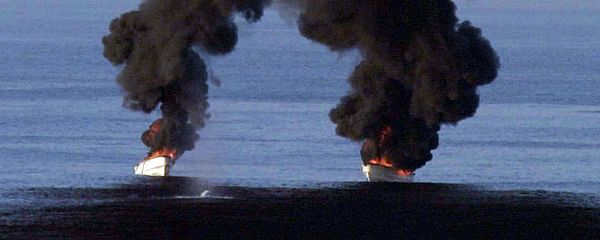
US NAVY: Suspected pirate skiffs burn from weapons fire from the guided-missile destroyer USS Momsen (Feb. 2011)

To be sure, if a commercial ship is under hostile attack by Somali pirates on the High Seas, the ship may exercise the right of individual or collective self-defense under Article 51 of the U.N. Charter. But it is a great extension of this principle to say that it permits preemptive action against suspected pirates who are not in the midst of an attack.

The so-called War on Terrorism provides a useful analogy here. In the wake of the 9/11 attacks, the second Bush Administration outlined its goals in the war on Terror in the National Security Strategy. That document provided:

For centuries, international law recognized that nations need not suffer an attack before they can lawfully take action to defend themselves against forces that present an imminent danger of attack. Legal scholars and international jurists often conditioned the legitimacy of preemption on the existence of an imminent threat—most often a visible mobilization of armies, navies, and air forces preparing to attack.

We must adapt the concept of imminent threat to the capabilities and objectives of today’s adversaries. Rogue states and terrorists do not seek to attack us using conventional means. They know such attacks would fail. Instead, they rely on acts of terror and, potentially, the use of weapons of mass destruction—weapons that can be easily concealed, delivered covertly, and used without warning.

The targets of these attacks are our military forces and our civilian population, in direct violation of one of the principal norms of the law of warfare. As was demonstrated by the losses on September 11, 2001, mass civilian casualties is the specific objective of terrorists and these losses would be exponentially more severe if terrorists acquired and used weapons of mass destruction.

The United States has long maintained the option of preemptive actions to counter a sufficient threat to our national security. The greater the threat, the greater is the risk of inaction— and the more compelling the case for taking anticipatory action to defend ourselves, even if uncertainty remains as to the time and place of the enemy’s attack. To forestall or prevent such hostile acts by our adversaries, the United States will, if necessary, act preemptively.

One might argue that Somali Pirates, armed with Rocket-propelled grenades and AK-47s pose an imminent threat to ships in the Indian Ocean, thereby justifying preemptive attack on pirate skiffs.  Such an analogy is flawed in several ways.

First, who are the parties to such a “War on Piracy?” According to the UN Special Adviser for Piracy’s report, there are around 1,500 Somali pirates and about 10 commanders. These are multiple enterprises; there is no single “Somali Pirate” outfit akin to Al Qaida. Second, against whom did Somali pirates declare war by attacking commercial ships, owned by companies in Norway, South Korea, India, and Malaysia, flagged in Malta and Liberia, and whose seafarers are nationals of the Philipines, India, and Kenya (to name but a few interested States)?

Second, the threat posed by piracy is largely financial. According to one estimate, the cost of Somali piracy to the world economy is between $7-12 billion per year. In addition, a large number of vessels and hostages remain captive. The International Chamber of Commerce reports that there are currently 33 Vessels and 712 Hostages being held by Somali pirates. But there are few reported incidents of civilian casualties. And certainly, the use of more destructive weaponry would be counterproductive for pirates as they can only ransom goods and hostages that remain intact.

Finally, this is not a battle of ideology as pirates and their victims are pursuing the same goal – that is to enrich themselves.  The difference is that pirates seek to enrich themselves illegally.

In short, even if one were to accept that a war on terrorism is a legitimate legal construct, the rationale does not extend to Somali piracy. For (1) there is no logical coherence to a war between disparate groups of pirates and the rest of the shipping world; and (2) piracy poses an economic threat, not a threat to the safety and security of the nations of the world.

This is not war; this is organized crime. And the scourge will only be eradicated when crime bosses are apprehended and prosecuted.

Manning up – Guns on Board

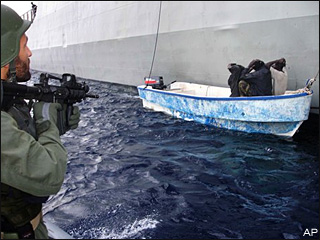
Navy commando is seen detaining a speedboat with suspected Somali pirates

Private security firms have found a new niche. In the absence of naval forces sufficient to protect all of the commercial ships traveling through the Indian Ocean and the Gulf of Aden, ship owners must decide whether to take the risk of hiring a private firm to protect their ships, with lethal force when necessary. Here and here are a few examples. One proposed venture would offer the following:

Vessels transiting Gulf of Aden waters will get both armed patrol boat escort and full anti-piracy cover for an average of US$21,500 per voyage, dependent on speed. This so-called Convoy Escort Program scheme would be classed as a “flag naval company” under the maritime and criminal law of a still-to-be-decided flag state.

Many ship owners have been reticent to hire private security companies to protect their ships because of: (1) the potential for escalation of violence; (2) questions regarding the legality of the use of force to prevent pirate attacks and (3) potential liability for injuries to seamen.

The need for adequate self-defence measures at sea leads to some surprising outcomes when faced with national regulation.  The criminal and regulatory regimes of a given State apply to a ship in a State’s territorial waters (usually 12 miles from shore). But when a ship is on the High Seas, the flag State where the ship is registered dictates what law applies. Considering the number of ports where a ship may dock, this makes for a complicated patch-work of laws. As a result, in order to avoid running afoul of local gun control laws, some maritime security companies are tossing weapons overboard prior to reaching port. There is a need to establish some kind of uniformity:

The Swiss government led efforts last year to create the International Code of Conduct for Private Security Service Providers, a set of principles for the growing global industry. But it is up to the countries that licence ships to oversee security teams.

Countries have vastly different laws for the use of force and for carrying weapons on board. The US allows for pre-emptive attacks on pirates, while Sweden will not allow any guns except for a single shotgun on any merchant ship it regulates.

For the time being, the International Maritime Organization Best Management Practices only provide, “The use of additional private security guards is at the discretion of the company, but the use of armed guards is not recommended.”

Pirates in Prada and Proving it

The Economist has a comprehensive report touching on many of the practical issues created by the rise of Piracy in the Indian Ocean. In the conclusion to the report, the report explains some of the reasons why there have not been more comprehensive efforts to address the problem.

Unfortunately, too many people like things as they are. Pirates gain wealth, excitement and glamour. Marine insurers, which last month extended the sea area deemed to be at threat from Somali pirates, are making good money from the business that piracy generates. At least for the time being, shipowners are willing to take the calculated risk of sailing in pirate-infested waters; so long as everyone bears his part of the extra $600m a year in premiums, they can pass the bill on to their customers. Patrolling foreign navies can demonstrate their usefulness to their sometimes sceptical political masters, while countries such as China and Russia are strengthening their operational experience.

Smithsonian Artifact: Slave Shackles

On another issue, the report acknowledged the difficulty in compiling evidence to prove acts of piracy. Professor Eugene Kontorovich has advocated for “Equipment Articles,” taking a cue from the slave era in which the British enacted laws creating a presumption that ships were engaged in slavery if they were in possession of certain equipment such as shackles. In the context of piracy, Professor Kontorovich states:

Equipment Articles could create a presumption of piracy for people found on a vessel less than a certain length, with engines of a certain horsepower, equipped with grappling hooks, boarding ladders, armed with RPGs and/or heavy machine guns, and/or far out at sea with obviously inadequate stores of food and water (which could suggest the skiff operates from a mothership).

Boarding ladders, such as the one seen in the header to this blog, and grappling hooks permit pirates to quickly gain access to a ship. But, the practical problem with this suggestion is set forth in the Economist report: “If they are caught in the middle of an attack, the pirates have no hesitation throwing their weapons—typically AK47 machine guns and rocket-propelled-grenade launchers—and their scaling ladders overboard to destroy evidence of their intentions.” All that would be left is a skiff with a large engine and, if the pirates are clever, a fishing net. The Equipment Articles would be of questionable utility in such circumstances.

But there is also a due process problem with such laws.  International criminal law has adopted the beyond a reasonable doubt standard of proof. Equipment Articles appear to lower the burden of proof such that the prosecution of a pirate would only require prima facie evidence that a suspect intended to commit piracy. In other words, Equipment Articles put the onus on the suspect to disprove that they intended to engage in piracy. Alternatively, Professor Kontorovich notes that during the slavery era, the United States never enacted Equipment Articles, but instead considered the possession of equipment as circumstantial evidence of slavery. This latter use is more consonant with contemporary International Criminal Law practice. Short of catching Pirates as they attempt to board a ship or after they have already taken hostages, compiling sufficient evidence to prove piracy will continue to pose a problem.

UPDATE: The Danish Navy was forced to release six suspected pirates for lack of proof to sustain a conviction. “The pirates “had thrown all their equipment used for piracy into the sea before the boat crew members of the Esbern Snare [the Danish Naval ship] had boarded. “

Prosecution of Pirates under CAT

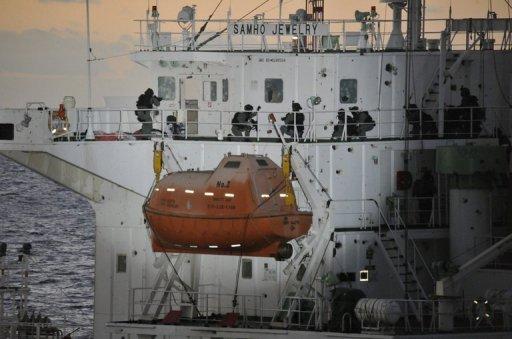
A South Korean Navy-issued photo shows SEAL troops storming the Samho Jewelry hijacked by Somali pirates in the Indian Ocean

UPDATE: The question has been raised in another forum how acts of piratical torture might be imputed to a State authority (as CAT is only applicable where such authorities participate in or acquiesce to such conduct). There are at least two cases on point. In 1999, the Committee Against Torture held that factions within Somalia “exercise certain prerogatives that are comparable to those normally exercised by legitimate governments,” and therefore, “the members of those factions can fall, for the purposes of the application of the Convention, within the phrase “public officials or other persons acting in an official capacity” contained in article 1 [of CAT]”. See Zelmi v. Australia. Similarly, a UK criminal court has held that an Afghan warlord could be considered a de facto public official for purposes of CAT even though a central government existed in Afghanistan at the time. See R v. Zardad. The crucial issues in that inquiry were: (1) the degree of organization of the entity; (2) the level of control exercised over a region; and (3) whether the entity exercised the types of functions that would normally be exercised by a government.

Since a majority of pirate attacks originate in the unrecognized region of Puntland, the question then becomes whether the officials in Puntland are to be held responsible as de facto public officials, or even, whether the leaders of pirate enterprises might be considered de facto public officials if they exercise effective control over the towns or regions in which they reside. The existence of a Transitional Authority in Mogadishu does not seem to prevent application of CAT since it does not have any influence outside a small part of the capital.

So much for pragmatic businessmen. Escalation is the word of the day. A seamen on a ship captured off of the Seychelles was killed, apparently in retribution for an attempted rescue. In another report, South Korean seamen from the Samho Jewelry described how their Somali pirate captors beat them. A Major General explained that Somali pirates “have begun systematically using hostages as human shields and torturing them.” These reports raise an important legal question: can the Somali pirates who hijacked the Samho Jewelry and who are currently being detained in South Korea, be prosecuted for torture?

There are at least two legal issues here: one jurisdictional and the other substantive. As to the first issue, the UN Convention Against Torture (UNCAT) provides that a State may exercise jurisdiction to prosecute a suspect for torture: (1) where the offence took place in its territorial jurisdiction or onboard a ship registered in that State; (2) where the suspect is a national of that State; or (3) where a victim is a national of that State. See UNCAT Article 5(1). Even where none of these criteria are met, UNCAT also permits any State in which the suspect is present to exercise jurisdiction. This begs the question, how a suspect would find himself in a State which did not, but for his presence, have jurisdiction to try him. Of course, once the suspect is transferred to any State, his presence alone would grant that State jurisdiction to try him on torture charges. But what is the legal basis for arresting and/or extraditing the suspect on torture charges, if none of the four jurisdictional criteria are met prior to the extradition?

In any event, the alleged victim appears to be a South Korean national. Therefore, there is a basis for exercising jurisdiction pursuant to UNCAT. Note: the Samho Jewelry is a Maltese flagged ship, so Malta would also have jurisdiction.

As to the second legal issue, the definition of UNCAT creates a problem in the prosecution of non-state actors. UNCAT was devised to prohibit torture by States and defines torture as:

Any act by which severe pain or suffering, whether physical or mental, is intentionally inflicted on a person [to obtain information, as punishment, intimidation, or coercion or for any discriminatory reason], when such pain or suffering is inflicted by or at the instigation of or with the consent or acquiescence of a public official or other person acting in an official capacity. (emphasis added).

Therefore, one element of the offence of torture pursuant to UNCAT is the participation of a public official. In a failed State such as Somalia, there are no public officials or other persons acting in any official capacity to consent or acquiesce to the conduct. This element cannot be proven and a prosecution for torture would fail.

The ICTY Appeals Chamber has addressed the peculiarity of the public official requirement in the UNCAT definition of torture. In one case, it held that the definition of torture in UNCAT, which now constitutes customary international law, included a public official element. See Furundzija Appeal Judgement at. para. 111. But in a subsequent case, in dicta, the ICTY Appeals Chamber opined, “[t]he public official requirement is not a requirement under customary international law in relation to the criminal responsibility of an individual for torture outside of the framework of the Torture Convention.” See Kunarac Appeal Judgement at paras. 147-48. In other words, where a State is concerned, there is a public official requirement. But where a State is not involved, the crime of torture does not require the involvement of a public official. Considering this was dicta, the issue has not been definitively resolved.

South Korea ratified UNCAT in 1995, but whether or not it could prosecute Somali pirates for torture would depend on the domestic legislation that was passed in conjunction with its ratification. If South Korea’s domestic legislation incorporated the public official requirement in the definition of torture, it might create a barrier to prosecution on this charge.

I should note that Piracy is defined by UNCLOS as “any illegal acts of violence,” and therefore, encompasses within its broad definition, acts of torture. See UNCLOS Article 101(a). However, there may be circumstances where a prosecution for Piracy fails and reliance must be made on other charges. In such a situation, UNCAT would provide a novel basis for prosecution.