Drones v. Pirates


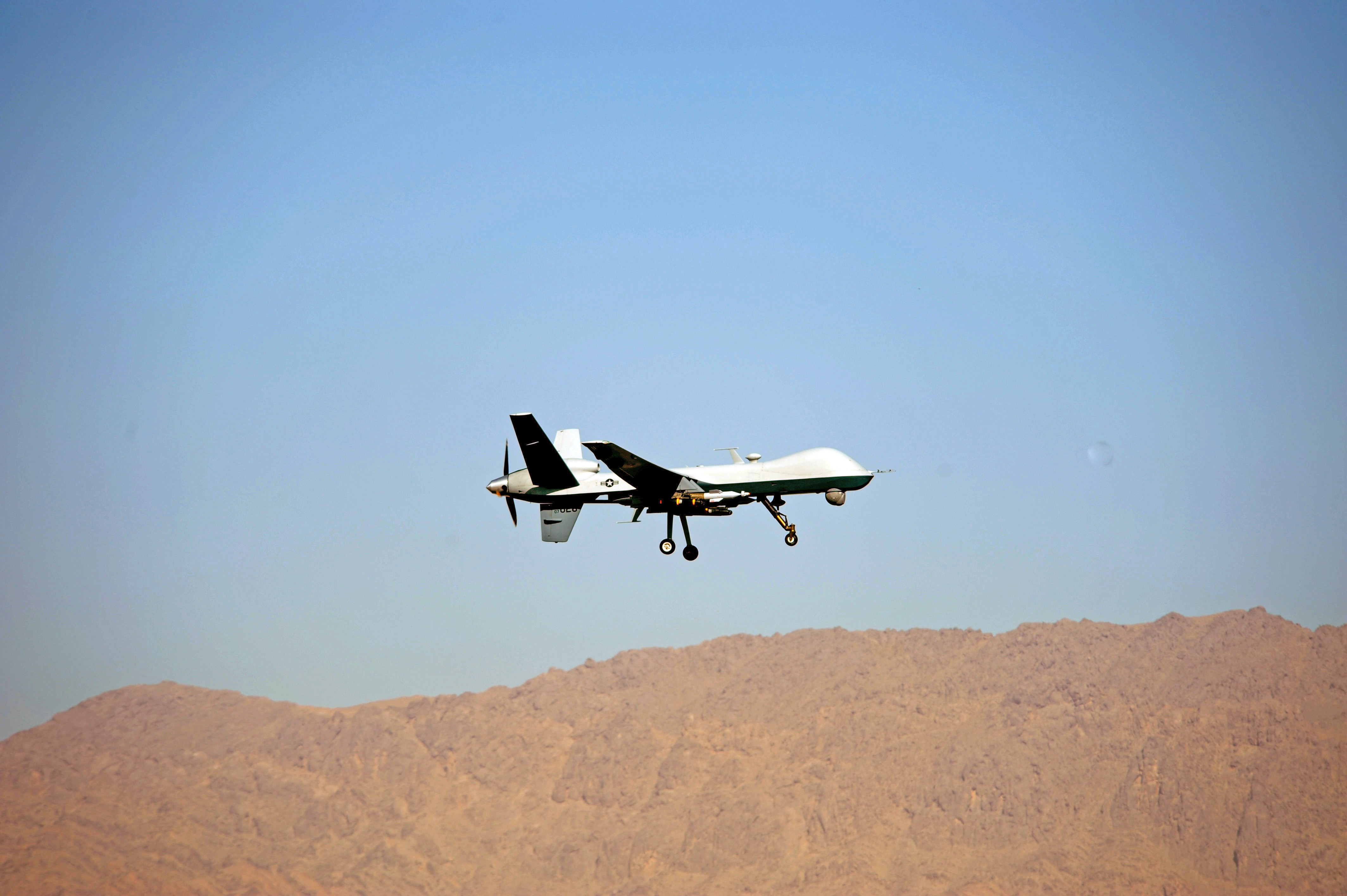
In today’s Wall Street Journal, it is reported that the U.S. is deploying armed drones to the island nation of the Seychelles in order to strike militant targets and, if and when necessary, Somali pirates:

A senior defense official said the U.S. hasn’t yet used the Reapers deployed the Seychelles to conduct armed reconnaissance on pirate ships, but the option is open to use the drones to strike at pirates who have mounted attacks.

“If there was a piracy situation gone wrong, the Seychelles are a good place from which to put something overhead,” said the senior defense official.

The U.S. stationed Reaper drones in the Seychelles from September 2009 until this past spring, when they were withdrawn. Those aircraft weren’t armed and were used only for surveillance. Officials said at the time that those drones were to be used to monitor pirates.

With terrorists and pirates living in such close quarters, it is easy to mistake them as one and the same. Consequently pirates become legitimate targets for pre-emptive attack. But even if pirates are considered to be terrorists (a very big “if”), there are limits as to how they may be engaged. The Deputy National Security Advisor John Brennan recently signaled that the U.S. continues to reserve the right to take unilateral action against individuals who are a threat to the United States. Nonetheless, he recognized: “International legal principles, including respect for a state’s sovereignty and the laws of war, impose important constraints on our ability to act unilaterally—and on the way in which we can use force—in foreign territories.” Even members of al-Qaida are entitled to basic protections afforded by the Geneva Conventions (See Hamdan v. U.S.).

On the other hand, if pirates are treated as criminals, destroying a pirate skiff by a drone-fired missile prior to an attack or even after an attack would constitute summary justice. As I have mentioned before, this does not prevent seafarers from protecting themselves in the face of an attack. But if an attack has occurred and pirates are racing off with their booty or if pirates are discovered at sea with the tell-tale signs of planning an attack (e.g. rifles, ladders), they must be arrested and not scuttled by an unmanned drone.

Although the Prime Minister of Somalia’s Transitional Federal Government (TFG) has no problem with the U.S. targeting members of al-Shabaab within Somalia’s territorial borders, he would not accept similar treatment of pirates. Without the consent of the TFG, drones will likely be restricted to a surveillance role regarding pirates within Somali’s territory and territorial waters. The same is likely true of pirates in international waters, absent extraordinary circumstances.

From the Gulf of Aden Back to the Gulf of Guinea: Piracy Reports in West Africa on the Rise

Dear Readers, Let me introduce you to today’s guest blogger, Matteo Crippa. Mr. Crippa has substantial experience in West Africa and in international criminal law, having served as a legal officer at the Special Court for Sierra Leone from its inception. He brings a fresh perspective and insight to today’s topic. I would like to express my appreciation for his contribution and hope that it is the first of many to come.

The UN Security Council recently expressed concerns over reports of increased piracy, armed robbery and hostage taking in the Gulf of Guinea and their adverse impact on security and economic activities in West Africa. It is calling for the UN Offices for West and Central Africa to work with the UN Office on Drugs and Crime and the International Maritime Organization, all concerned countries and regional organizations. The UN Secretary General further indicated its intention to deploy an assessment mission to explore possible options for UN support.

While today’s counter-piracy attention shifted to the Gulf of Aden, with more than half the global piracy attacks being ascribed to Somali pirates, the Gulf of Guinea has long been a high risk area. With the increase of maritime commercial traffic, discovery of oil off the coasts of countries other than Nigeria, installation of additional offshore extracting infrastructure and on-going instability in various coastal areas, acts of piracy are on the rise. In 2009, the number of attacks fell short of those in the South-East Asia region. But, there are an increasing number of attacks in Togo, Nigeria and Benin.

Albeit sharing similar criminal goals and root causes, the nature of the attacks appears to differ with those off the Somali coast, encompassing an equal amount of armed robberies or hijackings and hostage takings. In addition to the immediate financial effect on oil and natural resource exploration and exploitation, the increased piracy activity appears to have a substantial impact on a set of traditional economic activities, such as commercial trade, regional travel and fishing.

Notwithstanding this difference, one unique feature of West Africa piracy is its limited territorial and regional purview (at least for now). Particularly in the Gulf of Guinea, piracy is mainly a by-product of the Niger Delta crisis. Acts of piracy and related criminal activities are still largely, if not exclusively, confined to territorial waters, and pirates do not yet possess the logistics and organizational capabilities of those operating in Somalia. Piracy per se can only be committed beyond the territorial sea, with all the equivalent acts occurring within territorial and internal waters being a matter for a coastal state’s criminal jurisdiction under the label of armed robbery at sea. All other conditions being met, doubts arise whether the present situation conforms to the customary legal definition of piracy and warrants the import of international-level mechanisms of deterrence and repression.

In the light of these considerations, the UN intervention in the matter at this stage appears to derive principally from the absence of any locally coordinated resources and the need to engage regional cooperation. West African countries, much like East African countries, lack adequate legislative frameworks and enforcement capabilities, as well as logistics and know-how, to address piracy. In addition, they face the increasing threat of becoming a major route for narcotics and drug smuggling. It should be noted that local efforts are underway to counter piracy, including the creation of a piracy task force in Nigeria, coastline patrols in Nigeria and Benin and plans to convene an ad hoc summit to discuss a regional response

The UN counter-piracy strategy in West Africa is thus still at an embryonic stage. An initial point of concern is the immediate risk of resource fragmentation, with already a plethora of UN and regional agencies and organizations involved as possible stakeholders. Building upon the most recent Somali experience and the joint international efforts to tackle piracy, the UN seeks to preemptively mobilize leadership and coordinate resources to avoid the situation in the Gulf of Guinea spiraling further. This perhaps signals a shift from a traditional counter-piracy strategy to a more piracy-prevention oriented approach. Its success will very much depend upon its capacity to include and assess the broader social, political and economic causes feeding piracy.

High Season

As reported here, we are entering the part of the year when seas are flat and conditions are ripe for pirate attacks in the Gulf of Aden/ Indian Ocean.  Therefore, the coming months will likely see a spike in attacks.  The report also includes an assessment that the current military strategy is manifestly inadequate.  As to PMSCs, the chief of staff with EUNAVFOR (the EU naval force patrolling the maritime corridor under attack) states,

“I think a ship with private security onboard will be taken successfully by pirates — it is a matter of time.”

With current methods failing, the UN is faced with a number of proposals for a holistic approach to the problem. Perhaps the Secretary General will take a multi-pronged approach, including development assistance and the creation of a mechanism for prosecution, as part of his proposal due sometime in October.


UN Anti-Piracy Force

Following yesterday’s post on private security forces, the maritime shipping industry has urged the UN to create a peace-keeping operation to protect international waters.  In a letter to the UN Secretary General, the shipping companies assert:

“We believe that an important element in this approach would be the establishment of a U.N. force of armed military guards that can be deployed in small numbers onboard merchant ships.”

“This would be an innovative force in terms of U.N. peacekeeping activity but it would do much to stabilise the situation, to restrict the growth of unregulated, privately contracted armed security personnel and to allow those U.N. member states lacking maritime forces … to make a meaningful contribution in the area of counter-piracy,” they said.

Considering budget constraints at the UN, in particular within peacekeeping operations, it is unclear how such a project would be funded. But it might be a way of limiting legal liability of shippers who are currently hiring PMSCs.


Review: War by Contract – Private Contractors in the Fight Against Piracy


War by Contract – Human Rights, Humanitarian Law, and Private Contractors, Eds. Francesco Francioni and Natalino Ronzitti

Considering the increasing magnitude of maritime piracy, and the resulting growth of the private security field, it is surprising that very little in the legal literature has addressed the convergence of the two. In his article, The Use of Private Contractors in the Fight Against Piracy: Policy Options, Professor Ronzitti provides a unique survey of the legal implications of employing private contractors on maritime vessels.  It appears in War by Contract, analysing the legal regime applicable to private military and private security companies (PMSCs), including the Geneva Conventions and Human Rights Law. The article is a meaningful and necessary first step in such an analysis. But by answering the most pressing questions, it raises yet others.

The analysis is most relevant to the shipping industry, in particular, shipping companies, ship-owners and their insurers. Ronzitti briefly addresses an array of mechanisms available to shippers in order to safeguard the passage of their goods through pirate infested waters, both territorial and international. Among those options are pirate hunting by PMSCs; self-defence by seafarers; employing armed guards; detachments of armed soldiers employed by national militaries; the practice of escorting merchant vessels by military vessels; dispatching security teams from land bases and policing territorial waters.

Ronzitti bases his analysis mainly on the language of international treaties and the interpretation thereof by resort to recorded statements during their negotiation. For example, in the case of perhaps the most controversial topic, pirate hunting (i.e. hiring of PMSCs to pursue and capture/kill pirates), Ronzitti notes various maritime law treaties, including the 1958 Convention on the High Seas which provides in Article 21, “A seizure on account of piracy may only be carried out by warships or military aircraft, or other ships or aircraft on government service authorized to that effect.” He concludes that pirate hunting may be legally permissible if the vessel is on government service, authorized to chase pirates, and the hiring government bears international responsibility. However, he states that no practice of this kind currently exists.

Ronzitti asserts that the use of private contractors is, under appropriate conditions, legally permissible for each of the mechanisms considered. At the heart of his analysis is the concept of self-defence. Although some have suggested that ships possess a right of self-defence embodied in Article 51 of the UN Charter, such a right only applies to states.  Alternatively, Ronzitti suggests what permits ships to take action against pirates attacking them is “the right of self-defence of human beings, a right which is recognized by all legal orders of the members of the international community.”  The reference here is to the ICJ Statute, Article 38(1)(c), naming as a source of international law “general principles of law recognized by civilized nations.”

The basic principle of self-defence in that one may protect oneself against threats to one’s life by resort to force may be relatively uncontroversial. But Ronzitti takes the principle further stating, “Usually domestic legal orders recognize not only the right of self-defence but also the consequential right to take into custody the aggressor for the short span of time necessary for handing him over to the police authority” and further that the right of self-defence includes the right to intervene on behalf of a threatened individual.

However, there are differences between legal orders as to the proper scope and application of the principle of self-defence. For example, how much force is permissible? Must it be shown that there was no possibility of escape to justify the use of force? In addition, it is at least debatable whether the principle of self-defence would encompass the concept of “citizen arrest” by a merchant marine vessel.

Finally, what legal orders would be controlling here? If a death is to occur at sea as a result of piracy, jurisdiction to prosecute such a crime may be limited to the flag state, victim or defendant’s state. However this does not mean that the applicable substantive law should derive from the prosecuting state rather than international law. The ICJ suggests in the North Sea Continental Shelf case that in ascertaining general principles of international law, reference should be made predominantly to states with an interest in developing relevant practices. For example, in ascertaining the law applicable to the continental shelf, reference should be made to the practice of coastal nations. However, in the case of the basic concept of self-defence, most if not all legal orders have had an interest in developing the law on this topic. In ascertaining the bounds of the general principle of self-defence, the collection of states selected to evaluate state practice will determine its permissible bounds. One might also reference sources of customary international law such as Article 31(1)(c) of the Rome Statute (defining self-defence). The point is that it is an open question as to how the principle of self-defence would be defined and applied in the maritime piracy context.

In the end, Ronzitti’s analysis suggests that arming guards aboard ships has been made necessary and is legally permissible within certain bounds. He suggests that further regulation should be applied to conform the practice to international norms. However, the basic countervailing concern here is that it will lead to an escalation of violence by pirates. The International Maritime Organisation (IMO) has indicated the success-rate of pirate attacks in the Gulf of Aden has fallen from 50 percent to less than 20 percent this year. As a result,

“They [pirates] have become more aggressive, audacious and better organised.” This view was echoed by International Maritime Bureau director Captain Pottengal Mukundan, who said, “Attacks off the coast of Somalia have been characterised by a greater degree of violence against crews than before.”

Although legally justifiable in appropriate circumstances, the use of PMSCs will inevitably lead to more violent and deadly clashes with pirates.