Chatham House Report on Piracy
January 19, 2012 4 Comments
Dear Readers, we have a new contributor to CHO, Shannon Torrens. Ms. Torrens has served as legal adviser for the Marshall Islands Permanent Mission to the UN and negotiated the LOS and Fisheries resolutions for the country. She has also been involved with the International Tribunal for the Law of the Sea. We’re very excited to benefit from her expertise and look forward to her contributions to the site.
Traditional notions of piracy as an essentially negative enterprise are being increasingly challenged. Whilst Somali piracy off the East coast of Africa has undoubtedly resulted in the loss of lives, the infiltration of violence and fear to coastal communities and ocean dwellers, in addition to the squandering of billions of dollars in ransoms and depleted tourism, it remains relevant that some sectors of the community do benefit from piracy. This raises questions as to what strategies can be put in place to alleviate the root causes of piracy so that the economic incentive is not longer as valuable.

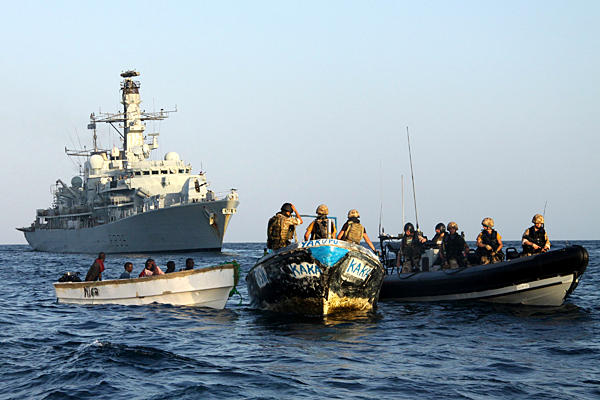
Source: EUNAVFOR
An alternative argument to the belief that piracy ransom money is invested in foreign goods or channelled into neighbouring countries such as Kenya appears in a report released by development economist Dr. Anja Shortland from Brunel University on behalf of the London-based think-tank Chatham House. Perhaps controversially, the report notes that piracy has provided stability to Somalia and structure for the troubled country’s governance. As part of the research for “Treasure Mapped: using Satellite Imagery to Track the Developmental Effects of Somali Piracy“, the report aimed to investigate and analyse the on-land impacts of piracy and specifically where the proceeds from piracy are invested. In doing so, the report looked at both day and night aerial photos and high resolution satellite images of Somalia and at economic data, to establish where the beneficiaries were located.
Conventional economic data on Somalia is lacking, therefore, the report utilised data collected by internationally funded NGOs who monitor commodity prices, which when combined with the aerial shots, provided evidence that a significant percentage of pirate ransoms, are converted into local Somali Shillings, benefitting casual labourers and pastoralists in the Puntland region. Furthermore, the aerial images showed that inland communities such as Garowe and Bosasso in Puntland, from where pirates are said to generally originate, had increased in wealth in line with the rise of piracy activities. Those communities showed more lights on at night (i.e. electricity) and increased construction projects taking place, all of which occurred during the same period as the explosion of pirate ransoms.
Interestingly, coastal communities or “Pirate capitals” such as Eyl and Hobyo which actually host the pirates throughout their off-shore operations did not show similar evidence of having benefitted through additional investments into the community. While the report does not suggest piracy as a method for developing underprivileged regions, it does suggest that piracy clearly benefits some sectors of the Somali community and that if piracy were to stop, there would be sections of the underprivileged in Somalia who would be deeply impacted, which would in turn undermine local security and development. Furthermore, due to the alleged benefits piracy funding has had on the local economy in these inland communities and in provincial Somali capitals, the report suggests that political elites would be unlikely to act decisively against piracy.

The alleged ransom distribution in Puntland is part of what the report points to as a “deep- rooted culture of sharing” whereby wealthy Somalis combine their resources within their social-clan and in doing so aspire to increase their financial standing cooperatively. This is part of a cultural obligation to assist others in one’s community through traditional economic survival patterns, which in this instance involves considerable financial redistribution and investment in inland areas. This reality combined with large local groups who have a vested-interest in the continuation of piracy for development purposes is said by the report to render the off-shore momentum of piracy difficult to stop and is also why the report suggests an on-shore, rather than off shore solution to piracy.
The “Treasure Mapped” report has been subject to a degree of negative commentary from some quarters, for its allegedly weak data, gaps and errors of information that some commentators believe affect the implementation and accuracy of suggestions. Further criticisms have been based on allegations that the report unfairly targets the reputation of the people in Puntland specifically, Somalia more generally and the counter-piracy initiatives of the Somali Government. In doing so, they argue that the report links Puntland and the government to piracy activities, when these areas and institutions have actually taken extensive steps to combat piracy, rather than participating in or facilitating it.
As part of its conclusions, the report suggests finding alternative economic stimulus to the Somali economy, as without such alternative job prospects, Somalis will continue to search out extra legal means of employment, which includes piracy. While controversially for counter-piracy initiatives, the report suggests that a “military crack-down… would deprive one of the world’s poorest nations of an important source of income and aggravate poverty,” the report concludes that despite the fact that a large number of people benefit from the proceeds of piracy, this should not stop the international community from acting to find land-based solutions which would ideally focus on attempts to replace piracy as a source of income in these communities.
 This past Wednesday, the UN Security Council received a


 But what of these particular Somalis? Will they be prosecuted and where? After the incident, the pirates were in American custody. The New York Times reports that the rescue occurred 210 miles off the coast of Iran, presumably in international waters. If that is the case, the United States as the seizing nation, has jurisdiction to prosecute, decide on penalties, and determine the action to be taken with regard to ships or property “subject to the rights of third parties acting in good faith.” (Article 105, UNCLOS). Iran, as a third party whose nationals were victims of the attacks, also has an interest in prosecuting the pirates. In this case, it is likely that Iran will defer to the U.S. to prosecute the pirates.
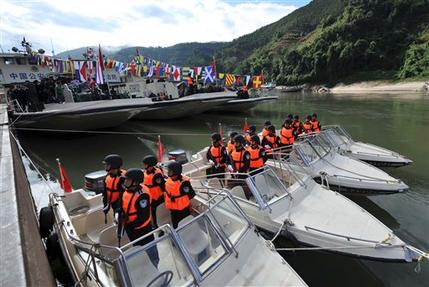
 It is problematic to fully assess the legal framework in which the patrols could be deemed to operate as well as their relation with anti-piracy and armed robbery efforts. Interestingly, a cursory review of the history of piracy reveals limited reported instances of so called “
 Roger L. Phillips
 Hilarie Henry
 Jon Bellish
 Matteo Crippa
 Milena Sterio
 Shannon Maree Torrens
 sonia messaoudi
 Michael Y. Liu
 Communis Hostis Omnium