New Contact Group on Piracy Website

The Contact Group on Piracy has just launched a website which compiles a number of very useful resources.  It is described as follows:

Pursuant to UN Security Council Resolution 1851, the Contact Group on Piracy off the Coast of Somalia (CGPCS) was established on January 14, 2009 to facilitate the discussion and coordination of actions among states and organizations to suppress piracy off the coast of Somalia. This international forum has brought together more than 60 countries and international organizations all working towards the prevention of piracy off the Somali coast.

According to the U.S. Dept. of State, the website is operated by the Republic of Korea with support from the United States and United Kingdom.

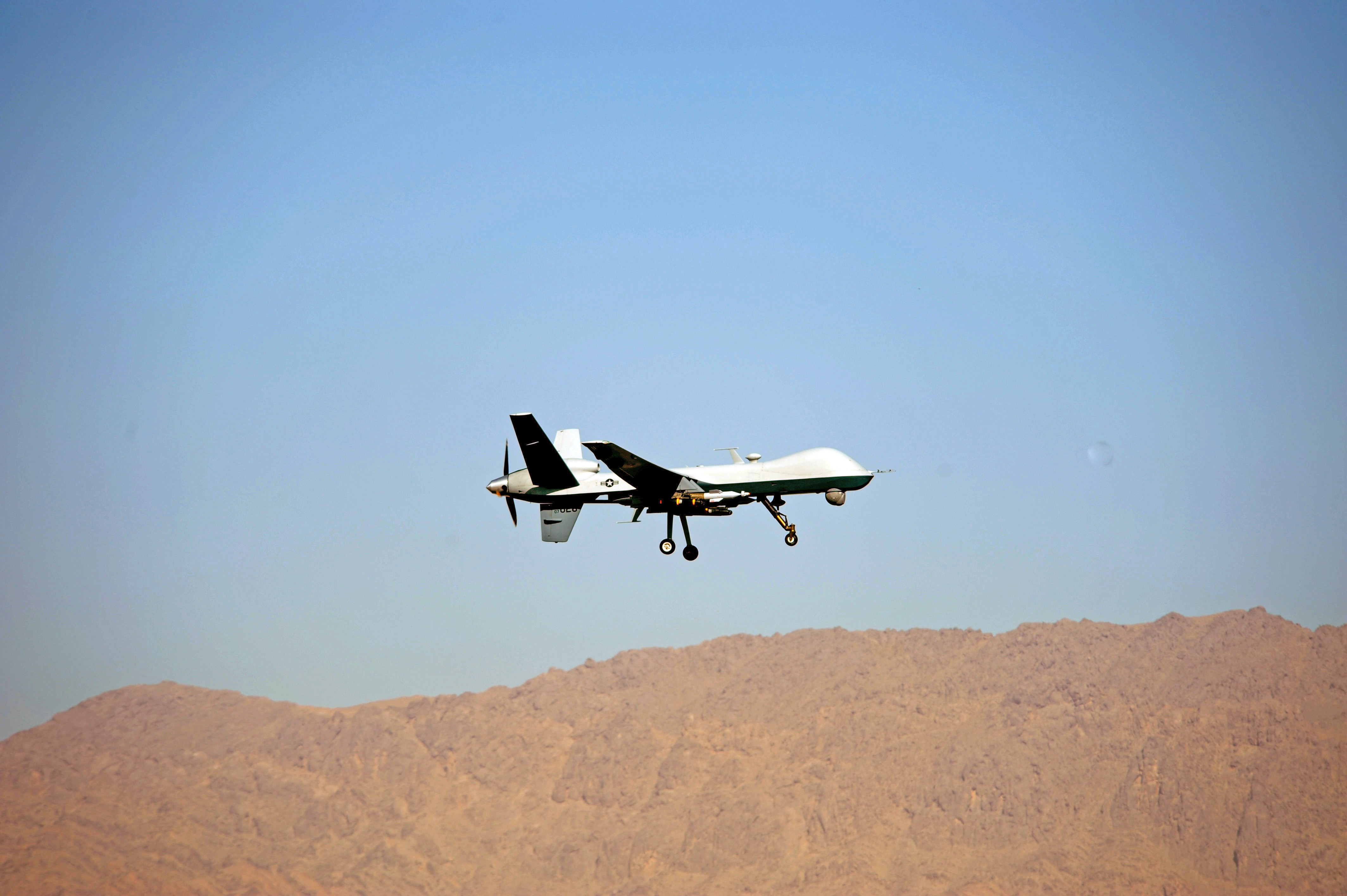
Drones v. Pirates


In today’s Wall Street Journal, it is reported that the U.S. is deploying armed drones to the island nation of the Seychelles in order to strike militant targets and, if and when necessary, Somali pirates:

A senior defense official said the U.S. hasn’t yet used the Reapers deployed the Seychelles to conduct armed reconnaissance on pirate ships, but the option is open to use the drones to strike at pirates who have mounted attacks.

“If there was a piracy situation gone wrong, the Seychelles are a good place from which to put something overhead,” said the senior defense official.

The U.S. stationed Reaper drones in the Seychelles from September 2009 until this past spring, when they were withdrawn. Those aircraft weren’t armed and were used only for surveillance. Officials said at the time that those drones were to be used to monitor pirates.

With terrorists and pirates living in such close quarters, it is easy to mistake them as one and the same. Consequently pirates become legitimate targets for pre-emptive attack. But even if pirates are considered to be terrorists (a very big “if”), there are limits as to how they may be engaged. The Deputy National Security Advisor John Brennan recently signaled that the U.S. continues to reserve the right to take unilateral action against individuals who are a threat to the United States. Nonetheless, he recognized: “International legal principles, including respect for a state’s sovereignty and the laws of war, impose important constraints on our ability to act unilaterally—and on the way in which we can use force—in foreign territories.” Even members of al-Qaida are entitled to basic protections afforded by the Geneva Conventions (See Hamdan v. U.S.).

On the other hand, if pirates are treated as criminals, destroying a pirate skiff by a drone-fired missile prior to an attack or even after an attack would constitute summary justice. As I have mentioned before, this does not prevent seafarers from protecting themselves in the face of an attack. But if an attack has occurred and pirates are racing off with their booty or if pirates are discovered at sea with the tell-tale signs of planning an attack (e.g. rifles, ladders), they must be arrested and not scuttled by an unmanned drone.

Although the Prime Minister of Somalia’s Transitional Federal Government (TFG) has no problem with the U.S. targeting members of al-Shabaab within Somalia’s territorial borders, he would not accept similar treatment of pirates. Without the consent of the TFG, drones will likely be restricted to a surveillance role regarding pirates within Somali’s territory and territorial waters. The same is likely true of pirates in international waters, absent extraordinary circumstances.

Manning up – Guns on Board

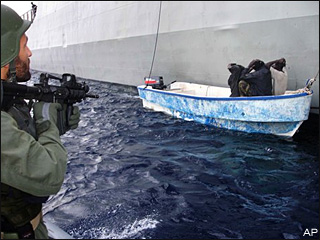
Navy commando is seen detaining a speedboat with suspected Somali pirates

Private security firms have found a new niche. In the absence of naval forces sufficient to protect all of the commercial ships traveling through the Indian Ocean and the Gulf of Aden, ship owners must decide whether to take the risk of hiring a private firm to protect their ships, with lethal force when necessary. Here and here are a few examples. One proposed venture would offer the following:

Vessels transiting Gulf of Aden waters will get both armed patrol boat escort and full anti-piracy cover for an average of US$21,500 per voyage, dependent on speed. This so-called Convoy Escort Program scheme would be classed as a “flag naval company” under the maritime and criminal law of a still-to-be-decided flag state.

Many ship owners have been reticent to hire private security companies to protect their ships because of: (1) the potential for escalation of violence; (2) questions regarding the legality of the use of force to prevent pirate attacks and (3) potential liability for injuries to seamen.

The need for adequate self-defence measures at sea leads to some surprising outcomes when faced with national regulation.  The criminal and regulatory regimes of a given State apply to a ship in a State’s territorial waters (usually 12 miles from shore). But when a ship is on the High Seas, the flag State where the ship is registered dictates what law applies. Considering the number of ports where a ship may dock, this makes for a complicated patch-work of laws. As a result, in order to avoid running afoul of local gun control laws, some maritime security companies are tossing weapons overboard prior to reaching port. There is a need to establish some kind of uniformity:

The Swiss government led efforts last year to create the International Code of Conduct for Private Security Service Providers, a set of principles for the growing global industry. But it is up to the countries that licence ships to oversee security teams.

Countries have vastly different laws for the use of force and for carrying weapons on board. The US allows for pre-emptive attacks on pirates, while Sweden will not allow any guns except for a single shotgun on any merchant ship it regulates.

For the time being, the International Maritime Organization Best Management Practices only provide, “The use of additional private security guards is at the discretion of the company, but the use of armed guards is not recommended.”

Pirates in Prada and Proving it

The Economist has a comprehensive report touching on many of the practical issues created by the rise of Piracy in the Indian Ocean. In the conclusion to the report, the report explains some of the reasons why there have not been more comprehensive efforts to address the problem.

Unfortunately, too many people like things as they are. Pirates gain wealth, excitement and glamour. Marine insurers, which last month extended the sea area deemed to be at threat from Somali pirates, are making good money from the business that piracy generates. At least for the time being, shipowners are willing to take the calculated risk of sailing in pirate-infested waters; so long as everyone bears his part of the extra $600m a year in premiums, they can pass the bill on to their customers. Patrolling foreign navies can demonstrate their usefulness to their sometimes sceptical political masters, while countries such as China and Russia are strengthening their operational experience.

Smithsonian Artifact: Slave Shackles

On another issue, the report acknowledged the difficulty in compiling evidence to prove acts of piracy. Professor Eugene Kontorovich has advocated for “Equipment Articles,” taking a cue from the slave era in which the British enacted laws creating a presumption that ships were engaged in slavery if they were in possession of certain equipment such as shackles. In the context of piracy, Professor Kontorovich states:

Equipment Articles could create a presumption of piracy for people found on a vessel less than a certain length, with engines of a certain horsepower, equipped with grappling hooks, boarding ladders, armed with RPGs and/or heavy machine guns, and/or far out at sea with obviously inadequate stores of food and water (which could suggest the skiff operates from a mothership).

Boarding ladders, such as the one seen in the header to this blog, and grappling hooks permit pirates to quickly gain access to a ship. But, the practical problem with this suggestion is set forth in the Economist report: “If they are caught in the middle of an attack, the pirates have no hesitation throwing their weapons—typically AK47 machine guns and rocket-propelled-grenade launchers—and their scaling ladders overboard to destroy evidence of their intentions.” All that would be left is a skiff with a large engine and, if the pirates are clever, a fishing net. The Equipment Articles would be of questionable utility in such circumstances.

But there is also a due process problem with such laws.  International criminal law has adopted the beyond a reasonable doubt standard of proof. Equipment Articles appear to lower the burden of proof such that the prosecution of a pirate would only require prima facie evidence that a suspect intended to commit piracy. In other words, Equipment Articles put the onus on the suspect to disprove that they intended to engage in piracy. Alternatively, Professor Kontorovich notes that during the slavery era, the United States never enacted Equipment Articles, but instead considered the possession of equipment as circumstantial evidence of slavery. This latter use is more consonant with contemporary International Criminal Law practice. Short of catching Pirates as they attempt to board a ship or after they have already taken hostages, compiling sufficient evidence to prove piracy will continue to pose a problem.

UPDATE: The Danish Navy was forced to release six suspected pirates for lack of proof to sustain a conviction. “The pirates “had thrown all their equipment used for piracy into the sea before the boat crew members of the Esbern Snare [the Danish Naval ship] had boarded. “

Terrorism as a Defence to Piracy (a definitional problem)

Last August, in U.S. v. Said, a federal court dismissed the most serious count of piracy, ruling mere attempts at piracy were not proscribed by the provision in question. The defendants in that case had approached the USS Ashland 300 miles off the coast of Djibouti, mistaking it for a commercial ship, and one of the defendants had fired a shot. They made no attempt to board the ship and their skiff was shot out of the water. Judge Jackson held that even if the facts were proved, this “attempt” did not amount to piracy. There has been considerable discussion of the memorandum decision here, here and here.  Most of the criticism centers on the Court’s limited reading of 18 U.S.C. 1651 which provides, “[w]hosoever, on the high seas, commits the crime of piracy as defined by the law of nations and is afterwards brought into or found in the United States, shall be imprisoned for life.”

Judge Jackson relied upon the U.S. Supreme Court decision of United States v. Smith, 18 U.S. 153 (1820) which defined piracy as robbery at sea. Many critics have noted the 1958 Convention on the High Seas (ratified by the U.S.) and the UNCLOS (not ratified by the U.S.), define Piracy to be inclusive of “attempt,” and that these Conventions constitute customary international law.  Because 18 U.S.C.1651 adopts the Law of Nation’s definition of piracy, the Court should have given more weight to the definition within these Conventions.

The definitional problem examined in U.S. v. Said is indicative of the challenges faced by States attempting to prosecute Somali pirates. Piracy laws are often antiquated or sometimes do not exist at all.  Even where a State has clear penal legislation proscribing acts of piracy and has adopted the UNCLOS definition, there are other potential hurdles.

The Old U.S. Supreme Court Chambers ca. 1820

UNCLOS article 101 defines piracy as “any illegal acts of violence or detention, or any act of depredation, committed for private ends…” (emphasis added).  The plain language of this definition provides that the motive for piracy must be pecuniary.  What if a private ship attacks another in order to achieve a political, as opposed to, a commercial purpose?  Professor Isanga points out several examples of this phenomenon, including attacks in the Niger Delta in Nigeria, and the PLF attack of the M/S Achille Lauro.  Although Somali pirates are generally attacking ships for profit, they have on occasion expressed political motivations.  For example, Somali pirates threatened to kill any South Korean seamen they take hostage in revenge for the killing of eight pirates by South Korean troops.  Furthermore, the Somali parliament failed to adopt piracy legislation with some parliamentarians arguing the pirates were protecting their national waters from overfishing by foreign vessels.  The current definition of piracy under UNCLOS would not encompass crimes with these motivational bases. (See Professor Isanga’s article for a discussion of this and other definitional issues.)

Establishing the jurisdictional parameters of a special tribunal for piracy creates a unique problem in this regard.  If a special tribunal’s jurisdiction is limited to the crime of piracy as defined by UNCLOS, it would not be competent to try attacks at sea committed for political purposes.  In answering charges of piracy, a suspect might claim to have attacked a ship for political, as opposed to pecuniary purposes.  If believed, the manifestly unjust result would be an acquittal on a piracy charge based on a defence of terrorism.  As the special tribunal would not have jurisdiction to try the terrorism charge, the suspect would go free.  Of course, the suspect could be transferred to a court with competence to hear terrorism charges.  However, the efficiency of the special tribunal would be undermined.  Further, in a terrorism trial, the suspect might change tack and claim that he was in fact pursuing commercial interests in the attack.

To avoid this result, the international community could (1) expand the definition of piracy to include terrorism or (2) expand the jurisdiction of piracy tribunals to encompass terrorism charges.  Either alternative would confuse two quite distinct issues.  I recently spoke with an individual who provides private security to commercial ships against Somali pirates.  He claims that piracy is a business (albeit an illegal one).  Few hostages have been killed because it is unprofitable to do so.  He told me that if a pirate ship sees a commercial ship is guarded by armed security, it generally withdraws to look for an easier target.  In contrast, terrorism seeks to use violent means to achieve a political result.  Hostage situations involving terrorists are highly unpredictable and hostages are often killed.  Piracy seeks the most profitable outcome; Terrorism often seeks the most violent outcome.  Do the two crimes deserve similar treatment?  As individual States and the international community pursue piracy prosecutions in earnest, these definitional problems will have to be addressed.

NB: It is possible that a pirate would have dual motives, both pecuniary and political. In such cases, a “terrorism defence” would not negate the criminal intent for piracy.  Cf. Prosecutor v. Ntakirutimana, ICTR-96-10-A, Judgement (AC)(holding in the context of the crime of genocide, “it is immaterial, as a matter of law, whether the refugees were targeted solely on the basis of their ethnicity or whether they were targeted for their ethnicity in addition to other reasons.”)