Tanzania – a case study

One of the goals of this blog has been to evaluate strategies for prosecuting Somali pirates.  A major strategy by the international community has been to transfer pirates who are captured by EUNAVFOR to regional countries, mainly Kenya and the Seychelles, to tackle prosecution. This strategy was undermined when a Kenyan Court ruled that it did not have jurisdiction to try piracy on the high seas. Nonetheless, there are a number of other regional States that are developing the capacity to prosecute piracy. This is the first in a series of posts examining how piracy affects other coastal nations in Africa and attempts by those States to increase capacity.

In Tanzania, examples of pirate activity are commonplace. But the following report provides some context. Pirates have been captured on the traditional tourist hot-spot of Mafia Island:

They were caught with various weapons, including a magazine laden with 21 rounds of ammunition, and SMG and SAR guns, police said. Anglers operating along the Indian Ocean shores saw the suspected pirates and tipped off the law enforcers, who arrested them at around 7pm at Kirongwe Village in Mafia District on Thursday.

Reports say the suspects landed at Kifinge Village at Baleni Ward at around 2pm on Wednesday aboard a fibre boat powered by an engine.

They reportedly looked hungry and tired, gesturing to the villagers as they asked for food in their mother language.

The villagers first took all the six suspects to a dispensary at the Kirongwe Village township where good Samaritans provided them with first aid and porridge before calling in the law enforcers.

Mr Mwakyoma said the interrogations were constrained by language hitches, as the suspects could neither speak Kiswahili nor English.

The suspects explained after an interrogation that they were 11 aboard two fibre boats, but the boat carrying some of their colleagues capsized and they were not aware of their whereabouts.

These Somalis were clearly far from home, not speaking the local languages and suffering from hunger and thirst.  But this has not stopped them from initiating attacks in Tanzania’s waters.

With the expansion of piracy east and south of Somalia, there have been attacks both within Tanzania’s territorial waters and within its exclusive economic zone. The ports of Mombasa, Kenya and Dar Es Salaam, Tanzania are high-traffic areas for commercial ships. Therefore, the shipping lanes through Tanzanian waters are ripe ground for pirate attacks.  Due to the increase of pirate attacks, the East African reported on 28 February 2011 (print edition only, updated article here) that Andy Linington, a top official of the UK union Nautilus said:

We could well have a situation this year where the leading seafarer nations, including the Filipinos, will refuse to crew ships which are sailing near the Gulf of Aden, the Somali coast or to the East African ports of Mombasa or Dar es Salaam.”

Such action would obviously deal a crushing blow to the economies of East Africa. Tanzania has a significant economic interest to protect as well as its reputation. Tanzania People’s Defence Forces have indicated it intends to protect commercial and private ships within its exclusive economic zone. But until recently it did not have a legal basis to prosecute piracy on the high seas.

However, in May 2010, Tanzania amended its Penal Code, adding a Section 6, which gives the Courts of Tanzania jurisdiction for “offences committed by any person on the high seas,”  where “high seas” is defined as “the open seas of the world outside the jurisdiction of any state.”

The law defines piracy as (a) “any act of violence or detention or any act of degradation, committed for private ends;” (b) participation in the operation of a ship with knowledge that the ship was intended was has been used in acts of piracy; or (c) incitement or intentional facilitation of either (a) or (b). Section 66(1)(c) appears aimed at financiers and pirate bosses, permitting prosecution of individuals who never step foot aboard a pirate ship. Whereas Section 66(1)(b) is interesting in that it permits prosecution of individuals who are not engaged in an attack of a vessel, so long as it can be proven that the ship in which they are traveling was intended to be used for pirate acts. Proof of intent might be a tricky business. Certainly, possession of guns, RPGs and ladders might be circumstantial evidence, but such evidence is routinely tossed overboard by pirates on the verge of capture.

Nonetheless, to date 11 pirates have been tried and sentenced in Tanzanian courts, presumably since the new law was enacted in May 2010.

Two other interesting provisions of the piracy law show that Tanzania is aware of the significant resources that might be involved in pursuing pirate prosecutions. Section 66(3) provides that unless a pirate ship is registered in Tanzania, “no prosecution shall be commenced unless there is a special arrangement between the arresting state or agency and Tanzania.” Likewise, pursuant to Section 66(4), the Director of Public Prosecutions must consent to any prosecution for piracy. Tanzania does not want to become the dumping ground for every pirate captured on the high seas.

To this end, EU anti-piracy task force officials have asked Tanzania to consider taking over the prosecutions as part of joint efforts to combat piracy in the region. Tanzanian Attorney General Frederick Werema confirmed that a special committee had been set up to consider the request. Tanzania, like other States, will undoubtedly request financial backing from Western powers to pursue the prosecution of pirates.
Manning up – Guns on Board

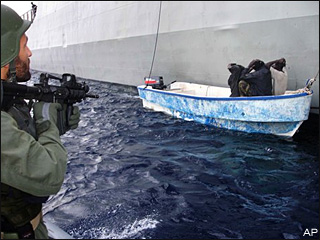
Navy commando is seen detaining a speedboat with suspected Somali pirates

Private security firms have found a new niche. In the absence of naval forces sufficient to protect all of the commercial ships traveling through the Indian Ocean and the Gulf of Aden, ship owners must decide whether to take the risk of hiring a private firm to protect their ships, with lethal force when necessary. Here and here are a few examples. One proposed venture would offer the following:

Vessels transiting Gulf of Aden waters will get both armed patrol boat escort and full anti-piracy cover for an average of US$21,500 per voyage, dependent on speed. This so-called Convoy Escort Program scheme would be classed as a “flag naval company” under the maritime and criminal law of a still-to-be-decided flag state.

Many ship owners have been reticent to hire private security companies to protect their ships because of: (1) the potential for escalation of violence; (2) questions regarding the legality of the use of force to prevent pirate attacks and (3) potential liability for injuries to seamen.

The need for adequate self-defence measures at sea leads to some surprising outcomes when faced with national regulation.  The criminal and regulatory regimes of a given State apply to a ship in a State’s territorial waters (usually 12 miles from shore). But when a ship is on the High Seas, the flag State where the ship is registered dictates what law applies. Considering the number of ports where a ship may dock, this makes for a complicated patch-work of laws. As a result, in order to avoid running afoul of local gun control laws, some maritime security companies are tossing weapons overboard prior to reaching port. There is a need to establish some kind of uniformity:

The Swiss government led efforts last year to create the International Code of Conduct for Private Security Service Providers, a set of principles for the growing global industry. But it is up to the countries that licence ships to oversee security teams.

Countries have vastly different laws for the use of force and for carrying weapons on board. The US allows for pre-emptive attacks on pirates, while Sweden will not allow any guns except for a single shotgun on any merchant ship it regulates.

For the time being, the International Maritime Organization Best Management Practices only provide, “The use of additional private security guards is at the discretion of the company, but the use of armed guards is not recommended.”

Pirates in Prada and Proving it

The Economist has a comprehensive report touching on many of the practical issues created by the rise of Piracy in the Indian Ocean. In the conclusion to the report, the report explains some of the reasons why there have not been more comprehensive efforts to address the problem.

Unfortunately, too many people like things as they are. Pirates gain wealth, excitement and glamour. Marine insurers, which last month extended the sea area deemed to be at threat from Somali pirates, are making good money from the business that piracy generates. At least for the time being, shipowners are willing to take the calculated risk of sailing in pirate-infested waters; so long as everyone bears his part of the extra $600m a year in premiums, they can pass the bill on to their customers. Patrolling foreign navies can demonstrate their usefulness to their sometimes sceptical political masters, while countries such as China and Russia are strengthening their operational experience.

Smithsonian Artifact: Slave Shackles

On another issue, the report acknowledged the difficulty in compiling evidence to prove acts of piracy. Professor Eugene Kontorovich has advocated for “Equipment Articles,” taking a cue from the slave era in which the British enacted laws creating a presumption that ships were engaged in slavery if they were in possession of certain equipment such as shackles. In the context of piracy, Professor Kontorovich states:

Equipment Articles could create a presumption of piracy for people found on a vessel less than a certain length, with engines of a certain horsepower, equipped with grappling hooks, boarding ladders, armed with RPGs and/or heavy machine guns, and/or far out at sea with obviously inadequate stores of food and water (which could suggest the skiff operates from a mothership).

Boarding ladders, such as the one seen in the header to this blog, and grappling hooks permit pirates to quickly gain access to a ship. But, the practical problem with this suggestion is set forth in the Economist report: “If they are caught in the middle of an attack, the pirates have no hesitation throwing their weapons—typically AK47 machine guns and rocket-propelled-grenade launchers—and their scaling ladders overboard to destroy evidence of their intentions.” All that would be left is a skiff with a large engine and, if the pirates are clever, a fishing net. The Equipment Articles would be of questionable utility in such circumstances.

But there is also a due process problem with such laws.  International criminal law has adopted the beyond a reasonable doubt standard of proof. Equipment Articles appear to lower the burden of proof such that the prosecution of a pirate would only require prima facie evidence that a suspect intended to commit piracy. In other words, Equipment Articles put the onus on the suspect to disprove that they intended to engage in piracy. Alternatively, Professor Kontorovich notes that during the slavery era, the United States never enacted Equipment Articles, but instead considered the possession of equipment as circumstantial evidence of slavery. This latter use is more consonant with contemporary International Criminal Law practice. Short of catching Pirates as they attempt to board a ship or after they have already taken hostages, compiling sufficient evidence to prove piracy will continue to pose a problem.

UPDATE: The Danish Navy was forced to release six suspected pirates for lack of proof to sustain a conviction. “The pirates “had thrown all their equipment used for piracy into the sea before the boat crew members of the Esbern Snare [the Danish Naval ship] had boarded. “

Lockerbie in Arusha – Significant Challenges Remain

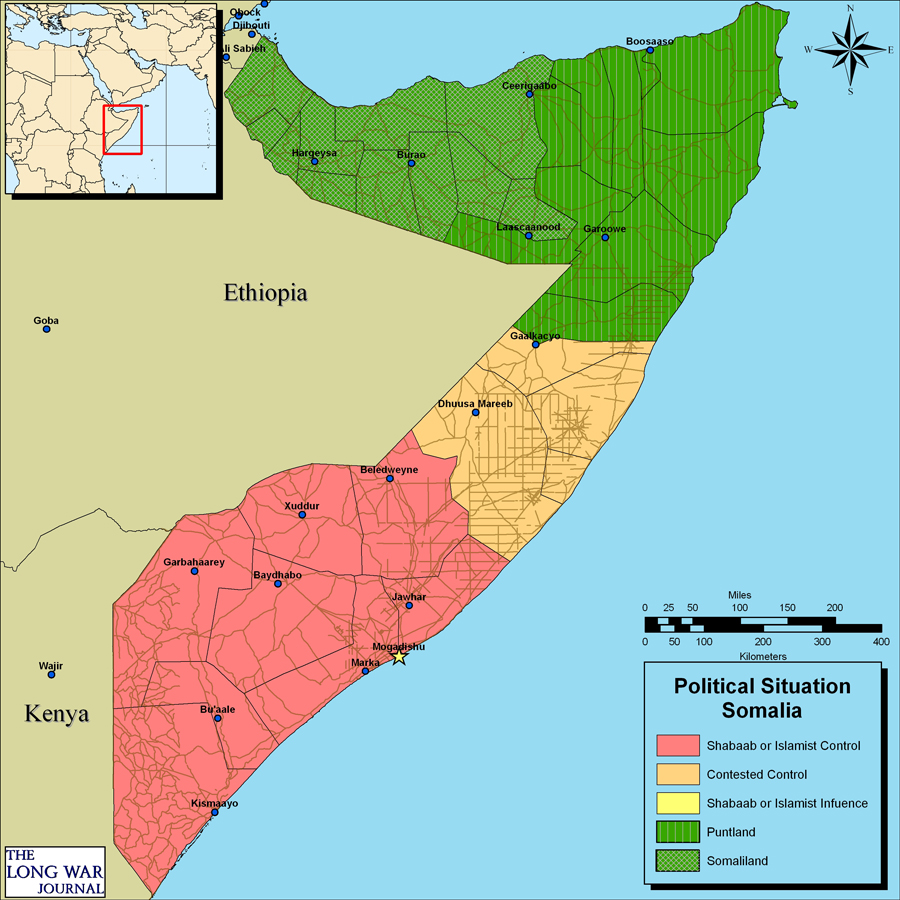
UPDATE: Lang actually recommended the creation of three courts: one in Puntland, one in Somaliland, and one in Arusha (to be moved to Mogadishu when conditions warrant). The Security Council members are generally in support of his recommendations, but you can discern some variations in their preferences by parsing the language of their statements. A number of questions come immediately to mind: (1) how will an arresting force determine to which of the three courts to send an arrested person? (2) Have Puntland and Somaliland delimited territorial waters where they would have exclusive jurisdiction? (3) Insofar as any nation may prosecute piracy on the High Seas, will the process of determining the proper venue be ad hoc or based upon formalized negotiations and agreements?

Jack Lang, UN Special Adviser on Piracy, has issued his report to the Secretary General.  News agencies are saying that he has recommended the creation of a Somali court sitting in another regional state (akin to the Lockerbie court).  There is some indication that Arusha, Tanzania is being considered as a seat for the Somali court due to the infrastructure already in place at the ICTR.  A number of serious challenges would need to be overcome to create such a court.

First, Somalia continues to be described as a monolithic entity, thereby necessitating a bilateral treaty between the regional State in which the court would be situated and Somali.  However, the United States policy has recently changed with regard to the heretofore unrecognized regions of Somaliland and Puntland. Assistant Secretary of State Johnnie Carson said at a briefing in September 2010:

We hope to be able to have more American diplomats and aid workers going into those countries [Somaliland and Puntland] on an ad hoc basis to meet with government officials to see how we can help them improve their capacity to provide services to their people, seeing whether there are development assistance projects that we can work with them on […] We think that both of these parts of Somalia have been zones of relative political and civil stability, and we think they will, in fact, be a bulwark against extremism and radicalism that might emerge from the South.

Carson said the United States will follow the African Union position and recognize only a single Somali state. However, with Somaliland and Puntland apparently offering to house convicted pirates within their territories, and other States increasingly recognizing their practical autonomy, it begs the question of whether or not an agreement to create a Somali court would require the assent of the Somaliland and Puntland governments. It would seem that a prerequisite to these regions signing an international treaty would be recognition of their Statehood.

The 26 July 2010 Report to the Security Council set forth several additional challenges with regard to the option put forward by Lang.  These include:(1) the considerable assistance that the UN will need to extend to the court; (2) the amount of time necessary for the court to commence functioning could be significant; and (3) the inadequacy of Somalia’s piracy laws and the capacity of Somalia’s judicial system.  In particular, the report noted:

Although there is some judicial capacity in Somalia and among the Somali diaspora, the challenge of establishing a Somali court meeting international standards in a third State would be considerable at present. Further, any advantages that such a court may enjoy would be outweighed if it were to draw limited judicial resources from Somalia’s courts.

One final point that should not be lost amidst the excitement is the mundane, but essential task of determining where Somalis who are eventually convicted of piracy, in the yet to be created court, will serve their sentences. Apparently, Lang has recommended the construction of one prison each in Somaliland and Puntland.  To which, Bronwyn Bruton, an author of reports on Somalia for the New York-based Council on Foreign Relations, reportedly said:

The idea that they’re [pirates] going to be scared off by prisons that meet UN human rights standards is wholly unrealistic. In these jails, they will have food, protection from violence and probably some basic literacy training. For these guys, it’s going to sound like a holiday camp.

Indeed the prospect of serving time in these prisons may not create a serious deterrent to piracy.  However, during the 8 or 20 years in which a pirate might serve a sentence, he will not be capable of committing further acts of piracy.  Furthermore, rehabilitation is a real possibility if stability can be maintained, jobs created, and inmates trained.  Any sustainable solution should take into account the possibilities for a newly released pirate.  If it does not, there is nothing to stop a jobless, ex-convict from continuing to seek bounty on the high seas.

Piracy Report Tomorrow

Jack Lang, the Special Adviser on Legal Issues related to Piracy off the Coast of Somalia, is due to issue his report tomorrow.  Lang was appointed by the Secretary General last August to:

identify any additional steps that can be taken to assist States in the region, as well as other States, to prosecute and imprison persons who engage in piracy; and explore the willingness of States in the region to serve as potential host for any of the options for potential new judicial mechanisms set out in the report of the Secretary-General.

The 26 July 2010 Secretary General’s Report set out 7 options to prosecute and imprison suspected acts of piracy off the coast of Somalia, including creating a special domestic chambers with international components, a regional tribunal or an international tribunal. [For further discussion, see the report: Suppressing Maritime Piracy -Exploring the Options in International Law.]

One of the options discussed by the Report, and which has been favored as a practical matter until present, has been to provide financial support to States within the region to prosecute suspected pirates in their national courts invoking universal jurisdiction. In this regard, the UN Office for Drugs and Crime and other donors have provided $5 million to refurbish the Shimo La Tewa court and prison in Mombasa where the suspects were being tried by Kenyan prosecutors.  The Seychelles has also started prosecuting pirates in its national courts with some assistance from the UN. Despite these efforts, Jack Lang, says that 9 out of every 10 pirates captured by marines are freed. Furthermore, in November 2010, the Kenyan High Court held that the Kenyan penal code does not give Kenyan courts jurisdiction over piracy on international waters, rendering in doubt any convictions obtained to date and casting a shadow on further efforts to prosecute suspected pirates in Kenyan courts.

The question now is what measures Jack Lang will propose. He hopes for a Security Council Resolution within three to four weeks.