Update on London Conference on Somalia: Somaliland to attend Conference

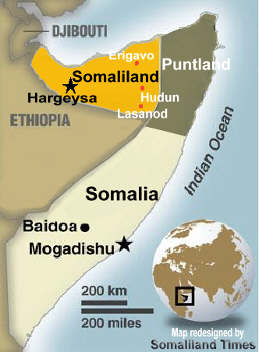
The parliament of Somalia’s separatist region of Somaliland overwhelmingly voted in favor to attend the upcoming international Conference on Somalia. The Conference will be hosted by the UK Government in London, on 23 February 2012. As previously noted, UK officials expect the attendance of world leaders and diplomats from over 40 countries. The vote marks a major policy shift for the separatist region, a former British protectorate, which has deliberately stayed away from several peace conferences concerning the situation in Somalia. Somaliland is located in northwestern Somalia, bordering Ethiopia in the south and west, Djibouti in the northwest and the autonomous Puntland region of Somalia to the east. Somaliland unilaterally declared independence from the rest of the country in 1991 but has not been recognized internationally.

Save the Date: London Conference on Somalia on 23 February 2012

As indicated in a recent post, the UK will host the London Conference on Somalia on 23 February 2012. Around 40 governments are expected to attend, along with the United Nations, African Union, European Union, World Bank, the Inter-Governmental Authority for Development, the Organisation of Islamic Conference, and the League of Arab States. Representatives of Somalia’s Transitional Federal Institutions, as well as the Presidents of the breakaway and autonomous regions of Somaliland, Puntland and Galmudug are also expected to attend. Ahead of the Conference, the UK Foreign Secretary today visited Mogadishu for the first time in nearly twenty years.

Somalia has been without an effective central government since President Siad Barre was overthrown in 1991. More than twenty years of civil war have had a dramatic effect on Somalia and its population. Announcing the Conference, UK Prime Minister David Cameron described Somalia as “a failed State”. Notably, the mandate of the Transitional Federal Institutions currently in charge of governing Somalia is due to end in August 2012.

The conference will discuss how the international community and Somali political leaders can step-up their efforts to tackle both the root causes and effects of the problems in the country. Central to the discussion are, obviously, anti-piracy efforts and perspectives. We will be trying to closely follow any relevant development in this regard, both on this blog as well as on our facebook page. In the meantime, those who are interested in this topic can follow the debate on the blog of the newly appointed UK Ambassador to Somalia.

International Maritime Bureau 2011 Global Piracy Report: Successful Piracy Attacks Decreasing

The International Maritime Bureau (IMB), the anti-maritime crimes arm of the International Chamber of Commerce, has released its 2011 Piracy Report. The Report is compiled on the basis of the incidents of piracy and armed robbery worldwide reported to the IMB.

Not surprisingly, pirate attacks against vessels in East and West Africa accounted for the majority of the world attacks, with Somali pirates accounting for more than 50% of these. Out of the 439 attacks reported in 2011, 275 attacks took place off the coast of Somalia and in the Gulf of Guinea. There are fears that pirate attacks in West Africa in 2011 were underreported.

The total number of pirate attacks fell only slightly from 445 in 2010 to 439 in 2011. Overall, in 2011 there were 176 vessels boarded, of which 45 were hijacked, and 113 were fired upon, in addition to 105 attempted attacks. While the number of Somali incidents increased from 219 in 2010 to 237 in 2011, the number of successful hijackings decreased from 49 to 28. The last quarter of 2011 shows an even more significant drop. However, these numbers do not take into account attacks on dhows and smaller vessels which are often targeted by pirates and may also unwittingly end up serving as motherships.

These figures echo a recent positive trend already signaled by the International Maritime Organization. According to the IMB, this is mainly attributable to the presence of international naval forces in the Gulf of Aden, the enforcement of the IMB best practices (such as the use of citadels, sprinkler systems, and other active defences) and the deterrent effect of the employment of privately armed security personnel on board.

Will these positive developments continue in 2012?

UK House of Commons Issues Piracy Report, Eyes Private Security Guards on Board, Local Prosecutions in East Africa (Part II)

This is the second part of an earlier post discussing the UK Foreign Affairs Committee Report on piracy off the coast of Somalia.

Regional and Local Prosecutions of Pirates (paras 74-110)

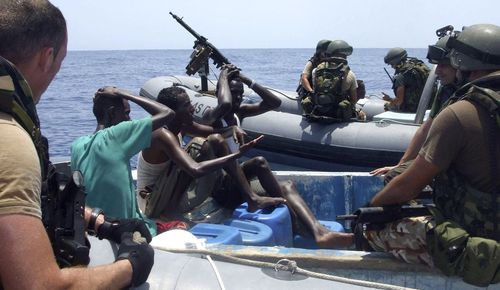
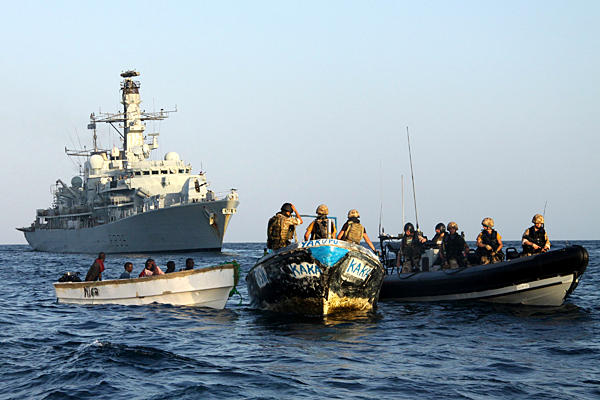
The trial and prosecution of pirates is also an extremely relevant, and pressing, topic. As noted in the Report, the peculiar features of modern day piracy, particularly in the Gulf of Aden and the lack of cohesive governance in Somalia, create several practical difficulties, including the apprehension, detention on board and transfer of suspected pirates. One of the primary purposes of policing activities through naval operations is, indeed, its deterrent effect on pirate attacks rather than the arrest and prosecution of the perpetrators.
The collection of sufficient evidence to secure successful prosecutions is particularly problematic, as we noted in a recent post. It should be remarked how any evidentiary assessment on whether to bring alleged perpetrators to justice should, ordinarily, be best placed in the hands of judicial authorities as neutral fact-finders rather than subject to the prelimary evaluation by the naval authorities upon the capture of suspected pirates. Moreover, the Report correctly points out how such assessment could benefit from modern technological means already available to the naval authorities, namely video, radar and satellite recording. In addition, remote testimony via video or audio link is recommended, particularly when victims are located in third countries or, more likely, have already set sail.

Modern international law asserts the possibility to exercise universal jurisdiction over piracy prosecutions. However, as one expert who gave evidence before the Committee put it, the obstacle to prosecution is not identifying the appropriate jurisdiction, but rather the inability, and unwillingness, to prosecute. In addition, the surge of modern piracy and armed robbery at sea has exposed the current inadequacy of national laws, including in the UK, against piracy. For those operating within the field of international criminal prosecutions, the phenomenon is not new. Several states suddenly found themselves incapable to put Genocide suspects on trial before municipal courts due to the inadequacy of their national laws in enacting the provisions of the Genocide Convention.

We have also discussed whether the response to modern piracy should contemplate a revision of the existing international counter-piracy legislation and mechanisms, in particular because it appears that current treaties have difficulty in addressing the difference between political and purely-financial motivations of pirates attacks, or whether attempted attacks are also punishable. Interestingly, as noted in the Report, the IMO has taken the view that “the development of a new multilateral instrument might be premature, or unnecessary, in light of the existing international legal framework on piracy, which was generally considered to be adequate”. Some concerns remain, however, particularly on the practical implementation and effectiveness of these mechanisms.

The main recommendation contained in the Report with regard to options for the investigation and prosecution of pirates is therefore the rejection of the establishment of a specialized Somali tribunal, initially recommended by the UN Special Adviser to the Secretary General Jack Lang as one possible alternative. This option would have established a court outside of Somalia in a neighboring state (most likely Tanzania) with funding and administration from the international community, but would employ Somali judges applying Somali law. There appear to be a number of compelling legal complications against such court, including its legality vis a vis the Somali Constitution. The UK Report rejected this proposal stating:

 “the Government was right to oppose the establishment of an extra-territorial Somali court as proposed in the Jack Lang report to try Somali pirates in a third country. We recommend that the Government set out in its response to this report its views on the more recent proposals for specialised anti-piracy courts established within regional states under ordinary national law.”(para. 92)

Among the main arguments in support of this conclusion are also the possible high costs of an extra-territorial institution, with a tentative figure of $100 million a year. This is not convincing, particularly considering the lack of clarity at the basis of this figure as well as the present estimates of the global costs of piracy, which already identified high costs from the current prosecutions as well as a cost of ransoms alone capping over $130 million per year. In addition, this figure would remain a fraction of the overall economic costs of piracy. It must be acknowledged, however, that an extra-territorial court, financially supported by international organizations, might not be able to promptly contribute as an anti-piracy deterrent and develop effective outreach capabilities within the turned-pirate population in and around the Gulf of Aden.

The rejection of the UN-funded option reflects a gaining trend to favor specialized piracy prosecutions within the area where the alleged attacks took place, counting on a much stronger deterred effect than trials taking place thousands of miles away. Local prosecution projects have already taken shape in Kenya, Mauritius and Seychelles, among other countries in the region. In addition, a small number of historic trials were also held in the US, Germany and the Netherlands, mainly because the alleged pirates were captured by the naval forces of these countries, or due to a nexus between the piracy acts and these latter.

However, while piracy prosecutions in the UK are still contemplated, albeit in limited circumstances, in the Report, the support expressed therein for local or regional anti-piracy courts also present several difficulties which should be carefully weighed. Requesting the help of regional states to prosecute pirates in their courts does not obviate the need to provide support to the various local authorities in the form of financing, training, monitoring and oversight extending not only to the mere prosecutions and trials of suspected pirates, but also to transfer, investigation, security, procurement and infrastructures as well as pre-trial and post sentence detention. Indeed, the fate of a recently arrested group of alleged Somali pirates by the UK Royal Navy after both Kenya and the Seychelles have refused to detain them because “their court systems are swamped”  is a rather timely reminder of some of these difficulties. As the Kenyan government stated last year when it refused to continue piracy prosecutions, ““We discharged our international obligation. Others shied away from doing so. And we cannot bear the burden of the international responsibility.”
UK House of Commons Issues Piracy Report, Eyes Private Security Guards on Board, Local Prosecutions in East Africa (Part I)

The Foreign Affairs Committee of the UK House of Commons recently released an interesting report on piracy off the coast of Somalia.  For those who are not conversant with its work, here is some background.

The Report was originally commissioned in June 2011 in response to the growing concerns from piracy and armed robberies activities in recent years, particularly off the coast of Somalia, and on their effect on the UK’s economy and security:

“Piracy off the coast of Somalia has escalated over the last four years and is a major concern for the UK. The threat is not primarily to UK ships as very few have been captured. Rather, the threat is to the UK’s economy and security. Piracy affects the UK’s banking, insurance and shipping industries, and threatens the large volume of goods which are transported to the UK by sea.” (para. 20)

More particularly, the Committee examined the role of the Foreign Commonwealth Office (FCO) in support of UK and international efforts to combat piracy, including the adequacy of international and domestic anti-piracy legislation, the support for anti-piracy projects on the ground in Somalia (including coordination at the international level, particularly with the United Nations), as well as UK naval involvement with NATO and EU anti-piracy operations. As part of this inquiry, the Committee received evidence from shipping and insurance industries, EUNAVFOR and the Ministry of Defence, in addition to experts on piracy and Somalia. Paul and Rachel Chandler, whose yacht was hijacked by Somali pirates in October 2009 and who were held captive for over a year also provided testimony.

The Report contains a set of wide ranging conclusions, the most important of which is a call for the UK, as a state “whose strengths and vulnerabilities are distinctly maritime”, to “play a leading role in the international response to piracy.” However, while its publication has been promptly noted by an authoritative legal source and welcomed by experts in the shipping, naval and security fields, the Report is yet to receive an in-depth legal analysis, at least with regard to some of its main recommendations. It is hoped that the UK Government response to the Report will help generate more discussion on the UK policies (as well as those of the international community) towards piracy in Somalia. As noted in the Report, the UK is also soon to host an high-profile international conference on piracy, to be held in February 2012.

The Committee’s final recommendations touch upon several relevant issues. These include the UK’s overall response to piracy and the need for the FCO to increase its support to victims and families as well as the continuation of the UK contribution to the naval task forces patrolling the Gulf of Aden. The Report also commended the positive efforts made by the shipping industry to ensure safety and exercise self-defence and discussed the appropriateness of the payment of ransoms to pirates to rescue hijacked boats and kidnapped seafarers as well as the need to improve the financial tracking of the monetary flows connected with piracy. In addition, the Report called for  more coordination in the international response and local solutions on the ground to tackle the social and economic root causes of piracy in Somalia. Finally, the Report addressed the deployment of armed security guards on board of vessels and local efforts to prosecute and enforce penalties against pirates. These two last points appear of particular momentum and interest, thus warranting a more focused comment.

Private Armed Security Guards (paras 26-43)

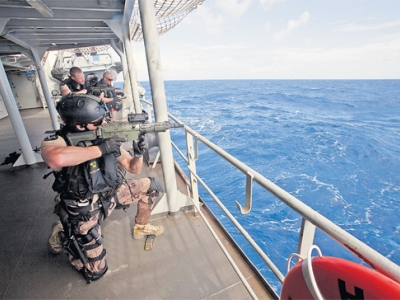
The use of private armed security guards (PASG) in post-war settings is not a novelty. Most recently, governments have increasingly resorted to outsource their security functions while private security companies have notoriously rushed to provide relief to military intervention forces in places such as Iraq and Afghanistan. It is therefore not surprising that, also considering the high costs associated with episodes of piracy and armed robberies off the Somali coast, the sector of private armed security on board of shipping and cruise vessels is booming. A simple internet search reveals a plethora of security companies offering services to the maritime industry. One cannot but agree with the Report when it cautions a “‘gold rush’ of new private maritime security firms.” As discussed in a recent post, the unprecedented launch of a fleet of fully fledged private armed ships appears imminent. As suprising as this might sound, worthy of note is that private security contractor Blackwater Worldwide appears to have previously attempted to provide similar security services. See also a comprehensive jurisdictional analysis on the use of PASG here, particularly noting how the underlying legal issue is mainly one of the exercise, and limits, of self-defence.

The Report notes and supports the recent UK Government about-face by now permitting the deployment of PASG on board of UK-flagged vessels:

“the evidence in support of using private armed security guards is compelling and, within legal limits and according to guidance, shipowners should be allowed to protect their ships and crew by employing private armed security guards if they wish to do so.”

This recommendation certainly marks a shift in favor of the deterrent effect and towards empowering and calling for shipowners, as well as insurers, to bear some of the responsibilities and costs associated with providing security along the main shipping routes. However, regulation and accountability mechanisms have not kept pace with the surging growth of the private security sector. The Report addresses the various risks of using PASG on board (particularly using lethal force), and calls for further formal and practical guidelines to better regulate their operation. However, it falls short of emphasising any concrete direction on what force can be used and when. The International Maritime Organization (IMO) has also issued interim guidelines on the use of private security guards as well as several aspects of their activities. The IMO previously clarified that these guidelines are not intended to institutionalise the use of armed and privately contracted security guards on ships and that they do not address all the legal issues that could be linked to their use. India and the U.S. have also issued guidances.

Calls for further and uniform clarifications have already been raised and, together with an assessment of the need for a permanent legislative framework that substitutes the current interim guidelines, should be on top of the agenda for the Government response to the report. In addition, with other States having opposed the use of such armed guards, the risk of fragmentation between flag, port and coastal states is of particular concern.  This leaves PASGs in the awkward position of being permitted by a flag-state to bear weapons on board and ship and tossing those weapons overboard before calling to port in a jurisdiction that may not permit armed personnel aboard commercial ships

In addition to the security of commercial ships, any holistic solution will encompass mechanisms for the prosecution, transfer and imprisonment of pirates. The solutions suggested by the Report in this regard will be discussed in a forthcoming separate posting.