The Mekong Pirates
December 30, 2011 1 Comment
The recent murder of 13 Chinese sailors on South-East Asia’s Mekong river triggered unprecedented joint international naval patrols by China, Laos, Myanmar and Thailand to provide security along parts of the estimated 4900 Km long river.
 After crossing the Tibetan plateau and leaving China’s Yunnan Province, the Mekong flows southwest and forms the border between Myanmar and Laos for about 100 kilometers. It then turns southeast to form briefly the border of Laos with Thailand, then flows east and south into Laos for some 400 kilometers and defines the Laos-Thailand border again for some 850 kilometers as it flows east. It then reaches Cambodia, providing significantly for the country’s fishing and rice farming economy. Finally the Mekong empties into the South China Sea and upon entering Vietnam, subdivides into the Mekong Delta. The Mekong flows at the hearth of the so-called “Golden Triangle”, an area overlapping the mountains of Myanmar, Vietnam, Laos, and Thailand which has long since been one of the most extensive opium and heroin-producing areas of Asia and of the world. More recently, the drug production and trade has shifted to methamphetamines.
According to initial reports, the sailors were attacked in October when sailing aboard two ships in the Golden Triangle area. Some of the sailors had been found in the river with their hands tied behind their backs, some were blindfolded and some had been shot. The ships were recovered by Thai river police after a gunfight. Some 900,000 methamphetamine tablets worth more than $3m were found aboard, hence drug smugglers were initially suspected of the attack. In response, China suspended all shipping activities on the Mekong and urged Thai authorities to arrest those responsible. Later reports suggest the involvement of 9 Thai soldiers attached to an anti-drug task force who surrendered shortly after the attack and are now facing prosecution.
While the motives of the attack appear closely linked with drug trafficking, the economic and political interests of the Mekong’s numerous riparian States give an international dimension to the incident. Seasonal variations in water flow and the presence of waterfalls have historically made navigation of the river difficult, thus dividing, rather than uniting, the people of the Mekong. In 1995, following the UN mediation, Laos, Thailand, Cambodia and Vietnam established the Mekong River Commission to assist in the management and coordinated use of the Mekong’s resources. In 1996, China and Myanmar became “dialogue partners” of the Commission and the six countries now work together within a cooperative framework. Recently, each of these countries have been notoriously engaged in lengthy discussions regarding a Chinese-sponsored hydroelectric dam construction project – currently suspended – and its overall impact on the region.
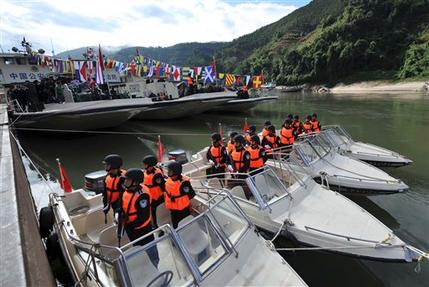 The patrols mark a significant shift in China’s long standing policy of non interference in other States internal affairs. The patrols are said to be the first instance of Chinese police being deployed outside their territory without a UN mandate. It is thus not surprising that China is taking a leading role in the operations. The patrols are headquartered in China with stations in each of the other countries. At a meeting in Beijing, ministers from all four countries agreed on the new measures. China contributed with the deployment of 200 police officers and 11 ships. The plan also involves police departments in the four countries setting up a coordination team to explore further security measures. Finally, China will also help train and equip police in Laos and Myanmar for the patrols.
 It is problematic to fully assess the legal framework in which the patrols could be deemed to operate as well as their relation with anti-piracy and armed robbery efforts. Interestingly, a cursory review of the history of piracy reveals limited reported instances of so called “river piracy”, mainly consisting of fluvial criminal activities in the 18th century within the USA. However, lacking its most fundamental element, namely the occurrence of the attack in the high seas, the Mekong incident squarely falls outside the relevant provisions of the Convention on the Law of the Sea (UNCLOS) relevant to piracy. Yet again, there appears to be a situation where the current applicable specialized international legal framework is not directly applicable to contemporary criminal activities or is capable to address their underlying root causes and overall impact, particularly in areas of flourishing economic development. States (including signatories to UNCLOS) are free to adopt broader definitions of piracy applicable to internal waters. However, the current trend is to legislate the definition in Article 101 of UNCLOS. Armed robbery at sea pertains to piratical acts within the territorial sea, but criminal acts within internal waters (even if such waters have an international character) remain unaddressed. The most important upshot to the situation at hand is that the principles which could resolve competing claims of police and judicial jurisdiction over criminal activity along the Mekong are not codified.
Recourse to the current, yet scarce and developing, legal framework attaching to international rivers might therefore provide for more focused analysis. Rivers are ordinarily considered as part of a country’s internal waters. However, rivers are also often used to demarcate borders. More importantly, lengthy rivers could cross several countries, reflecting a wide range of political, geographic, economic and cultural circumstances. The Mekong, the world’s 10th longest, is one such international river. These are also referred to as shared or transboundary rivers, as well as international watercourses.
Riparian states, namely states through which a transboundary river flows or form part of its borders, developed riparian rights and obligations normally confined over the use of the river for livelihood or sustainability purposes. Riparian States traditionally resorted to specific watercourse agreements or treaties to regulate the use of a shared river. Much of these rights and obligations are defined by the UN Convention of Non-Navigational Use of International Watercourses, which has yet to enter into force. Among its key guiding principles, contained in Articles 5 and 7, are the “equitable and reasonable utilization” and the obligation “not to cause significant harm” to other riparian states.
Literature on sharing international rivers define these as both catalyst for cooperation or conflict but also points to several important benefits from a structured cooperation among riparian states, including environmental, direct economic, political, and indirect economic benefits. Instances of state cooperation, however, seldom refer directly to issues relevant to the security of the watercourses, with the exception of risks deriving from pollution or excessive exploitation. Notably, Articles 7 and 8 of the UN Watercourses Convention requires States to “take all appropriate measures” to prevent or mitigate significant harm to other States as well as a general obligation to cooperate among riparian states.
Control of international rivers is inextricably linked with economic opportunity, national security, society and culture. It is within this general framework that the agreed cooperation over patrolling the Mekong and ensuring the safety of its navigation, in essence an international basin or watercourse agreement, should be seen. Such cooperation could cut individual States security costs and further their overall benefits from the use of the river, addressing issues of policing, extradition and prosecution as well as solidifying channels of communication between riparian states to address a potentially volatile situation. In other words, better security over the river will promote unity and integration among the riparian States and more possibility for each of them to manage the development and use of the river.

 Roger L. Phillips
 Hilarie Henry
 Jon Bellish
 Matteo Crippa
 Milena Sterio
 Shannon Maree Torrens
 sonia messaoudi
 Michael Y. Liu
 Communis Hostis Omnium