Intentional Facilitation and Commission of Piracy as part of a Joint Criminal Enterprise

Defendant Ali Mohamed Ali, Source: Foxnews

In the U.S. government’s efforts to ramp up piracy prosecutions to include pirate kingpins, several cases of mid-level negotiators are working their way through the courts. We discussed one such case here. Another such prosecution recently met some setbacks when a U.S. District Court ruled in U.S. v. Ali that conspiracy to commit piracy was not a cognizable crime and further limited the application of intentional facilitation of piracy to acts committed on the high seas. See alsohere. The latter issue was apparently moot at the outset since the prosecution alleged that the negotiator was on the high seas when he intentionally facilitated the acts of piracy. However, in a contentious hearing last week, it became apparent that the Accused only spent about 25 minutes on the high seas and that his criminal conduct may not have occurred in that time frame. Therefore the high seas issue is now central to the outcome of the case. The Prosecution has signalled its intent to file an interlocutory appeal and the Judge has ordered that the Accused be released on bail, noting misrepresentations by the prosecution on this issue. In my view, the conspiracy ruling was correct, but intentional facilitation was improperly limited to conduct on the high seas. This latter error would impede future prosecutions of pirate leaders in U.S. courts.

It should be made clear that U.S. courts that have addressed the issue in the last several years have uniformly concluded that although the U.S. is not a party to the U.N. Convention on the Law of the Sea, this treaty contains the definition of piracy under customary international law which is incorporated by the U.S. piracy statute (18 USC 1651). Therefore, piracy is defined in the U.S. purely by reference to international law, and not domestic U.S. law. See here for further background.

In its 13 July Decision in U.S. v. Ali, the Court held that the piracy statute requires that intentional facilitation occur on the high seas. See Memorandum Opinion at 17. I disagree with this interpretation of UNCLOS for several reasons. First, a plain language reading of UNCLOS does not impose a requirement that inciting or intentionally facilitating an act of piracy occur on the high seas. Article 101(a)(i) of UNCLOS defines piracy as “any illegal acts of violence or detention, or any act of depredation, committed for private ends […] on the high seas […]” Intentional facilitation of such an act of piracy appears in subsection (c) of Article 101 which does not include the requirement that the act occur on the high seas. In other words, the illegal act of violence or detention must occur on the high seas, but the facilitation need not occur there.

The U.S. piracy statute could create some confusion as it specifically refers to piracy committed on the high seas which might be interpreted to extend the high seas requirement to intentional facilitation. (See 18 USC 1651 which provides in full, “Whoever, on the high seas, commits the crime of piracy as defined by the law of nations, and is afterwards brought into or found in the United States, shall be imprisoned for life.”) However, the reference to piracy on the high seas in 18 USC 1651 is redundant. By definition under customary international law, acts of piracy (though not incitement or facilitation) must occur on the high seas. The reference to acts on the high seas in 18 USC 1651 was only meant to emphasize that conduct committed in the territorial waters of another state would not constitute piracy (such conduct is instead robbery at sea, solely within the purview of the littoral state). It is not at all clear that Congress would intend to modify the otherwise settled view of the law of nations. Therefore, to impose the high seas requirement on subsection (c) of UNCLOS (pertaining to intentional facilitation), which does not appear in the plain language of the treaty, would be contrary to the U.S. Supreme Court’s Charming Betsy canon (whereby a statute should be construed not to violate international law).

Furthermore, restricting intentional facilitation of piracy to crimes perpetrated wholly on the high seas is not necessary to protect the sovereignty of states where pirate kingpins may reside. The piracy statute only provides personal jurisdiction over those who are “afterwards brought into or found in the United States.” If a pirate kingpin has negotiated a ransom from the territory of another state, the U.S. must request extradition through the usual means prescribed by international law. For all of these reasons, the high seas requirement should not be added to the crime of intentional facilitation of piracy.

As to the District Court’s second holding, the decision to dismiss the conspiracy to commit piracy charge appears well-founded. However, it is worth considering whether other forms of responsibility, firmly established in customary international law, might support the criminalization of the conduct in question. For example, commission has been interpreted by the ad hoc tribunals (ICTR, ICTY, SCSL, STL) to encompass the form of responsibility referred to as joint criminal enterprise (JCE) where there exists (1) a plurality of persons; (2) a common plan, design or purpose which amounts to or involves the commission of a crime and (4) the accused’s participation in the common plan. Of course, the tribunals did not have competence to consider charges of piracy. However, similar forms of accessory liability are found in numerous domestic legal systems and piracy prosecutions in Seychelles have been successful on a theory of accomplice liability akin to JCE. See here and here. This mode of responsibility has not been considered by any U.S. court in a piracy case.

Jama Idle Ibrahim, sentenced last year to 25 years for his role in the same attack, will be a government witness against Ali.

Apart from the jurisdictional issues, the ultimate question in this prosecution is whether negotiators acting as middlemen between pirate hostage-takers and those seeking their release “intentionally facilitate” piracy pursuant to UNCLOS. The answer will depend on the factual circumstances and how the mens rea of facilitation is construed. The drafters of UNCLOS limited facilitation by requiring that the accused intentionally (not merely negligently or recklessly) facilitated the piratical act. This suggests not only that the Accused must intend to support the illegal act of violence or detention, but also that the facilitator must share the pirate’s intent to commit the act “for private ends” (i.e. for personal enrichment or other non-political purposes). Involvement in negotiations to release the hostages for humanitarian reasons would not satisfy this mens rea requirement. Elsewhere, Professor Kontorovich suggests that intentional facilitation cannot occur after an act of piracy, but must have occurred prior to it. But if the piratical act was committed with the pre-formed intent to hold hostages for ransom, then the completed piratical act would not have been possible but for the intervention and assistance of a negotiator to complete the transaction. If a negotiator also possesses the intent to personally enrich himself, the conduct would appear to fall within Article 101(c) of UNCLOS.

One final word about the fairness of this prosecution. Depending on the circumstances of a case, the negotiation of a ransom (or the financing of piracy for that matter) may appear to be less reprehensible than the acts of violence committed against seafarers on the high seas. Such is the dichotomy between low-level perpetrators and their white-collar sponsors. If a mandatory life sentence, as is imposed by the U.S. piracy statute, is inappropriate in some cases involving accomplice liability, this is a matter of charging strategy best left to the prosecutor. There are a number of other non-piracy statutes in the prosecutor’s repertoire that could be put to use. But it is an overbroad statement to assert that all white-collar facilitators of piracy deserve leniency.

Kingpins Enjoy Impunity

A confidential UN report, made available to Reuters, highlights the considerable disparity in the treatment of low-level operatives versus pirate kingpins in that the latter enjoy impunity. The report notes:

The UN Monitoring Group on Somalia said in a report to the Security Council, seen by Reuters, that senior pirate leaders were benefitting from high level protection from Somali authorities and were not being sufficiently targeted for arrest or sanction by international authorities.

[…]

The UN report said pirate leaders are now increasingly involved in land-based kidnap for ransom of foreign tourists and aid workers in northern Kenya and Somalia, as well as selling services as counter-piracy experts and consultants in ransom negotiations, and exploring “new types of criminal activity”.

“This evolution of the piracy business model is being driven largely by members of the Somali diaspora, whose foreign language skills and bank accounts are all valuable assets,” it said.

[…]

The [Monitoring] Group said that in spite of three international task forces and efforts by a dozen national governments in maritime counter-piracy efforts, serious legal obstacles remain that “impede the prosecution and sanctioning of pirate leaders and kingpins”.

Further to this last observation, a recent opinion by a U.S. District Court brings into question the ability to prosecute pirate kingpins who never set foot aboard a pirate vessel on the high seas. For reasons I will set forth in a forthcoming post, I think the court reached some faulty conclusions. But if the reasoning in that opinion gains traction, prosecution of high-level pirates under the framework set forth in UNCLOS will become increasingly untenable.

Incitement to Hunt al-Shabaab

Ahmed Abdi aw-Mohamed, founder of al-Shabaab

Last month, the U.S. State Department announced that it was offering rewards of $3-7 million for information that would lead to the senior leaders of al-Shabaab. See also, here. As Somali pirates continue to meet considerable resistance at sea, and successful pirate attacks see a precipitous drop, they are seeking new sources of income. This raises the possibility that they will seek to provide information about the whereabouts of al-Shabaab leaders pursuant to the State Department Rewards for Justice program. But there are potential legal obstacles to paying for information from pirates.

As some background, there continues to be debate as to whether members of al-Shabaab and Somali pirates are colluding with one-another. For example, in a recent trial in Italy, the prosecutors asserted that pirates had connections to al-Shabaab and planned on using the ransom proceeds to finance terrorist activities. Likewise, Kenya justified its initial incursions into Somalia based upon the assertion that recent kidnappings of tourists and aid workers in Kenya were the work of al-Shabaab (though some of these attacks were likely perpetrated by pirates with no political objective). There have also been assertions that the port of Kismayo, al-Shabaab’s most important source of income, was being shared by pirates. Kenyan Prime Minister Raila Odinga has requested assistance from the EU naval mission to help to take Kismayo, but the EU has been reluctant because it considers the port to be an al-Shabaab stronghold and not a stronghold of pirates.

Readers of this blog will recall that in 2010, President Obama issued executive order 13536 imposing economic sanctions on suspected financiers of Somali piracy. Although this same executive order imposed sanctions on the organization of al-Shabaab, the preface specifically declared a national emergency to deal with “the deterioration of the security situation and the persistence of violence in Somalia, and acts of piracy and armed robbery at sea off the coast of Somalia.” Terrorism and al-Qaida were not mentioned, suggesting the economic sanctions were being targeted at pirates.

This brings us to the Rewards for Justice program and the list of seven senior leaders of al-Shabaab. Of this list, it appears that three individuals also appeared in the President’s executive order 13536 annex. Perhaps the economic sanctions had always contained a list of both pirates and al-Shabaab. Another possibility is that former pirates have joined the forces of al-Shabaab. Whatever the case, the State Department is prohibited by executive order 13536 from paying for information from the individuals named in the order. Considering the past confusion as to potential links between al-Shabaab and pirates, it will prove a challenging task to verify that a particular individual providing information is not affiliated with one of the individuals named in the executive order or with al-Shabaab. Even if information does not come from individuals specifically named in the executive order, the State Department will have to consider the possibility that reward money will go to finance pirate operations. In the end, it may be a case of the enemy of my enemy is my friend (at least for today). Regardless, the possibility that pirates could provide information as to the whereabouts of al-Shabaab’s senior leaders might be enough to prevent any future alliance between the two organizations.

Efforts to Support Somalia-based Prosecutions Continue

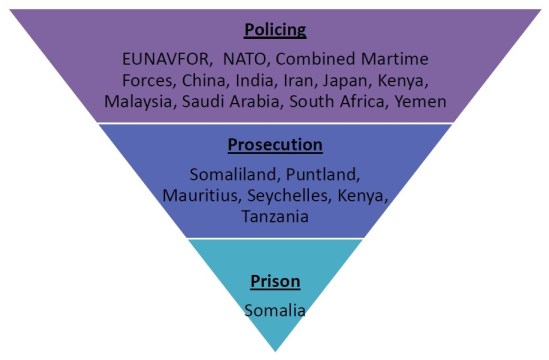
Following a recent trial in the UAE resulting in the conviction of 10 pirates, the UAE has announced that it will host a training of Somali judges to buttress local, Somalia-based prosecutions. The UN report from January recommended regional prosecutions, in lieu of an international court, to tackle the expanding docket of Indian Ocean piracy cases without an obvious home. Such prosecutions were recommended and have continued in regional states, including Kenya, Tanzania, Mauritius, and Seychelles. Moreover, the UN report suggested that the break-away regions of Somaliland and Puntland, as well as the Transitional Federal Government in Mogadishu, would be appropriate locations for prosecutions. Since then, violence against the judiciary and fair trial concerns have arisen in Puntland in particular. Nonetheless, the UAE judicial training, apparently supported by the French ministry of foreign and European affairs, will identify and train judges from Puntland, Somaliland and the TFG. The move is consistent with efforts to funnel the piracy issue back to Somalia as regional states grow tired of bearing the brunt of the prosecutorial burden. The UAE report notes:

The Kenyan ambassador to the UAE Mohamed Gello said prosecuting pirates in neighbouring countries such as his was also a strain on resources.”Any move that will help the Somali judicial system effectively deal with pirates is welcome,” Mr Gello said. “This sends the right signals that law and order is slowly being restored, along with the administration of justice. “It is crucial to build confidence in the judicial system and for the pirates to be dealt with in their own country.”

Funneling Pirates Back to Somalia

USAID may increase development assistance to Somalia

Senator Kirk at the Shimo la Tewa Prison in Mombasa, Kenya
where five dozen Somali pirates are held, including Ahmed
Abdulkadir Hersi.

From 2008 to 2011 the development assistance provided by USAID to Somalia decreased from $260 to $80 million. Language has been inserted into the foreign appropriations bill that could indicate a change in this trend in order to address the root-causes of piracy.  Last week, the Senate Appropriations Committee approved S.3241, including the following provision:

(g) PIRACY.—Not later than 180 days after enactment of this Act, and following consultation with other relevant Federal agencies, the Secretary of State shall submit to the Committees on Appropriations a diplomacy and development counter-piracy strategy for the Horn of Africa region, including an assessment of the potential effectiveness of economic and security assistance for vulnerable Somali and Kenyan communities in providing gainful alternatives to piracy and encouraging collective action within such communities against groups and individuals involved in piracy. (emphasis added).

The language was inserted by Mark Kirk who has taken on maritime piracy as one of his policy initiatives. In April 2011, he compiled a report including recommendations to stem the rise of piracy:

  1. A US/UN ban on ransom payments that support the expansion of pirate operations
    and support for East African Al Qaeda/Al Shabaab terror;
  2. Aggressive Rules of Engagement giving authority for local naval commanders to
    attack and disable pirate “motherships,” leaving them adrift to empower on-scene
    commanders with the tactical authority to arrest pirates and rescue crews;
  3. Economic Assistance to reward Transitional Federal Government (TFG),
    Somaliland, Puntland, Ahlusunna Wal-jamea (ASWJ) and Jubaland frontline
    communities who confront or convert Al Shabaab or pirate-controlled areas;
  4. Judicial Assistance to Puntland and Kenya to expand their courts and prisons to
    readily accept pirates captured by international or Somali allied military/law
    enforcement forces;
  5. Military Assistance to TFG, Puntland, Somaliland, ASWJ or Jubaland forces who
    gain control of Al Shabaab or pirate-controlled areas; and,
  6. A Blockade of the three primary pirate ports and shorelines, including the El Danaan
    Anchorage, where 12 western tankers/merchant ships with 290 hostages are held.

The language inserted into the bill would ostensibly support point 3 on the list of proposals.  Development assistance has been encouraged as a way to dis-incentivize piracy as the lack of any other sources of income has made piracy an attractive option for young Somalis. However, any increase in assistance would have to contend with the danger of graft in the TFG and other institutions. As USAID puts it, “The situation in Somalia is highly fluid, and Somalia’s social, economic, and political development faces formidable challenges.”