Contact Group on Piracy Recommends Prosecution of Pirate Leaders

The Contact Group on Piracy off the Coast of Somalia met in New York on 21 March 2011 in the first of its thrice-yearly meetings.  The Contact Group was created pursuant to U.N. Security Council Resolution 1851 and is composed of about 60 countries and several international organizations , including the African Union, the League of Arab States, European Union, the International Maritime Organization, the North Atlantic Treaty Organization and various departments and agencies of the United Nations.

To date, I am unaware of any prosecution of pirate ring leaders or financiers. Those who have been prosecuted in various countries for piracy are the footsoldiers who execute the attacks.  You can remove dozens of footsoldiers from the equation, but if the financing for pirate ventures is uninterrupted, pirate attacks will continue.  In this regard, the Chairperson of the Contact Group, Ertuğrul Apakan of Turkey, stated:

In the effort to end impunity, such an approach would include a multifaceted, aggressive effort to prosecute and incarcerate pirates, including their leaders and financiers, through information sharing, other innovative mechanisms and support for national prosecution.

A key policy decision regarding the prosecution of pirates is whether or not to pursue those individuals responsible for financing piracy. Such individuals never step foot on a pirate boat which makes proving their link to attacks more challenging. Such efforts might require leveraging lower level criminals to testify against their superiors, and tracing financing and ransom payments. This implies lengthy investigations, requiring significant resources. As the ICTR/ICTY models have shown, these efforts can drag on. It is unclear whether the international community would want to tackle such a task when the cost or duration of such prosecutions could not be reasonably estimated.  Prosecuting footsoldiers is a much simpler business.

UN Security Council to Consider Piracy Thursday

According to Businessweek:

China, as president of the Security Council this month, plans to lead a meeting on March 10 to call for a more comprehensive international strategy for dealing with political instability, piracy and the threat posed by the Islamic al- Shabaab militia. Secretary-General Ban Ki-moon is scheduled to brief the council on the latest developments.

This is a follow-up to Jack Lang’s report of 25 January 2011 which was the subject of a previous post. At that time, Lang was hoping for a Security Council Resolution by the end of February. With all of the events in Egypt, Tunisia, Libya, etc., the SC has had its hands full. Notwithstanding other pressing issues, apparently China saw fit to add piracy to the schedule.

Four Americans Dead – What Went Wrong?

Jean and Scott Adams - Owner's of the Quest hi-jacked by pirates

The killing of four Americans at the hands of Somali pirates has certainly brought the issue of piracy into full view of the American public. Until now, there has been a marginal increase in the price of goods due to insurance pay-offs in the form of ransoms. But it is hard to overestimate the effect of the confluence of events leading up to the death of four Americans and a significant shift in American policy. If the Adams had accepted the offer of yachting friends to ship their yacht through the Red Sea to avoid the threatened seas; if they somehow sailed through the Indian Ocean unscathed, or if the hostage negotiation had been successful, the U.S. would not now be considering increased military intervention and potentially attacks on pirate bases in Somalia.

This last factor, the failed hostage negotiation, not only serves as a cautionary tale, but highlights the significant gaps in our understanding of Somali piracy. Although generally outside the purview of this law blog, I spoke with a friend of mine, Dr. Laurie Charlés, who has published a book on hostage negotiation and she has some interesting insight into the dynamics of hostage negotiations.

In the case of the four Americans killed by pirates, a New York Times report raised questions as to the decision to detain the Somali pirate negotiators apparently because the Americans thought the Somalis were not serious. Dr. Charlés first notes that the nature of negotiation is incredibly complex. The nuanced communication practices are impossible to capture in any substantive form by a reporter or journalist writing.  Therefore, it is a bit of arm-chair quarterbacking to criticize this decision.

That said a lack of a cohesive policy on the part of American negotiators may have contributed the failed negotiation. Dr. Charlés notes that the involvement of more than one agency & jurisdiction can lead to problems. In this situation there was undoubtedly more than one negotiator. These negotiators likely agreed on the theory of negotiation but the application of this theory is not always obvious or successful. A lot of these lessons were learned in the 70s and 80s in negotiating with airline hijackers in addition to the negotiations in the Achille Lauro incident. Dr. Charlés notes that in the beginning of the field of hostage negotiation, many hostages died because of in-fighting in real time between different jurisdictional groups with competing ideas on when or if the use of force was appropriate. The biggest and best example is the negotiations with the Branch Davidians in Waco, Texas which resulted in 76 deaths, including more than 20 children.

What is certain is that additional hostages will be taken by Somali pirates, added to the 700-800 who are estimated to be held by them. The inherently multi-jurisdictional nature of piracy will lead to different negotiators and militaries with different ideas on how and when the use of force is appropriate. In order to avoid future bad outcomes, these competing philosophies will have to be resolved.

Tanzania – a case study

One of the goals of this blog has been to evaluate strategies for prosecuting Somali pirates.  A major strategy by the international community has been to transfer pirates who are captured by EUNAVFOR to regional countries, mainly Kenya and the Seychelles, to tackle prosecution. This strategy was undermined when a Kenyan Court ruled that it did not have jurisdiction to try piracy on the high seas. Nonetheless, there are a number of other regional States that are developing the capacity to prosecute piracy. This is the first in a series of posts examining how piracy affects other coastal nations in Africa and attempts by those States to increase capacity.

In Tanzania, examples of pirate activity are commonplace. But the following report provides some context. Pirates have been captured on the traditional tourist hot-spot of Mafia Island:

They were caught with various weapons, including a magazine laden with 21 rounds of ammunition, and SMG and SAR guns, police said. Anglers operating along the Indian Ocean shores saw the suspected pirates and tipped off the law enforcers, who arrested them at around 7pm at Kirongwe Village in Mafia District on Thursday.

Reports say the suspects landed at Kifinge Village at Baleni Ward at around 2pm on Wednesday aboard a fibre boat powered by an engine.

They reportedly looked hungry and tired, gesturing to the villagers as they asked for food in their mother language.

The villagers first took all the six suspects to a dispensary at the Kirongwe Village township where good Samaritans provided them with first aid and porridge before calling in the law enforcers.

Mr Mwakyoma said the interrogations were constrained by language hitches, as the suspects could neither speak Kiswahili nor English.

The suspects explained after an interrogation that they were 11 aboard two fibre boats, but the boat carrying some of their colleagues capsized and they were not aware of their whereabouts.

These Somalis were clearly far from home, not speaking the local languages and suffering from hunger and thirst.  But this has not stopped them from initiating attacks in Tanzania’s waters.

With the expansion of piracy east and south of Somalia, there have been attacks both within Tanzania’s territorial waters and within its exclusive economic zone. The ports of Mombasa, Kenya and Dar Es Salaam, Tanzania are high-traffic areas for commercial ships. Therefore, the shipping lanes through Tanzanian waters are ripe ground for pirate attacks.  Due to the increase of pirate attacks, the East African reported on 28 February 2011 (print edition only, updated article here) that Andy Linington, a top official of the UK union Nautilus said:

We could well have a situation this year where the leading seafarer nations, including the Filipinos, will refuse to crew ships which are sailing near the Gulf of Aden, the Somali coast or to the East African ports of Mombasa or Dar es Salaam.”

Such action would obviously deal a crushing blow to the economies of East Africa. Tanzania has a significant economic interest to protect as well as its reputation. Tanzania People’s Defence Forces have indicated it intends to protect commercial and private ships within its exclusive economic zone. But until recently it did not have a legal basis to prosecute piracy on the high seas.

However, in May 2010, Tanzania amended its Penal Code, adding a Section 6, which gives the Courts of Tanzania jurisdiction for “offences committed by any person on the high seas,”  where “high seas” is defined as “the open seas of the world outside the jurisdiction of any state.”

The law defines piracy as (a) “any act of violence or detention or any act of degradation, committed for private ends;” (b) participation in the operation of a ship with knowledge that the ship was intended was has been used in acts of piracy; or (c) incitement or intentional facilitation of either (a) or (b). Section 66(1)(c) appears aimed at financiers and pirate bosses, permitting prosecution of individuals who never step foot aboard a pirate ship. Whereas Section 66(1)(b) is interesting in that it permits prosecution of individuals who are not engaged in an attack of a vessel, so long as it can be proven that the ship in which they are traveling was intended to be used for pirate acts. Proof of intent might be a tricky business. Certainly, possession of guns, RPGs and ladders might be circumstantial evidence, but such evidence is routinely tossed overboard by pirates on the verge of capture.

Nonetheless, to date 11 pirates have been tried and sentenced in Tanzanian courts, presumably since the new law was enacted in May 2010.

Two other interesting provisions of the piracy law show that Tanzania is aware of the significant resources that might be involved in pursuing pirate prosecutions. Section 66(3) provides that unless a pirate ship is registered in Tanzania, “no prosecution shall be commenced unless there is a special arrangement between the arresting state or agency and Tanzania.” Likewise, pursuant to Section 66(4), the Director of Public Prosecutions must consent to any prosecution for piracy. Tanzania does not want to become the dumping ground for every pirate captured on the high seas.

To this end, EU anti-piracy task force officials have asked Tanzania to consider taking over the prosecutions as part of joint efforts to combat piracy in the region. Tanzanian Attorney General Frederick Werema confirmed that a special committee had been set up to consider the request. Tanzania, like other States, will undoubtedly request financial backing from Western powers to pursue the prosecution of pirates.

A War on Piracy? (Part 1)

“The only way to fight piracy is to hang the pirates.” “The only language they understand is force.” “This is war.” So says, a veteran of Norway’s shipping industry, Jacob Stolt-Nielsen. He acknowledges that his company is arming guards on board their vessels and suggests that the pirates should be executed on the spot.

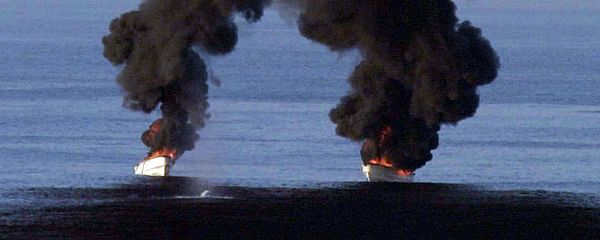
US NAVY: Suspected pirate skiffs burn from weapons fire from the guided-missile destroyer USS Momsen (Feb. 2011)

To be sure, if a commercial ship is under hostile attack by Somali pirates on the High Seas, the ship may exercise the right of individual or collective self-defense under Article 51 of the U.N. Charter. But it is a great extension of this principle to say that it permits preemptive action against suspected pirates who are not in the midst of an attack.

The so-called War on Terrorism provides a useful analogy here. In the wake of the 9/11 attacks, the second Bush Administration outlined its goals in the war on Terror in the National Security Strategy. That document provided:

For centuries, international law recognized that nations need not suffer an attack before they can lawfully take action to defend themselves against forces that present an imminent danger of attack. Legal scholars and international jurists often conditioned the legitimacy of preemption on the existence of an imminent threat—most often a visible mobilization of armies, navies, and air forces preparing to attack.

We must adapt the concept of imminent threat to the capabilities and objectives of today’s adversaries. Rogue states and terrorists do not seek to attack us using conventional means. They know such attacks would fail. Instead, they rely on acts of terror and, potentially, the use of weapons of mass destruction—weapons that can be easily concealed, delivered covertly, and used without warning.

The targets of these attacks are our military forces and our civilian population, in direct violation of one of the principal norms of the law of warfare. As was demonstrated by the losses on September 11, 2001, mass civilian casualties is the specific objective of terrorists and these losses would be exponentially more severe if terrorists acquired and used weapons of mass destruction.

The United States has long maintained the option of preemptive actions to counter a sufficient threat to our national security. The greater the threat, the greater is the risk of inaction— and the more compelling the case for taking anticipatory action to defend ourselves, even if uncertainty remains as to the time and place of the enemy’s attack. To forestall or prevent such hostile acts by our adversaries, the United States will, if necessary, act preemptively.

One might argue that Somali Pirates, armed with Rocket-propelled grenades and AK-47s pose an imminent threat to ships in the Indian Ocean, thereby justifying preemptive attack on pirate skiffs.  Such an analogy is flawed in several ways.

First, who are the parties to such a “War on Piracy?” According to the UN Special Adviser for Piracy’s report, there are around 1,500 Somali pirates and about 10 commanders. These are multiple enterprises; there is no single “Somali Pirate” outfit akin to Al Qaida. Second, against whom did Somali pirates declare war by attacking commercial ships, owned by companies in Norway, South Korea, India, and Malaysia, flagged in Malta and Liberia, and whose seafarers are nationals of the Philipines, India, and Kenya (to name but a few interested States)?

Second, the threat posed by piracy is largely financial. According to one estimate, the cost of Somali piracy to the world economy is between $7-12 billion per year. In addition, a large number of vessels and hostages remain captive. The International Chamber of Commerce reports that there are currently 33 Vessels and 712 Hostages being held by Somali pirates. But there are few reported incidents of civilian casualties. And certainly, the use of more destructive weaponry would be counterproductive for pirates as they can only ransom goods and hostages that remain intact.

Finally, this is not a battle of ideology as pirates and their victims are pursuing the same goal – that is to enrich themselves.  The difference is that pirates seek to enrich themselves illegally.

In short, even if one were to accept that a war on terrorism is a legitimate legal construct, the rationale does not extend to Somali piracy. For (1) there is no logical coherence to a war between disparate groups of pirates and the rest of the shipping world; and (2) piracy poses an economic threat, not a threat to the safety and security of the nations of the world.

This is not war; this is organized crime. And the scourge will only be eradicated when crime bosses are apprehended and prosecuted.