Negotiator Sentenced to Multiple Life Terms – SCOTUS on the horizon

Defendant Mohamed Salid Shibin appears in court

As we previously discussed here and here, Mohammad Saaili Shibin has been convicted for his role as a pirate negotiator in two separate incidents. During the trial, there was evidence that the hostages were tortured, but Shibin’s main role was to negotiate a ransom payment. Shibin has now been sentenced to 12 life terms and his attorney has promised to appeal. Two issues could lead to overturning Shibin’s convictions and might soon reach the Supreme Court.

First, Shibin’s attorney has stated that piracy can only occur if someone commits robbery at sea. In other words, the issue is whether piracy under the 18 USC 1651 (which incorporates the law of nations) is an evolving or a static concept. If it is a static concept, then a robbery was necessary to complete the offence. Since Shibin never boarded the hijacked yacht, he did not commit a robbery and his conviction for piracy, the basis for the life terms, could not stand. If, however, piracy is an evolving concept, then the UNCLOS definition would prevail and, because it does not require a robbery, Shibin’s conviction would stand.

Shibin’s appeal will first be heard by a 3-judge panel of the 4th Circuit. Another panel of the same court has ruled, in U.S. v. Abdi Wali Dire, that piracy is an evolving concept. A petition for rehearing was subsequently denied in that case, and the defence is filing an appeal with the US Supreme Court. Shibin could appeal the same issue to the 4th Circuit and might win if a different panel hears the case. However, if his appeal is denied, which is likely, he will have to take the case to the US Supreme Court as well.

The second issue that might result in overturning his convictions is whether Shibin’s actions in Somali territory can constitute piracy under the law of nations. The Federal Court in the DC Circuit recently held, in U.S. v. Ali, that the international crime of piracy can only be committed on the high seas. Therefore, negotiating a ransom for pirated hostages on land or within a state’s territorial waters does not constitute piracy. There is a healthy debate as to the correctness of this decision. See here and here. Nonetheless, it appears that Shibin only boarded the pirated vessel in Somali territorial waters. The U.S. Attorney prosecuting Shibin said that Shibin was a hostage negotiator operating from within Somalia, and it is reported that Shibin only boarded the pirated ship after it entered Somali waters.Therefore, if the Ali-rationale were applied in Shibin’s appeal, his convictions would be overturned. Even though Shibin did not appear to make this particular argument at trial, if it is determined that piracy under the law of nations does not include actions from Somali territory, universal jurisdiction would not permit the U.S. to pursue this prosecution. Therefore, this is a jurisdictional issue that can be raised for the first time on appeal.

Members of Ogoni Community interested by Kiobel v. Royal Dutch Shell Source: Amnesty International

There you have it: two issues that could invalidate Shibin’s convictions. Either or both of these issues could reach the Supreme Court, perhaps not in Shibin’s case, but possibly in U.S. v. Dire. The justices may be inclined to grant certiorari as a rhetorical counterpoint to Kiobel v. Royal Dutch Shell which is on the court’s docket for the next term and will require the court to interpret the statutory language “the law of nations” as part of the Alien Tort Statute. The piracy cases might be helpful to those who would argue that universal jurisdiction only applies to those offenses originally contemplated and discussed by the First Congress (when the piracy law and the Alien Tort Statute were passed). According to this view, piracy would satisfy the requirement, but relatively newer crimes such as crimes against humanity would not.

Somalia’s New Constitution (what it does and doesn’t do for piracy)

Somalia’s Official Emblem adopted by the 2012 Provisional Constitution

On 1 August, delegates to the Somalia’s National Constituent Assembly adopted a provisional constitution. The document must still be approved by a majority vote of the electorate in a referendum. Nonetheless, the Provisional Constitution marks an important step towards the establishment of a representative federal government in Somalia. Further, it has significant ramifications for the prosecution of piracy.

Article 140 of the Provisional Constitution requires the Somali Federal Government to respect all prior treaty obligations. This includes UNCLOS which a preceding government signed in 1982 and ratified on 24 July 1989. Of course, UNCLOS sets forth the definition of the international crime of piracy, but in the event of any lacunae in that definition, Article 40 of the Provisional Constitution permits reference to Shariah Law, international law and decisions of courts in other countries as persuasive authority. Therefore, reference may be made to recent piracy judgements in Seychelles, Netherlands, France, and the U.S. among others.

In addition, the Provisional Constitution provides extensive individual rights for criminal defendants. These include a fundamental right to be brought before a capable court within 48 hours of arrest (see Article 35(5)). If pirates are arrested at sea it may be impracticable to bring them before a judge within that time frame. In such cases, some remedy, in the form of a reduced sentence (upon eventual conviction) or the dropping of charges (in extreme cases) will have to be considered. An alternative would be to perform an arraignment (first appearance) aboard the capturing vessel. But for this to be plausible, it might be necessary to bring a Somali judge onto the naval vessel. If the arraignment were performed by a judge from a foreign nation (e.g. a national of the naval power that captured the pirates), the judge would not have the power to put the Accused on notice of charges under Somali law.

Article 35 also incorporates the principle of nullum crimen sine lege (prohibition against ex post facto legislation). In the case of piracy, this should not prove controversial as Somalia ratified UNCLOS, which defines piracy, in 1989. However, the principle of nulla poena sine lege (no punishment without law) is also incorporated within this concept. Thus, without a specific sentencing regime in force for piracy, one could argue that an Accused did not have notice of the potential range of penalties available for those convicted of piracy thereby rendering any punishment impermissible. One might look to prior Somali legislation to fill this gap. But as Matteo has previously noted, Somalia’s prior anti-piracy legislation lacked a number of important provisions and was inconsistent with customary international law. The new Somali Federal Parliament will soon have an opportunity to remedy these problems as the Constitution sets forth a list of priority legislation to be enacted by the Federal Parliament and anti-piracy legislation appears 16th on this list. See Schedule One (d).

Pirate Attacks Hit “Low Season” in Somalia – Why and What’s Next?

According to the International Maritime Bureau, pirate attacks off the coast of Somalia continued to fall sharply in the first half of 2012.  July 2012 was particularly significant, with no reported attempted attack. Remarkably, it was the first full month with no noteworthy pirate activity off the coast of Somalia and the larger Indian Ocean since at least half a decade. The last reported attack dates back to 26 June 2012, when a Maltese-flagged bulk ship was fired upon near the Yemeni coast. As of 29 July 2012, Somali pirates are still holding at least 11 vessels and 174 crew members.

A piracy situational map we’ve rarely seen – Courtesy Oceanus Live

The suprising drop in Somali pirate activity is spurring a debate on the reasons behind it and the impact of the international efforts to counter pirate attacks. Among the main factors are the pre-emptive and disruptive counter piracy tactics employed by the international navies, with military operations now extending both at sea and on land, the effective implementation of the Best Management Practices by the shipping industry, including the use of citadels and other ship hardening means, the strengthening of a regional judicial system of law enforcement and prosecution, also targeting piracy financiers and kingpins, and in particular, the manyfold increase in the use of Privately Contracted Armed Security Personnel and government-provided Vessel Protection Detachments by ships travelling through the area. It is likely that all these factors together and concurrently have contributed to the falling numbers, tipping the risk aspect to rise above the possible profit expectations for wannabe pirates. Bad monsoon weather is also an additional factor often overlooked, with July and August being traditionally difficult months to set off to sea in the region for both pirate mother ships and small skiffs.

What’s Behind the Horizon?

The current status quo requires the operational strategy to continue and focus also on wider land-based solutions encompassing both security and economic development. Some commentators have warned that pirates and their financiers are simply sitting idle awaiting for better days to come.  Notably, August 2012 will mark the end of the Somalia TGF. While there are high hopes for a better future for Somalia, it is difficult to assess how this will reshape the Country’s current political landscape. There are also fears that the successes of current anti-piracy measures will detract the necessary attention below warning levels with a consequential lull in the international and national effors to combat piracy. If so, the momentum could shift back in the pirates’ favor.

Intentional Facilitation and Commission of Piracy as part of a Joint Criminal Enterprise

Defendant Ali Mohamed Ali, Source: Foxnews

In the U.S. government’s efforts to ramp up piracy prosecutions to include pirate kingpins, several cases of mid-level negotiators are working their way through the courts. We discussed one such case here. Another such prosecution recently met some setbacks when a U.S. District Court ruled in U.S. v. Ali that conspiracy to commit piracy was not a cognizable crime and further limited the application of intentional facilitation of piracy to acts committed on the high seas. See alsohere. The latter issue was apparently moot at the outset since the prosecution alleged that the negotiator was on the high seas when he intentionally facilitated the acts of piracy. However, in a contentious hearing last week, it became apparent that the Accused only spent about 25 minutes on the high seas and that his criminal conduct may not have occurred in that time frame. Therefore the high seas issue is now central to the outcome of the case. The Prosecution has signalled its intent to file an interlocutory appeal and the Judge has ordered that the Accused be released on bail, noting misrepresentations by the prosecution on this issue. In my view, the conspiracy ruling was correct, but intentional facilitation was improperly limited to conduct on the high seas. This latter error would impede future prosecutions of pirate leaders in U.S. courts.

It should be made clear that U.S. courts that have addressed the issue in the last several years have uniformly concluded that although the U.S. is not a party to the U.N. Convention on the Law of the Sea, this treaty contains the definition of piracy under customary international law which is incorporated by the U.S. piracy statute (18 USC 1651). Therefore, piracy is defined in the U.S. purely by reference to international law, and not domestic U.S. law. See here for further background.

In its 13 July Decision in U.S. v. Ali, the Court held that the piracy statute requires that intentional facilitation occur on the high seas. See Memorandum Opinion at 17. I disagree with this interpretation of UNCLOS for several reasons. First, a plain language reading of UNCLOS does not impose a requirement that inciting or intentionally facilitating an act of piracy occur on the high seas. Article 101(a)(i) of UNCLOS defines piracy as “any illegal acts of violence or detention, or any act of depredation, committed for private ends […] on the high seas […]” Intentional facilitation of such an act of piracy appears in subsection (c) of Article 101 which does not include the requirement that the act occur on the high seas. In other words, the illegal act of violence or detention must occur on the high seas, but the facilitation need not occur there.

The U.S. piracy statute could create some confusion as it specifically refers to piracy committed on the high seas which might be interpreted to extend the high seas requirement to intentional facilitation. (See 18 USC 1651 which provides in full, “Whoever, on the high seas, commits the crime of piracy as defined by the law of nations, and is afterwards brought into or found in the United States, shall be imprisoned for life.”) However, the reference to piracy on the high seas in 18 USC 1651 is redundant. By definition under customary international law, acts of piracy (though not incitement or facilitation) must occur on the high seas. The reference to acts on the high seas in 18 USC 1651 was only meant to emphasize that conduct committed in the territorial waters of another state would not constitute piracy (such conduct is instead robbery at sea, solely within the purview of the littoral state). It is not at all clear that Congress would intend to modify the otherwise settled view of the law of nations. Therefore, to impose the high seas requirement on subsection (c) of UNCLOS (pertaining to intentional facilitation), which does not appear in the plain language of the treaty, would be contrary to the U.S. Supreme Court’s Charming Betsy canon (whereby a statute should be construed not to violate international law).

Furthermore, restricting intentional facilitation of piracy to crimes perpetrated wholly on the high seas is not necessary to protect the sovereignty of states where pirate kingpins may reside. The piracy statute only provides personal jurisdiction over those who are “afterwards brought into or found in the United States.” If a pirate kingpin has negotiated a ransom from the territory of another state, the U.S. must request extradition through the usual means prescribed by international law. For all of these reasons, the high seas requirement should not be added to the crime of intentional facilitation of piracy.

As to the District Court’s second holding, the decision to dismiss the conspiracy to commit piracy charge appears well-founded. However, it is worth considering whether other forms of responsibility, firmly established in customary international law, might support the criminalization of the conduct in question. For example, commission has been interpreted by the ad hoc tribunals (ICTR, ICTY, SCSL, STL) to encompass the form of responsibility referred to as joint criminal enterprise (JCE) where there exists (1) a plurality of persons; (2) a common plan, design or purpose which amounts to or involves the commission of a crime and (4) the accused’s participation in the common plan. Of course, the tribunals did not have competence to consider charges of piracy. However, similar forms of accessory liability are found in numerous domestic legal systems and piracy prosecutions in Seychelles have been successful on a theory of accomplice liability akin to JCE. See here and here. This mode of responsibility has not been considered by any U.S. court in a piracy case.

Jama Idle Ibrahim, sentenced last year to 25 years for his role in the same attack, will be a government witness against Ali.

Apart from the jurisdictional issues, the ultimate question in this prosecution is whether negotiators acting as middlemen between pirate hostage-takers and those seeking their release “intentionally facilitate” piracy pursuant to UNCLOS. The answer will depend on the factual circumstances and how the mens rea of facilitation is construed. The drafters of UNCLOS limited facilitation by requiring that the accused intentionally (not merely negligently or recklessly) facilitated the piratical act. This suggests not only that the Accused must intend to support the illegal act of violence or detention, but also that the facilitator must share the pirate’s intent to commit the act “for private ends” (i.e. for personal enrichment or other non-political purposes). Involvement in negotiations to release the hostages for humanitarian reasons would not satisfy this mens rea requirement. Elsewhere, Professor Kontorovich suggests that intentional facilitation cannot occur after an act of piracy, but must have occurred prior to it. But if the piratical act was committed with the pre-formed intent to hold hostages for ransom, then the completed piratical act would not have been possible but for the intervention and assistance of a negotiator to complete the transaction. If a negotiator also possesses the intent to personally enrich himself, the conduct would appear to fall within Article 101(c) of UNCLOS.

One final word about the fairness of this prosecution. Depending on the circumstances of a case, the negotiation of a ransom (or the financing of piracy for that matter) may appear to be less reprehensible than the acts of violence committed against seafarers on the high seas. Such is the dichotomy between low-level perpetrators and their white-collar sponsors. If a mandatory life sentence, as is imposed by the U.S. piracy statute, is inappropriate in some cases involving accomplice liability, this is a matter of charging strategy best left to the prosecutor. There are a number of other non-piracy statutes in the prosecutor’s repertoire that could be put to use. But it is an overbroad statement to assert that all white-collar facilitators of piracy deserve leniency.

Mauritius Strengthens Its Anti-Piracy Capacity

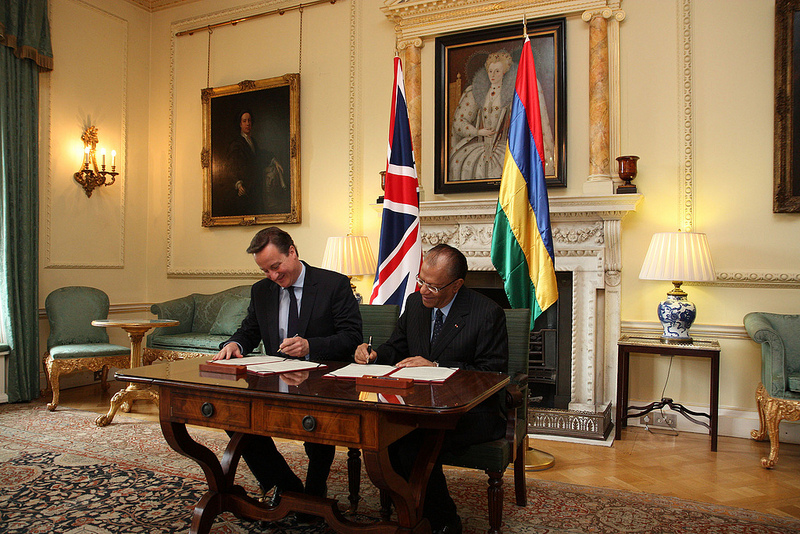
Last month, Mauritius became the latest country in the Indian Ocean area to enter into an agreement with the United Kingdom for the transfer of suspected pirates before its courts for prosecution. The agreement was announced earlier this year during the London Conference on Somalia, which highligthed the UK driving role in Somalia’s recovery, including the fight against piracy. Mauritius thus follows in the footsteps of Tanzania and the Seychelles who have recently penned similar agreements with the UK, in 2012 and 2010, respectively, aiming to break the pirates business circle by providing a jurisdictional basis for their prosecution after apprehension at sea.

Prime Minister David Cameron and his Mauritius counterpart Navinchandra Ramgoolam sign the prisoners transfer agreement – FCO

Notoriously, foreign navies deployed off the Somali coast to counter piracy are reluctant to take pirate suspects to their own countries because they either lack the jurisdiction to put them on trial, or fear that the pirates may seek asylum. Evidentiary hurdles are also seen as an increasing impediment to effective prosecutions. Suspected pirates detained on the high seas are therefore often released after a brief detention due to the governments’ reluctance to bring them to trial.

Under the terms of the new international agreement, Mauritius will receive and try suspected pirates captured by British Forces patrolling the Indian Ocean. Last year, Mauritius entered into another agreement with the European Union for the transfer, trial and detention of suspected pirates captured by the EUNAVFOR naval mission. As reported on this blog, Mauritius has also inked a deal with the TFG, Somaliland and Puntland to start to transfer convicted pirates to Somali prisons, paving the way for the commencement of prosecutions in Mauritius.

The first trial of a suspected Somali pirates is due to commence in September 2012. In the meantime, Mauritius, already a signatory of UNCLOS, further strengthened its anti-piracy capabilities by adopting various relevant legislative instruments. First and foremost, a new anti piracy law was adopted at the end of 2011. The new Piracy and Maritime Violence Act 2011, premised on the transnational dimension of modern day piracy and the principle of universal jurisdiction to counter it, incorporates nearly verbatim in the national judicial system the definition of piracy as contained in Article 101 of UNCLOS. Acts of violence within Mauritius internal waters are defined as “Maritime Attack”. The novel term adds a degree of fragmentation in the definition of this offence, which is otherwise commonly referred to internationally as “armed robbery at sea”. In an attempt to cater for a wider range of piracy related criminal activities, the Piracy Act also criminalizes the offences of hijacking and destroying ships as well as endangering the safety of navigation. For each of these offences, the Piracy Act provides for a maximum term of imprisonment of 60 years.

More interestingly, the Piracy Act introduces the possibility for the holding of video-link testimonies and/or the admission of evidence in written form where the presence of a witness, for instance a seafearer, cannot be secured. While not uncommon in certain national criminal jurisdictions, as well as those of international criminal courts, the introduction of out of court statements, particularly when relevant to the acts and conducts of an accused, could trigger fair trial rights issues. These issues are principally due to the limited ability of the defence to test such evidence when relied upon at trial in the absence of the witness. In light of these concerns, the Piracy Act provides for the admissibility of evidence in rebuttal as well as for the court’s discretionary power in assessing the weight to be given to written statements.

In addition to the Piracy Act, which entered into force on 1 June 2012, Mauritius also adopted and/or amended its laws concerning assets recovery and mutual assistance in criminal matters in order to foster cooperation with foreign governments to tackle pirates and criminal cartels. The implementation of the agreement with the UK, however, is still to be fully tested. In May 2012, the UK announced that defence budget cuts required it to scale back its naval commitments in the region, withdrawning its ships from full-time counter-piracy operations.


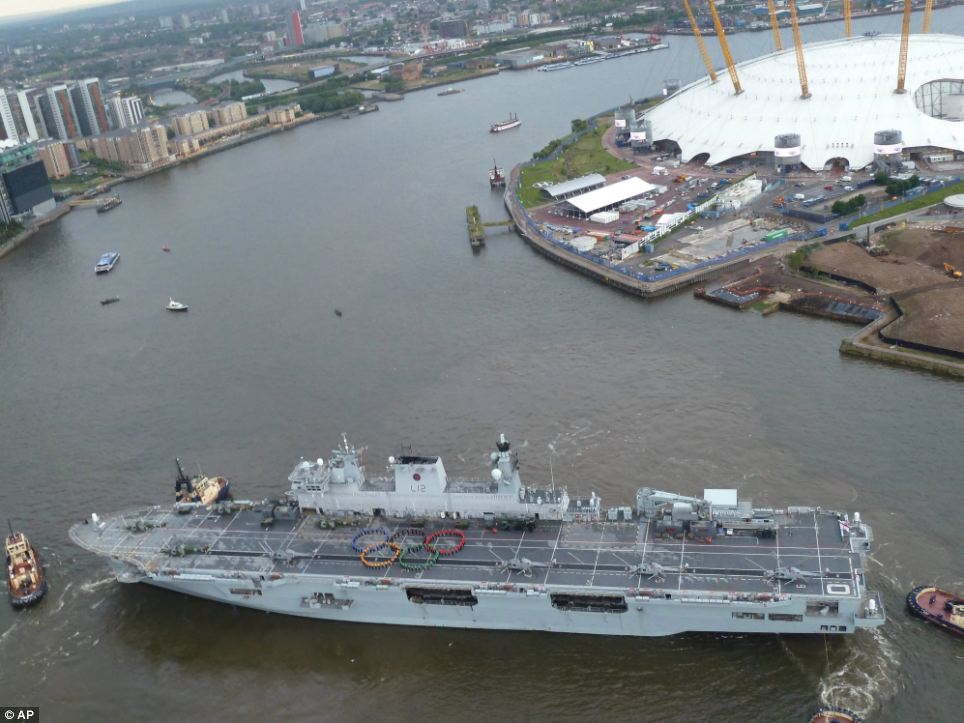
The HMS Ocean Arrives in London Ahead of the London 2012 Olympic Games – Courtesy AP

These difficulties have been compounded by the need to commit ships and personnel to the security efforts for the London 2012 Olympic Games. The UK long-term commitment to combat piracy in Somalia extends beyond its current patrolling and disruption efforts in the Indian Ocean. To remain within the Olympic spirit, French Baron Pierre de Coubertin, considered the founder of the modern Olympics Games, famously noted how “The important thing in life is not the triumph but the struggle, the essential thing is not to have conquered but to have fought well.”  With piracy attacks in the region at their lowest level, during monsoon season, however, it is worth considering whether we should be content with the current efforts to combat piracy, or whether we should be aiming for more.