Weekly Piracy Review: Costs & Sentencing

As reported here, in October pirates off the coast of Somalia fired at a small boat deployed from the HNLMS Rotterdam as part of its routine patrolling operations. After the ensuing fire-fight and rescue operation, the fishing boat’s captain revealed that he and his crew, along with their ship, had been hijacked off the coast of Oman several weeks earlier. The captain identified six of the people rescued from the water after the fishing boat caught fire as the pirates who took them hostage. Four of those men are now set to be prosecuted for their acts of piracy in Dutch court, as the marines they fired at from the Rotterdam were from the Netherlands. The two remaining suspected pirates were released, as they are minors. Two pirates and six of the original crew-members from the hijacked boat were wounded in this altercation, and one crew-member was killed. Two of the crew from the fishing boat are reportedly missing at this time.

Fifteen pirates were sentenced in the Republic of Seychelles on November 5 after being convicted for acts of piracy in attacking a merchant ship and abducting thirteen Iranian fishermen. The US praised Seychelles for their leadership in prosecuting those suspected of piracy, and reported that there have now been 631 convictions against pirates worldwide, with 98 of those coming from Seychelles. Additionally, 440 suspected pirates are currently facing justice in 21 countries.

After being held by Somali pirates since they were captured last November, two Seychelles fishermen were released early this week. The office of the President in Seychelles confirmed that after extensive effort and negotiations the two hostages had been released. A Somali pirate allegedly reported that a $3 million ransom was paid for their release, but this has not been confirmed. Since February 2009, pirates have hijacked five Seychelles boats, and eleven hostages have been kidnapped and subsequently released.

The Australian Navy sent its newly constructed warship on a 12,000 mile detour around Africa in order to avoid the possibility of being attacked by pirates while travelling through the dangerous waters in the Gulf of Aden. Though it likely would have taken about two weeks and $2 million less for the ship to make its journey from Spain to Australia through the Suez canal, the danger of encountering pirates on that route outweighed concerns regarding the time and expense of moving the ship to Australia. Other options were considered to thwart the possibility of pirate attacks, including sending a Navy frigate alongside the other ship and placing armed mercenaries onboard, but it was decided that the most effective method would simply be to take a safer route. That these measures were considered necessary is a clear indication that the cost of piracy is quite high.

Thursday marked the opening of a two-day Maritime and Coastal Security Africa conference in Cape Town, South Africa. A primary goal of this conference is to discuss better approaches to enhancing cooperation among different nations in the counter-piracy efforts being carried out. This concern arises due to the fact that nearly all African countries are major exporters of oil, and as such there are a large number of merchant vessels carrying valuable cargo all around Africa. These ships are attractive targets for pirates seeking to commandeer the cargo or hijack these ships and their crew for ransom, so the need to police these waters is ever-present.

According to the International Maritime Bureau, as of October 27, there have been 252 attacks and 26 hijackings so far in 2012. There have been 71 incidents, 31 successful hijackings, and 212 hostages taken by Somali pirates. Currently, Somali pirates are reportedly holding nine vessels and 154 hostages.
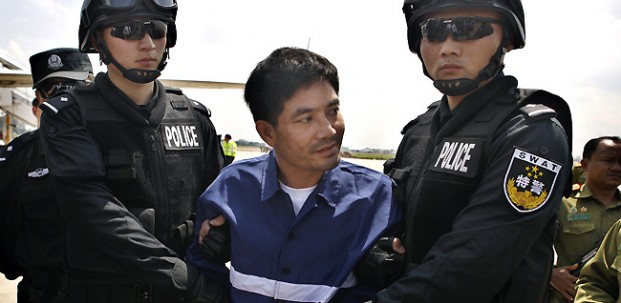
Update: Mekong Pirates Sentenced to Death

Further to his earlier conviction for the murder of 13 chinese sailors on the Mekong River last year, notorious former druglord Naw Kham has been sentenced to death today by the Intermediate People’s Court of Kunming, in China’s Yunnan province. We blogged on the Mekong River murders here. The incident was one of the deadliest assaults on Chinese nationals overseas and prompted unprecedented joint boat patrols along the river.

Naw Kham Upon His Transfer from Laos to China for Trial in May this Year – Asian Correspondent

Three of Naw Kham’s gang members were also sentenced to death, another received a  suspended death sentence while one was sentenced to eight years in prison, respectively. They had all pleaded guilty on a 3-day long trial in September this year. We previously blogged about the Mekong Trial here. The defendants were also ordered  to pay compensations to the victims families. They all said they will appeal the verdict.


Piracy Takes Center Stage at UN Security Council

Indian ambassador to the UN Hardeep Singh Puri, who assumed the month-long presidency of the UN Security Council, interacts with the media after convening an emergency meeting on Syria, in New York. Source: PTI Photo

As noted by Christine, India has assumed the month-long presidency of the UN Security Council and has brought piracy to the center of the debate. As the Security Council Report points out this is the first time that piracy has been addressed as a thematic issue as opposed to in a state or regional discussion.

Key Issues

A key issue for the Council is how to strengthen the international response to piracy as a global threat to international peace and security.

Another issue is what lessons can be learned from the experiences gained so far at the regional level that may be applied universally.  These experiences cover areas such as effective coordination and cooperation mechanisms, preventive measures taken by the shipping industry (which include the use of privately contracted armed security personnel on ships), strengthening legal frameworks to ensure accountability for acts of piracy, capacity-building for states in the affected regions and addressing the root causes of piracy. A related issue is the difference across regions in the way pirates operate and the capacity of regional states to take effective action.

There also seems to be growing recognition of the human cost of piracy as an issue deserving more attention, including how to ensure assistance to hostages and their families.

Options

The main option for the Council is to adopt a presidential statement that would call for strengthened international action against piracy based on some of the experiences already gained and mechanisms in place. Such a statement could also ask the Secretary-General for a report on piracy at the global level and recommendations for further action.

The framework adopted by the Security Council could form the basis for the further solidification of customary international law. While the Security Council has issued numerous resolutions regarding piracy off the coast of Somalia, it has been careful to disclaim any opinio juris in creating precedents that might contradict UNCLOS. A further strengthening of the UNCLOS framework, in addition to an elucidation of areas of ambiguity in the treaty would be welcome in light of continued acts of piracy off the coast of Somalia, in the Gulf of Guinea, in the Malacca Straight, and, potentially, in new areas where conditions are ripe for such criminality.

Weekly Piracy Review: Expanded Territory

Map of attempted (yellow) and successful (red) attacks in 2012

Recent trends indicate that piracy around Somalia and in the Gulf of Aiden is becoming less prevalent. Through September of this year Somali pirates have reportedly carried out 70 attacks, down from 199 in the same period of 2011. These attacks are becoming less successful as well – in 2011 about one in three attempted raids were successful, while now the figure is closer to about one in 20. Armed guards onboard ships, the presence of patrolling warships in the region, and onboard security measures such as barbed wire are among the efforts credited with this decrease in piracy. However, agencies such as the International Maritime Bureau continue to warn against complacency, pointing out that Somali pirates alone still hold 11 ships and 167 crew members hostage. More than 20 of those hostages have been under the control of their captors for over 30 months. The IMB also reports that it calculates the global cost of piracy was $12 billion in 2010, which is a clear indication that continued efforts to impede the ability of these criminals in carrying out acts of piracy is essential moving forward.

Along with this decrease in pirate activity off of East Africa, there is a growing threat in West Africa around the Gulf of Guinea. As the international community has put an increased effort into protecting merchant ships in other hot-spots, the threat of maritime piracy is spreading farther and affecting areas previously thought to be fairly safe. Specifically, reported attacks have more than doubled off of West Africa so far this year from those reported in 2011. Oil production is growing in countries such as Nigeria, and as a result shipping traffic is increasing, creating a new “market” for those seeking to hijack boats and seize cargo for profit. Since August at least three large tankers have been attacked, and about 10,000 tons of oil have been robbed from those ships. Up until recently it was considered relatively safe for large ships to anchor for days at a time and carry out ship-to-ship transfers near Ivory Coast, but recent attacks there indicate that the reach of maritime piracy is spreading quickly.Though prior attacks have often focused on holding a ship and its crew hostage for ransom, these goal in these recent incidents appears to be the appropriation of oil to be sold on the black market. The more widespread area in which attacks have occurred, and the fact that many have taken place much further out to sea than in the past, shows that these are sophisticated pirates with access to larger ships, greater resources, and information on ship movement.

Over the weekend the Nigerian Navy and the Nigerian Maritime Administration and Safety Agency (NIMASA) met to strengthen efforts under a memorandum signed a few years ago outlining the need for counter-piracy measures. The meeting was prompted after a presidential directive to end illegal activities (specifically maritime piracy and sea robbery) in Nigeria was handed down. The hope is to more effectively police the waters around Nigeria through increased cooperation and resource-sharing between the two agencies.

On Monday senior officials from the US, India, and Japan met for the third time to formally discuss strategies for combating piracy and bolstering maritime security. The three agreed to increase efforts in combating piracy through greater cooperation.

India took over the rotating Presidency of the United Nation Security Council (UNSC) this week. Hardeep Singh Puri, India’s Representative to the UNSC, has already indicated that India will use its post to seek a “comprehensive anti-piracy strategy to tackle the maritime menace.” Maritime piracy clearly presents a significant challenge to the international community and its effects are felt especially strongly in India and the surrounding region, so Puri intends to cultivate debate on the topic of how the UNSC will address piracy as an international crime.

Weekly Piracy Review: Crossfire near Somalia, Hostages Released

Pirate vessel ignites during firefight with HNLMS Rotterdam, NATO’s counter-piracy flagship

While patrolling the waters off the coast of Somalia on Wednesday the HNLMS Rotterdam, NATO’s counter-piracy flagship, destroyed a pirate fishing boat. The Rotterdam had deployed a boarding team to check out the boat, and upon confronting those aboard the ship the team began to take fire from fighters on the boat and on land. The fishing boat aroused suspicion as it was the type generally employed to transport pirates in their efforts to hijack larger merchant ships. The attack on the boarding team prompted the Rotterdam to return fire, which resulted in the fishing boat catching fire. Those on board were forced to flee into the sea, and despite continuing to draw fire from those onshore the Rotterdam proceeded to rescue at least 25 people from the water. One person was found dead, and it is unknown whether they were a pirate or being held hostage. It is also unclear how that person died. The Rotterdam suffered only minor damage and no one from the Dutch warship was injured.

In December of 2010 the MV Orna, a UAE-owned cargo vessel, was hijacked by a group of Somali pirates about 400 nautical miles North East of the Seychelles in the Indian Ocean. Since then the ship has been held hostage, along with the crew members who were taken with it. After growing impatient following nearly two years of attempting to collect a ransom for the return of the Orna and its’ crew, it has been reported that one of the hostages was killed in late August of this year. This killing was allegedly  carried out in an effort to prompt a ransom payment, though the truth of the story has recently been disputed by a technical advisor to the ship’s management company. If true, this act is believed to have been the first killing of a hostage by Somali pirates, as generally hostages are held unharmed until ransom is paid.

MV Orna

Last Saturday the vessel and 13 of the 19 crew believed to have been aboard were finally released following a ransom payment reported to be between $400,000 and $600,000. The ship’s captain, the chief engineer, and four other crew members were not released, and are still being held hostage. It is believed that their captors are divided into two separate groups, who disagree over the amount of money they require in order to release these remaining six hostages. The remaining hostages are being held by piracy investors, who support piracy by providing food and security for hostages during negotiations in return for a portion of the ransom. Negotiations are continuing between these piracy investors and the UAE company that owns the Orna.

The UAE’s National Transport Authority (NTA) announced a new anti-piracy security system it will be implementing. As part of the security measures being taken, tracking devices are being installed on commercial ships bearing UAE flags and carrying over 300 tons of cargo. This will allow these ships to be monitored around the clock from offices in Abu Dhabi and Dubai. According to the NTA, 150 ships have already been outfitted with the system, which will soon be installed on about 800 more. In addition, the system implemented by the NTA will provide on-board security protection for these vessels to further discourage piracy attacks.

The International Maritime Bureau reported this week that the number of reported attacks by Somali pirates has dropped to its’ lowest point since 2009. This is largely a reflection of increased efforts on the part of the international community to police the waters of the Arabian Sea around Somalia, focusing on patrolling the Gulf of Aiden. Along with this drop in pirate activity around Somalia there has been an increase in the number of attacks in other areas, including the Gulf of Guinea, Indonesia, and other parts of South Asia.