4th Circuit Decides Definition of Piracy Evolves with the Law of Nations

A three-judge panel of a U.S. appeals court has decided that UNCLOS sets forth the definition of piracy for purposes of U.S. law. As we signalled here and here, the U.S. Court of Appeals for the 4th Circuit was faced with the question of whether “piracy as defined by the law of nations” in 18 U.S.C. § 1651 (adopted in 1816) constitutes a static or evolving concept. In a well-written and extremely thorough decision, the court has determined that the law of nations is an evolving concept and that the definition contained within UNCLOS constitutes the law of nations as defined in the statute.  Since UNCLOS defines piracy in part as ‘an illegal act of violence,’ a completed theft is not requisite to the crime. This has important repercussions for future prosecutions because pirates are often unsuccessful in boarding ships or taking anything of value even though they may fire upon vessels with AK-47s and RPGs.  Limiting the definition to the law of 1816 would have prevented U.S. courts from exercising jurisdiction where conduct less than a completed robbery was perpetrated. Here are the crucial bits of the opinion:

The defendants would have us believe that, since the Smith era, the United States’ proscription of general piracy has been limited to “robbery upon the sea.” But that interpretation of our law would render it incongruous with the modern law of nations and prevent us from exercising universal jurisdiction in piracy cases. See Sosa, 542 U.S. at 761 (Breyer, J., concurring in part and concurring in the judgment) (explaining that universal jurisdiction requires, inter alia, substantive uniformity among the laws of [the exercising] nations”). At bottom, then, the defendants’ position is irreconcilable with the noncontroversial notion that Congress intended in § 1651 to define piracy as a universal jurisdiction crime. In these circumstances, we are constrained to agree with the district court that § 1651 incorporates a definition of piracy that changes with advancements in the law of nations.

We also agree with the district court that the definition of piracy under the law of nations, at the time of the defendants’ attack on the USS Nicholas and continuing today, had for decades encompassed their violent conduct. That definition, spelled out in the UNCLOS, as well as the High Seas Convention before it, has only been reaffirmed in recent years as nations around the world have banded together to combat the escalating scourge of piracy. For example, in November 2011, the United Nations Security Council adopted Resolution 2020, recalling a series of prior resolutions approved between 2008 and 2011 “concerning the situation in Somalia”; expressing “grave[ ] concern[ ] [about] the ongoing threat that piracy and armed robbery at sea against vessels pose”; and emphasizing “the need for a comprehensive response by the international community to repress piracy and armed robbery at sea and tackle its underlying causes.” Of the utmost significance, Resolution 2020 reaffirmed “that international law, as reflected in the [UNCLOS], sets out the legal framework applicable to combating piracy and armed robbery at sea.”

Considering the importance of this opinion, the public defender may choose to petition for en banc review. The three judges on this panel were all Democratic appointees, which may mean they were more receptive to the evolving law concept. Whereas if the entire bench (15 judges) were to hear the case, it could reach a different conclusion.  The defendants also have the option of appealing to the U.S. Supreme Court. Therefore, there may yet be more to this story.


Prosecution seeks death penalty for Felony Murder

Ahmed Muse Salad, Abukar Osman Beyle and Shani Nurani Shiekh Abrar entered their pleas to murder and other charges in U.S. District Court in Norfolk, July 20, 2011. (Credit: AP)

It was recently announced that federal prosecutors in the U.S. intend to seek the death penalty against three Somalis if they are convicted of murder in the fatal shooting of four Americans which occurred aboard a hijacked yacht during a failed rescue attempt last year. Of the other Somalis implicated in the incident: one was released by authorities because he is a juvenile; eleven have pleaded guilty to piracy and been sentenced to life in prison; and the ransom negotiator’s piracy conviction is on appeal.  Furthermore, the AP reports that four of the hijackers died on board, including two who have been identified in court records as those who shot at the Americans. This last assertion is based on the charging documents before a judge or jury has established the actual facts of the case. But, if these facts are borne out at trial, the three Somalis who remain to be prosecuted, and for whom the Federal prosecutors are seeking the death penalty did not commit premeditated murder.

Somali pirates do not take hostages with the intent of killing them; that is bad for business. They intend to hold the hostages for ransom. Of course, the pirates who pointed guns at the American hostages and killed them evidently changed their plans upon the imminent boarding of the yacht by U.S. Navy SEALS (and were killed themselves). But it is not clear that that those charged in this last case intended to kill the hostages. Some of them claim to have attempted to stop the killings. This is supported in part by the Prosecutor’s charging documents which indicate the deaths occurred in the commission or immediate flight from the offenses of kidnapping, hostage taking and violence against maritime navigation. Therefore, the basis for seeking the death penalty on the murder charges in this case appears to be the felony murder rule, whereby a killing that occurs in the course of a dangerous felony, even an accidental death, can be charged as first-degree murder. If the three pirates at issue here were fleeing the scene when two other pirates killed the hostages, is the death penalty a just sentence?

This issue is further highlighted by a discrepancy in the way the US Attorney is charging the eleven pirates who pleaded guilty and the three for whom the death penalty is sought.  By accepting pleas for life imprisonment for the former, the US Attorney has indicated that the death penalty is not forcibly necessary to serve the interests of justice in this case. It may be that there are facts that support a harsher sentence for the latter three. It may also be that the three refused to enter a plea agreement, so the US Attorney is wielding a stiffer penalty as leverage. But the question remains, is the death penalty an appropriate penalty for felony murder?

One final incongruity is the fact that the Prosecutor is not seeking the death penalty on the charge of piracy. From 1790, the crime of piracy pursuant to U.S. statutory law imposed a mandatory death penalty. The death penalty was replaced by “imprisonment at hard labor for life” in 1897, and then “imprisonment for life” in 1909. Therefore, the death penalty is no longer available for the crime of piracy under 18 U.S.C. 1651. The fact that Congress amended the statute to eliminate the death penalty indicates Congress’ view that the death penalty is not an appropriate punishment for piracy. If the principle crime at issue here is piracy, and Congress intended that no person be put to death for the crime of piracy, should that penalty still be available if the crime is charged as hostage taking or violence against maritime navigation resulting in death? Of course, a jury will have to decide whether the aggravating factors have been proven to justify a sentence of death.  But I really am curious as to what you all think on these issues.

What Does Piracy Have to Do with North Korea?

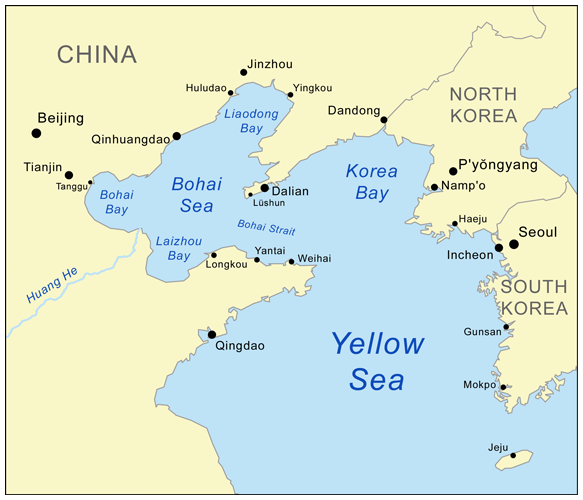
The reclusive authoritarian Democratic People’s Republic of Korea is once again back on the news headlines. Surprisingly, this time is not about the reactivation of its purported nuclear programme, or because of a new attempt to lift off a satellite/ballistic missile, or for some leaked information on the poor living conditions endured by its citizens. Media outlets are reporting on the possible hijack of 3 Chinese fishing vessels and the kidnap of their 29 crew members earlier this month. The vessels and all the captives were released today, following the intervention of the Chinese authorities. The incident has all the hallmarks of a piracy attack off the coast of Somalia or in West Africa. However, it occurred in the Yellow Sea, in an area between North Korea and China.

News reports are still contradictory and any in-depth analysis into this will necessarily depend on the real circumstances of the case. Notably, the incident has not been reported to the IMB Piracy Reporting Centre. In particular, it is not clear whether the incident took place in international waters. The identity of the assailants is also unclear. Some reports indicate that these were members of the North Korean military, while according to others Chinese mafia from the city of Dandong, on the North Korean border, might have been involved, possibly in cooperation with the North Korean military. Several news reports indicate that the vessels, originating from the city of Dalian, were accosted at sea by armed men and forced to sail to North Korea. The ship owners confirmed the capture of the vessels and their crew. According to the owners, the vessels were navigating within Chinese national waters. They also confirmed that the captors have asked for the payment of a ransom of nearly 190.000 US Dollars and have threatened to harm their captives if no payment was made.

If the assailants have no connection with state authorities, the main issue will be to determine whether the incident qualifies as piracy committed in the high seas rather than armed robbery within China’s territorial sea. However, whether the assailants are members of the North Korean military or not, the use of force and the request for a ransom renders them de facto pirates, because they appear to have acted in pursuit of private ends. If the available information is correct, their actions could also qualify as mutiny. In this regard, it is worth recalling that Article 102 UNCLOS encompasses acts of piracy committed by a government ship whose crew has mutinied.

Actions by the North Korea authorities have in the past drawn widespread international condemnation. However, it is difficult to envisage Pyongyang secretive rulers now embracing a state policy to terrorize fishermen in the Yellow Sea for ransom purposes, particularly when this has an impact on a longtime ally and regional military superpower as China. This latter routinely issues strong protests over fishing related disputes with Japanese, South Korean, Vietnamese or Philippine fishing vessels. China will likely take certain actions to prevent any further escalation of such attacks in the Yellow Sea, as it has done by policing Southeast Asia’s  Mekong river from drug smugglers and criminal cartels. However, doubts remain on whether the public outcry sparked by this incident will have an impact on its already strained relationship with North Korea.

Mauritius Officially On Board to Prosecute as Other Options Dwindle

Beau Bassin Prison in Mauritius where pirate suspects may be detained

Reuters is reporting that Mauritius has inked a deal with the TFG, Somaliland and Puntland to start to transfer convicted pirates to Somali prisons, paving the way for prosecutions in Mauritius. This comes as the locations proposed for prosecution by the UN Secretary General have dwindled. In January, the UN Secretary General issued a report noting Somaliland and Puntland as suitable locations for the prosecution of pirates. It is becoming increasingly clear that these autonomous regions may have difficulty in laying the foundations necessary for fair trials in the foreseeable future. For example, last week a Somaliland military court abruptly sentenced 17 civilians to death the day after violent clashes in the northern city of Hargeisa, leading a UN special envoy to urge a retrial in which the fair trial rights of the Accused would be respected. Therefore, the focus will have to shift to the remaining states recommended by Secretary General (i.e. Kenya, Tanzania, Seychelles, and Mauritius). As one of only four states in the region deemed suitable for prosecutions, the Mauritius announcement is undoubtedly appreciated by the states patrolling high risk areas who are searching for states willing to prosecute pirates.

As to the trio of other states identified in the UNSG report, Kenya is moving forward with prosecutions in the High Court in Mombasa, despite a 2010 decision by Judge Ibrahim (now of the Kenyan Supreme Court) holding that Kenyan courts lack jurisdiction to try the crime of piracy. Judge Ibrahim’s decision is pending an appellate decision by the Kenyan Court of Appeal.  But in the interim, his decision is not binding authority on other judges of the High Court (although they are still free to follow Judge Ibrahim’s decision if they so choose). Seychelles continues to prosecute pirates but may periodically refuse suspects due to a lack of space in its prisons. Finally, last month it was reported that Tanzania had yet to sign a pirate-suspect transfer agreement with the EU, indicating that prosecutions in Tanzania will be limited to those captured by Tanzanian naval authorities for the time-being.

ReCAAP and the Anti-Piracy Information-Sharing System in Asia

Furthering its current efforts to enhance international cooperation to tackle piracy, the United Kingdom recently became the 18th party to the Regional Cooperation Agreement on Combating Piracy and Armed Robbery against Ships in Asia, commonly referred to as ReCAAP.

Entered into force in September 2006, ReCAAP is the first regional agreement for the promotion and the enforcement of multilateral cooperation against piracy and armed robbery at sea in Asia. Among its original contracting parties are South and East Asian countries. Since its entry into force, ReCAAP is also open for accession by other countries. Like the U.K., other global shipping countries with an interest in Asian maritime economy, such as Norway and the Netherlands, are also parties. Pursuant to its Article 1, ReCAAP adopts the same definition of piracy set forth in UNCLOS as well as the IMO definition of armed robbery at sea. However, ReCAAP does not provide for enforcement powers beyond those already provided in UNCLOS. Many of the lessons learned from the implementation of ReCAAP were incorporated in the Djibouti Code of Conduct, which provides a framework for information sharing, training and capacity building in the Gulf of Aden.

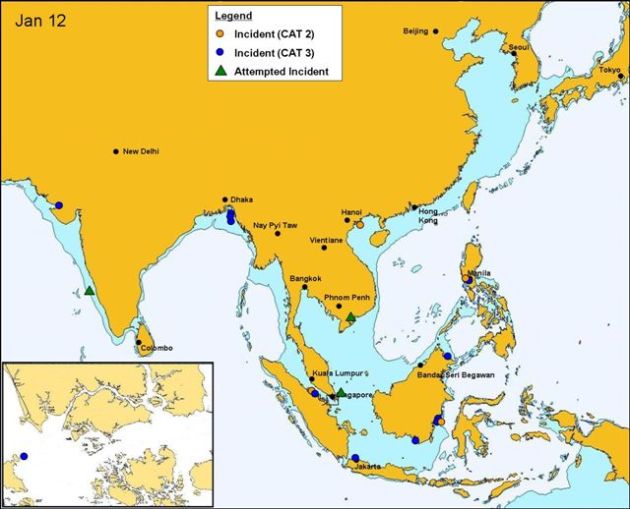
Notably, ReCAAP established an Information Sharing Centre (ReCAAP ISC), which is now a recognized international organization, headquartered in Singapore. ReCAAP ISC’s main functions include facilitating communication and piracy-related information-sharing among the contracting parties as well as furthering capacity building with other organizations and the shipping industry to develop and improve anti-piracy measures. As part of its mandate, ReCAAP ISC produces periodic consolidated incident reports and alerts on piracy and armed robberies at sea in the Asia region. Incidents are classified under 4 different gravity levels, measuring violence and economic impact.

 Map of ReCAAP Consolidated Incident Report for January 2012

Once piracy hot-spots, the straits of Malacca and Singapore as well as the South-China Sea more recently registered a significant drop in piracy related incidents. Due to improved surveillance and security presence, reported incidents now mainly consist of armed robberies or petty thefts at ports and anchorages, particularly in Indonesia.