Kingpins Enjoy Impunity

A confidential UN report, made available to Reuters, highlights the considerable disparity in the treatment of low-level operatives versus pirate kingpins in that the latter enjoy impunity. The report notes:

The UN Monitoring Group on Somalia said in a report to the Security Council, seen by Reuters, that senior pirate leaders were benefitting from high level protection from Somali authorities and were not being sufficiently targeted for arrest or sanction by international authorities.

[…]

The UN report said pirate leaders are now increasingly involved in land-based kidnap for ransom of foreign tourists and aid workers in northern Kenya and Somalia, as well as selling services as counter-piracy experts and consultants in ransom negotiations, and exploring “new types of criminal activity”.

“This evolution of the piracy business model is being driven largely by members of the Somali diaspora, whose foreign language skills and bank accounts are all valuable assets,” it said.

[…]

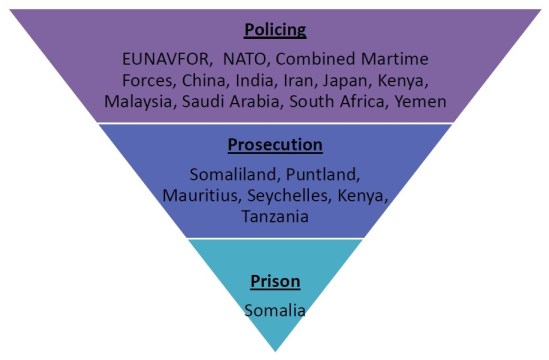
The [Monitoring] Group said that in spite of three international task forces and efforts by a dozen national governments in maritime counter-piracy efforts, serious legal obstacles remain that “impede the prosecution and sanctioning of pirate leaders and kingpins”.

Further to this last observation, a recent opinion by a U.S. District Court brings into question the ability to prosecute pirate kingpins who never set foot aboard a pirate vessel on the high seas. For reasons I will set forth in a forthcoming post, I think the court reached some faulty conclusions. But if the reasoning in that opinion gains traction, prosecution of high-level pirates under the framework set forth in UNCLOS will become increasingly untenable.

Incitement to Hunt al-Shabaab

Ahmed Abdi aw-Mohamed, founder of al-Shabaab

Last month, the U.S. State Department announced that it was offering rewards of $3-7 million for information that would lead to the senior leaders of al-Shabaab. See also, here. As Somali pirates continue to meet considerable resistance at sea, and successful pirate attacks see a precipitous drop, they are seeking new sources of income. This raises the possibility that they will seek to provide information about the whereabouts of al-Shabaab leaders pursuant to the State Department Rewards for Justice program. But there are potential legal obstacles to paying for information from pirates.

As some background, there continues to be debate as to whether members of al-Shabaab and Somali pirates are colluding with one-another. For example, in a recent trial in Italy, the prosecutors asserted that pirates had connections to al-Shabaab and planned on using the ransom proceeds to finance terrorist activities. Likewise, Kenya justified its initial incursions into Somalia based upon the assertion that recent kidnappings of tourists and aid workers in Kenya were the work of al-Shabaab (though some of these attacks were likely perpetrated by pirates with no political objective). There have also been assertions that the port of Kismayo, al-Shabaab’s most important source of income, was being shared by pirates. Kenyan Prime Minister Raila Odinga has requested assistance from the EU naval mission to help to take Kismayo, but the EU has been reluctant because it considers the port to be an al-Shabaab stronghold and not a stronghold of pirates.

Readers of this blog will recall that in 2010, President Obama issued executive order 13536 imposing economic sanctions on suspected financiers of Somali piracy. Although this same executive order imposed sanctions on the organization of al-Shabaab, the preface specifically declared a national emergency to deal with “the deterioration of the security situation and the persistence of violence in Somalia, and acts of piracy and armed robbery at sea off the coast of Somalia.” Terrorism and al-Qaida were not mentioned, suggesting the economic sanctions were being targeted at pirates.

This brings us to the Rewards for Justice program and the list of seven senior leaders of al-Shabaab. Of this list, it appears that three individuals also appeared in the President’s executive order 13536 annex. Perhaps the economic sanctions had always contained a list of both pirates and al-Shabaab. Another possibility is that former pirates have joined the forces of al-Shabaab. Whatever the case, the State Department is prohibited by executive order 13536 from paying for information from the individuals named in the order. Considering the past confusion as to potential links between al-Shabaab and pirates, it will prove a challenging task to verify that a particular individual providing information is not affiliated with one of the individuals named in the executive order or with al-Shabaab. Even if information does not come from individuals specifically named in the executive order, the State Department will have to consider the possibility that reward money will go to finance pirate operations. In the end, it may be a case of the enemy of my enemy is my friend (at least for today). Regardless, the possibility that pirates could provide information as to the whereabouts of al-Shabaab’s senior leaders might be enough to prevent any future alliance between the two organizations.

Efforts to Support Somalia-based Prosecutions Continue

Following a recent trial in the UAE resulting in the conviction of 10 pirates, the UAE has announced that it will host a training of Somali judges to buttress local, Somalia-based prosecutions. The UN report from January recommended regional prosecutions, in lieu of an international court, to tackle the expanding docket of Indian Ocean piracy cases without an obvious home. Such prosecutions were recommended and have continued in regional states, including Kenya, Tanzania, Mauritius, and Seychelles. Moreover, the UN report suggested that the break-away regions of Somaliland and Puntland, as well as the Transitional Federal Government in Mogadishu, would be appropriate locations for prosecutions. Since then, violence against the judiciary and fair trial concerns have arisen in Puntland in particular. Nonetheless, the UAE judicial training, apparently supported by the French ministry of foreign and European affairs, will identify and train judges from Puntland, Somaliland and the TFG. The move is consistent with efforts to funnel the piracy issue back to Somalia as regional states grow tired of bearing the brunt of the prosecutorial burden. The UAE report notes:

The Kenyan ambassador to the UAE Mohamed Gello said prosecuting pirates in neighbouring countries such as his was also a strain on resources.”Any move that will help the Somali judicial system effectively deal with pirates is welcome,” Mr Gello said. “This sends the right signals that law and order is slowly being restored, along with the administration of justice. “It is crucial to build confidence in the judicial system and for the pirates to be dealt with in their own country.”

Funneling Pirates Back to Somalia

In Brief: Second International Counter-Piracy Conference Concludes in Dubai

The second International Counter-Piracy Conference concluded yesterday in Dubai, UAE. The Conference, which brought together public and private stakeholders in the fight against piracy, welcomed the significant progress made in combating maritime piracy on land and in the waters off the coast of Somalia and reiterated the need for a comprehensive approach to eradicate piracy and its root causes. The Conference Declaration, adopted by foreign ministers and senior government officials, as well as representatives from UN agencies and top executives from leading maritime companies and organisations, backed the UAE proposal to make the UN Trust Fund to Support Initiatives of States to Counter Piracy off the Coast of Somalia a centralized focal point for funds donated towards the development of Somalia’s maritime security capacity. During the Conference, the UAE pledged US$1million to the Trust Fund. The donation was then matched by a pledge made by Ocean Beyond Piracy.

The Conference also expressed support toward the establishment of a permanent, legitimate, and fully representative government for Somalia and welcomed initiatives to foster long-term economic development in Somalia’s on-shore communities, as well as the increasing financial contributions made by the global maritime industry towards counter piracy initiatives. Industry leaders attending the conference also issued a statement underlining concerns about the impact of hostage taking and violence on seafarers and their families and calling for clear and consistent standards of conduct for privately contracted armed security guards on board of vessels.

Somalia’s Transitional Government President Sheikh Sharif and Somaliland’s President Ahmed Mahamoud Silanyo

One of the most significant development of the Conference, however, has been the holding of unprecendented formal discussions between the leaders of Somalia and the self-proclaimed breakaway region of Somaliland, further to initial talks held last week in London. Somaliland initially agreed to enter into talks with Somalia during the London Conference earlier this year. While the parties are still far apart, particularly with regard to Somaliland’s independence status, they jointly inked the Dubai Declaration, which aims to pave the way for future talks and cooperation between them, including the common fight against piracy and terrorism.

The International Day of the Seafarer

Today, 25 June 2012 marks the second international Day of the Seafarer. This year, the IMO is asking people around the world to use the power of social networks to highlight the importance of the work of seafarersm and raise awareness of seafarers and their unique role. Everyone, regardless of where they live, can join the campaign online, in particular by commenting the Day of the Seafarer Facebook page at www.facebook.com/SeafarerDay.

“Seafarers leave their homes and families, often for long periods to ensure that essential items and commodities on which our lives depend arrive safely at our homes.” (IMO)

Seafarer often finds themselves under demanding and sometimes dangerous circumstances, particularly in pirate-prone areas. The following are some of the most significant findings from the recently released 2011 Oceans Beyond Pirates Report on the human cost of piracy in the Indian Ocean:

  • 3,863 seafarers were fired upon by Somali pirates with assault rifles and rocket propelled grenades;
  • 968 seafarers came into close contact with pirates, who managed to board their vessels;
  • 413 seafarers were rescued from citadels;
  • 1,206 hostages were held captive by Somali pirates;
  • 555 seafarers were taken hostage in 2011; 645 hostages were captured in 2010 and remained captive during 2011; 6 tourists and aid workers were kidnapped on land;
  • 35 hostages died as a result of pirate captivity in 2011;
  • Average length of captivity was 8 months.

These findings are particulary concerning and demand continuing attention and engagement from all stakeholders in the maritime field. Several initiatives have been launched to support the plight of kidnapped seafarers and their families. Among those, is Save Our Seafarers which runs an on-going worldwide awareness campaign to raise the profile of Somali piracy in political and media circles, in order to see Somali piracy deterred, defeated and eradicated, and to stop seafarers being tortured and murdered.